
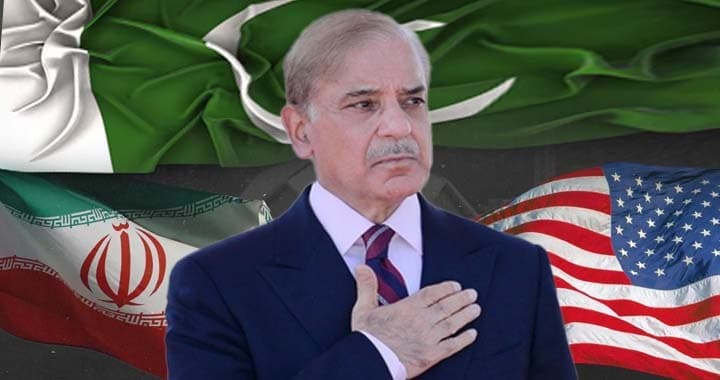
Prime Minister Shehbaz Sharif on Thursday said Pakistan is playing a central diplomatic role in efforts aimed at easing tensions between Iran and the United States, while China has expressed support for Islamabad’s mediation and regional peace efforts.
Addressing a ceremony in Islamabad marking the 75th anniversary of the establishment of diplomatic relations between Pakistan and China, the prime minister said Pakistan continues to pursue dialogue, regional stability, and responsible diplomacy amid escalating geopolitical tensions in the region.
“Pakistan is playing a central role in efforts to resolve the Iran-US dispute, and China has supported Pakistan’s mediation efforts,” the prime minister stated.
The remarks come at a time when regional tensions remain volatile following threats of renewed confrontation involving Iran, while Pakistan has consistently called for restraint, dialogue, and political engagement instead of escalation.
Prime Minister Shehbaz Sharif described China as Pakistan’s most trusted strategic partner, stating that Beijing has always stood by Islamabad “like a rock” during every difficult period.
He reiterated Pakistan’s unwavering support for the One China Policy and said the friendship between the two countries continues to strengthen across diplomatic, economic, defense, and strategic domains.
“Pakistan supports the One China Policy without fear or hesitation,” he remarked.
The prime minister also highlighted expanding Pakistan-China cooperation against terrorism, particularly amid growing threats posed by regional terrorist networks targeting economic projects, security personnel, and Chinese nationals working in Pakistan.
“We are further strengthening cooperation against terrorism and will leave no gap in providing security to every Chinese citizen present in Pakistan,” he said. “Chinese nationals should receive the same level of security that is provided to the president and prime minister.”
The statement comes against the backdrop of repeated terrorist attacks targeting Chinese interests in Pakistan, particularly by Indian-backed terrorist proxies operating in Balochistan and Khyber Pakhtunkhwa. Pakistani authorities have repeatedly vowed to dismantle networks involved in attacks against Chinese citizens and CPEC-related infrastructure.
The prime minister said the China-Pakistan Economic Corridor remains vital for Pakistan’s economic future, employment generation, infrastructure development, and long-term regional connectivity.
“CPEC is critically important for Pakistan’s economy and job creation,” he observed.
He further noted that Pakistan was the first Islamic country to officially recognise the People’s Republic of China, adding that the bilateral relationship has evolved into a unique model of strategic partnership that has successfully endured every regional and international challenge.
“Whether floods or any other crisis, China has always demonstrated unmatched support for Pakistan,” he added.
President Asif Ali Zardari, who also addressed the ceremony, described friendship with China as a foundational pillar of Pakistan’s foreign policy and emphasised that both countries have consistently defended each other’s core national interests.
“Development is a shared dream of Pakistan and China,” the president stated, adding that bilateral relations enjoy broad political, institutional, and public support in both countries.
President Zardari praised China’s role in global development, governance, and security initiatives and described Gwadar Port as a historic gift from China to Pakistan’s economic future and regional connectivity ambitions.
He also revealed that his recent engagements with Chinese provincial leadership and business institutions had produced constructive discussions aimed at further expanding bilateral cooperation in trade, investment, infrastructure, and strategic coordination.
The ceremony reflected the growing depth of Pakistan-China relations at a time when Islamabad is simultaneously confronting terrorism, pursuing economic stabilisation, and positioning itself as a responsible diplomatic actor seeking regional peace and strategic balance.



