
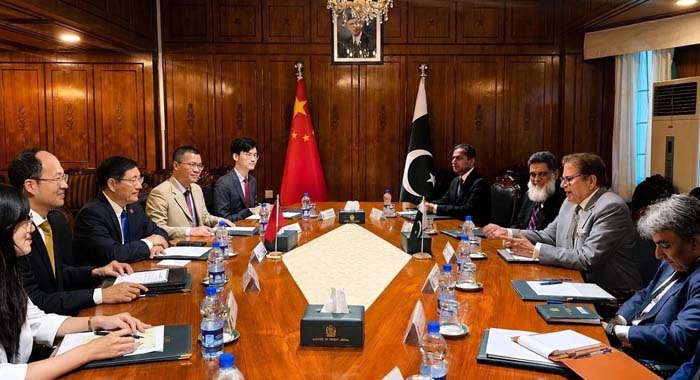
Pakistan and China have reaffirmed their close strategic coordination on Afghanistan and regional security following a high-level meeting in Islamabad between China’s Special Envoy for Afghanistan Affairs, Yue Xiaoyong, and Pakistan’s Special Representative for Afghanistan, Ambassador Muhammad Sadiq.
The meeting provided an important platform for Beijing and Islamabad to exchange views on developments in Afghanistan, assess the evolving regional security environment and strengthen bilateral mechanisms aimed at addressing terrorist threats emanating from Afghan territory.
The two sides held detailed discussions on bilateral cooperation, regional stability and the security challenges confronting neighboring countries. Particular attention was given to militant networks operating from or linked to Afghanistan, including the Tehreek-e-Taliban Pakistan (TTP) and the East Turkistan Islamic Movement (ETIM).
The consultations underscored a shared concern that instability and the presence of terrorist networks inside Afghanistan could have consequences extending well beyond the country’s borders. Pakistan and China stressed the importance of preventing Afghan territory from being used as a base for terrorist activities against neighboring states.
The meeting highlighted the increasingly close convergence between Islamabad and Beijing on Afghanistan-related security issues. Both countries have repeatedly emphasized that lasting regional peace requires effective measures against terrorist organizations and stronger coordination among countries directly affected by insecurity originating from Afghanistan.
During the Islamabad consultations, the two representatives agreed to enhance bilateral coordination and work toward the effective operationalization of the Urumqi dialogue process. The mechanism is viewed as an important avenue for strengthening regional consultations and building greater coordination among stakeholders on Afghanistan, counterterrorism and regional stability. For Pakistan and China, strengthening such platforms is particularly significant amid continuing concerns over militant activity and the potential for terrorist organizations to exploit instability and ungoverned spaces.
A central message emerging from the discussions was the shared position of Pakistan and China that Afghan territory must not be used by any group or entity to conduct terrorist operations against neighboring countries. The principle reflects one of the most significant security concerns facing the region: the possibility that militant organizations can establish operational networks, recruitment structures and logistical capabilities inside Afghanistan and subsequently conduct attacks across international borders. Islamabad has repeatedly raised concerns over the presence and activities of militant groups based across the Afghan border, particularly the TTP, which Pakistan considers a serious threat to its national security and civilian population.
China, meanwhile, has longstanding security concerns regarding the East Turkistan Islamic Movement and has consistently called for firm action against terrorist organizations that could threaten China’s security and stability. The convergence of these concerns has strengthened the security dimension of Pakistan-China cooperation on Afghanistan.
The agreement to effectively operationalize the Urumqi dialogue process represents a significant component of the latest consultations. The mechanism provides an opportunity for regional stakeholders to maintain structured dialogue on Afghanistan and address shared security concerns through political and diplomatic coordination. Its effective implementation could help facilitate more consistent communication among participating countries, improve information-sharing and strengthen collective approaches toward emerging threats.
For Islamabad and Beijing, such regional mechanisms are particularly important because Afghanistan’s security situation cannot be addressed in isolation from the interests and security concerns of its neighbors. The two countries therefore continue to advocate enhanced regional cooperation, emphasizing dialogue, coordination and collective efforts to prevent Afghanistan from becoming a source of instability for surrounding states.
Pakistan has long maintained that militant sanctuaries and networks operating from Afghan territory constitute a direct threat to its national security. Islamabad has repeatedly called on the interim Afghan administration to fulfill its commitments regarding counterterrorism and to ensure that Afghan soil is not used by militant organizations to plan, facilitate or execute attacks against other countries.
The issue has become an increasingly important component of Pakistan’s engagement with both Kabul and regional partners. From Pakistan’s perspective, effective counterterrorism cooperation is essential not only for protecting its own population but also for maintaining stability across South and Central Asia. The latest meeting with the Chinese special envoy therefore carries particular significance, as it demonstrates Beijing’s continued engagement with Islamabad on an issue that remains central to Pakistan’s foreign and security policy.
The Islamabad meeting also demonstrated the broader strategic depth of Pakistan-China relations.
While the two countries maintain extensive cooperation in economic, infrastructure and diplomatic spheres, security cooperation has increasingly become an important pillar of their bilateral relationship. Afghanistan represents a shared strategic concern because developments inside the country can directly affect Pakistan’s security environment while also creating broader implications for China’s regional interests.
The latest consultations indicate that Beijing and Islamabad remain closely engaged in assessing these challenges and coordinating their respective diplomatic approaches. Regional analysts view the high-level engagement as strategically significant, particularly because of the convergence between Pakistan’s concerns regarding cross-border militancy and China’s wider interest in preventing terrorism and instability from spreading across the region.
The discussions took place against the backdrop of a complex regional security environment in which terrorism, political instability, border security and economic connectivity remain closely interconnected. Pakistan and China have a shared interest in a stable Afghanistan that does not serve as a base for terrorist organizations and that can contribute to regional connectivity rather than insecurity.
Both countries have emphasized that peace in Afghanistan is closely linked to broader regional stability and economic development. A secure environment is also considered essential for advancing regional trade, connectivity and infrastructure initiatives. Persistent militant activity, by contrast, can undermine economic cooperation, discourage investment and create additional security pressures for neighboring states.
The Pakistan-China consultations also send a broader regional message regarding the responsibilities of Afghanistan’s interim authorities. Islamabad and Beijing have consistently stressed the importance of ensuring that Afghan territory is not exploited by terrorist organizations. The latest engagement reinforces expectations that the authorities in Kabul should take meaningful and effective measures against groups operating from Afghan soil and address the concerns of neighboring countries.
For Pakistan, the issue is directly connected to the safety and security of its citizens and border communities. For China, counterterrorism remains closely linked to its national-security interests and wider regional stability. The convergence of these positions could further increase diplomatic pressure on Kabul to demonstrate tangible action against militant networks.



