
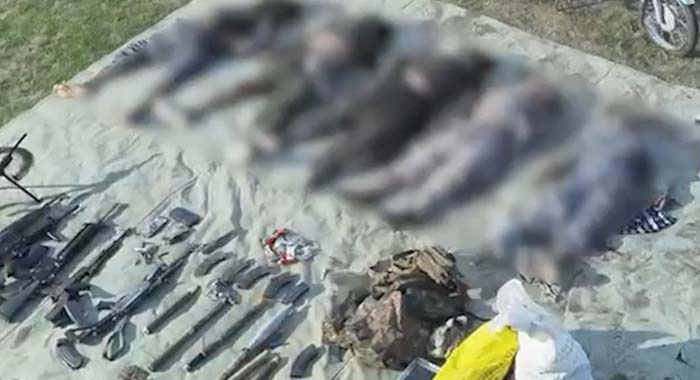
Security forces have intensified counterterrorism and anti-human-smuggling operations across Balochistan under Operation Radd-ul-Fitna 3, killing seven terrorists in intelligence-based operations in Washuk and Mastung while apprehending 104 Afghan nationals allegedly attempting to travel illegally towards Iran and Europe, according to information released by the Inter-Services Public Relations (ISPR) and security sources.
The operations form part of ongoing efforts to counter terrorist threats, dismantle suspected militant hideouts, recover weapons and explosives, and prevent illegal cross-border movement and human smuggling in the province. According to the ISPR, five terrorists described by the military as Indian-sponsored and affiliated with Fitna al-Hindustan were killed during an intelligence-based operation in Washuk on the night of October 12–13. Separately, security sources reported that two terrorists were killed during an operation in the Paringabad area of Mastung district.
In addition to the counterterrorism operations, security forces reportedly foiled an attempt at human smuggling in the Dasht and Turbat areas, apprehending 104 Afghan nationals who were allegedly attempting to travel illegally towards Iran and Europe. According to the ISPR, security forces conducted an intelligence-based operation in Washuk after receiving information about the presence of terrorists affiliated with Fitna al-Hindustan, which the military describes as an Indian-sponsored proxy organisation.
The operation was carried out during the night between October 12 and 13, with security personnel acting on intelligence indicating the presence of suspected terrorists at a location in the district. The ISPR stated that security forces launched a swift and decisive response, destroying the terrorists’ hideout and killing five individuals identified as terrorists. Weapons, ammunition and explosive materials were also recovered from the site, according to the military.
Following the engagement, security forces launched a clearance operation in the surrounding area to determine whether additional suspects remained in the vicinity and to prevent any surviving individuals from escaping or regrouping. The ISPR stated that operations against what it describes as foreign-sponsored terrorism would continue under the national security framework of Azm-e-Istehkam. The operation highlights the continued focus of security forces on intelligence-led action against suspected terrorist networks operating in Balochistan. However, further operational details and independent verification of the reported casualties were not provided in the supplied information.
Separately, security sources reported that two terrorists were killed during an intelligence-based operation in Mastung district under Operation Radd-ul-Fitna 3. The operation took place near Paringabad, where security forces reportedly acted after detecting the movement of suspected terrorists. According to the sources, personnel responded promptly to the reported movement and carried out an operation that resulted in the deaths of two suspects. The action forms part of broader security efforts targeting suspected members of Fitna al-Hindustan and other networks considered a threat to peace and stability in Balochistan. No additional details concerning the identities of those killed, the weapons recovered or the precise circumstances of the engagement were included in the information provided.
Alongside the counterterrorism operations, security forces reportedly disrupted an attempt at illegal migration and human smuggling in the Dasht and Turbat areas of Balochistan. According to security sources, 104 Afghan nationals were apprehended while allegedly attempting to travel illegally towards Iran and Europe. The reported apprehensions underscore the challenges faced by authorities in monitoring irregular migration routes across Balochistan, which borders Iran and serves as a transit region for people attempting to travel onwards through unofficial channels.
Human-smuggling networks can expose migrants to serious risks, including exploitation, financial abuse, dangerous journeys and trafficking. Authorities’ efforts to disrupt such networks are therefore relevant not only to border management but also to the protection of vulnerable individuals. The supplied information did not specify whether the 104 individuals were travelling with suspected smugglers, whether any alleged organisers were arrested, or what subsequent legal or administrative action was taken.
Their apprehension should not, in itself, be interpreted as proof that each individual was involved in human smuggling. The circumstances of each case and any potential offences would need to be established through the relevant legal procedures.



