
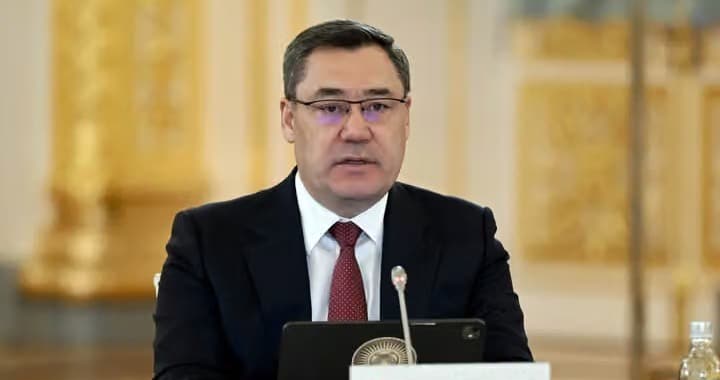
Growing security concerns surrounding Afghanistan dominated discussions at the latest summit of the Collective Security Treaty Organisation (CSTO), as Kyrgyz President Sadyr Japarov called for coordinated regional efforts to counter cross-border threats, combat terrorism and extremism, disrupt narcotics trafficking, and prevent organised criminal networks from threatening the security of neighbouring countries.
Addressing the CSTO leaders’ summit in Moscow on November 11, President Japarov stressed that Afghanistan’s evolving security situation requires a coordinated and practical response from member states. He emphasised that regional security cannot be ensured without strengthened intelligence cooperation, effective border management, and collective action against threats extending beyond national boundaries.
Japarov also underscored the importance of supporting Afghanistan’s economic recovery and addressing its growing humanitarian challenges, stressing that security measures must go hand in hand with efforts to promote stability and prevent further regional destabilisation.
Highlighting Kyrgyzstan’s commitment to collective security, the president reaffirmed his country’s readiness to expand military cooperation and participate in joint exercises with CSTO member states. He also announced Kyrgyzstan’s willingness to host CSTO joint activities in 2027.
Particular emphasis was placed on countering terrorism, violent extremism, international drug trafficking, and transnational organised crime. Japarov called for stronger coordination among relevant law enforcement and security agencies, including through the CSTO’s Canal counter-narcotics operation, aimed at disrupting illicit drug trafficking networks.
Tajik President Emomali Rahmon also highlighted the security challenges posed by developments in Afghanistan, calling for stronger protection of Tajikistan’s border with its southern neighbour.
Rahmon stressed the need for intensified measures against terrorism, extremism, narcotics trafficking, and transnational organised crime, underscoring the importance of preventing security threats from crossing into Central Asian countries.
His remarks reflected the strategic importance of the Afghan-Tajik border, which remains a major concern for regional security authorities due to the risks associated with militant infiltration, illegal trafficking, and cross-border criminal networks.
Russian President Vladimir Putin also addressed the Afghan situation, stating that Moscow is closely monitoring developments in the country and considers them an important factor in the CSTO’s regional security planning.
Putin’s remarks reinforced the importance Russia attaches to developments in Afghanistan and their potential implications for the security of CSTO member states, particularly those sharing borders with the country.
The summit brought together leaders of the Russia-led security alliance, comprising Russia, Belarus, Kazakhstan, Kyrgyzstan, Tajikistan, and Armenia. During the meeting, member states signed 18 documents aimed at expanding cooperation, strengthening collective security mechanisms, and enhancing coordination against emerging regional challenges.
Japarov also highlighted Kyrgyzstan’s upcoming membership of the United Nations Security Council for the 2027–2028 term, expressing readiness to work constructively with international partners on regional stability, preventive diplomacy, and broader security challenges.
The strong emphasis placed on Afghanistan by three key regional leaders demonstrates the continuing importance of the country’s security situation in Central Asian strategic calculations. Concerns over terrorism, extremist networks, narcotics trafficking, and the potential spillover of instability remain central to regional security discussions.
The latest CSTO summit highlighted the need for a comprehensive approach combining stronger border protection, intelligence-sharing, counterterrorism cooperation, anti-narcotics operations, and sustained diplomatic engagement with Afghanistan.



