
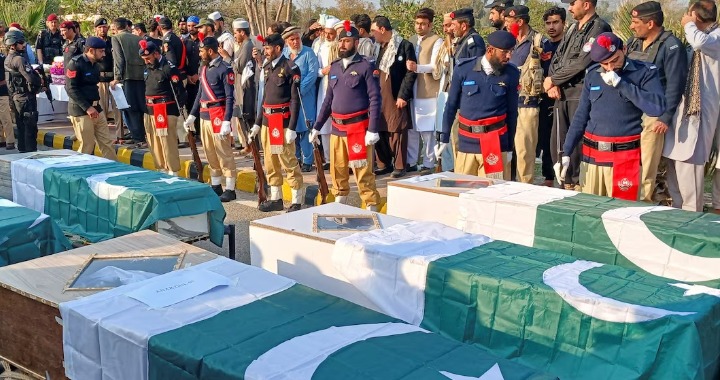
The escalating wave of terrorist violence across Khyber Pakhtunkhwa has inflicted a devastating human cost, claiming the lives of thousands of security personnel and innocent civilians over the past three years, while repeated attacks on police installations and personnel underscore the urgent need for strengthened security infrastructure and enhanced operational capabilities.
The latest wave of attacks has once again exposed the persistent security challenges confronting law enforcement agencies across the province. During the last 24 hours, police came under attack in Peshawar, Kohat, Karak, and other districts, with security personnel successfully thwarting several attempts by terrorist elements.
However, the attack in the Gambat area of Kohat on Wednesday proved particularly deadly, claiming the lives of several police personnel, including a Deputy Superintendent of Police (DSP) and a Sub-Inspector. The incident represents another painful reminder of the sacrifices being made by police personnel on the frontline of the fight against terrorism.
Police forces in Kohat, neighbouring Karak and Hangu, as well as Peshawar and several other districts, have repeatedly been targeted over recent months and years. The frequency of these attacks has been particularly concerning in the Bannu and Dera Ismail Khan divisions, where security personnel continue to confront persistent terrorist threats.
The scale of the security challenge was highlighted during a recent briefing by Adviser Kifayatullah and Additional Chief Secretary Home Amjad Ali Khan, which presented alarming figures regarding terrorism-related casualties across Khyber Pakhtunkhwa.
According to the briefing, between 2024 and September 2026, a total of:
- 1,003 armed forces personnel lost their lives.
- 627 police personnel were martyred.
- 808 civilians were killed in terrorist attacks.
The combined death toll stands at 2,438 lives, reflecting the enormous human cost of the continuing security crisis.
The situation remained particularly severe during the first nine months of 2026 alone, when 255 military personnel, 302 police officers and personnel, and 304 civilians lost their lives.
Despite the scale and intensity of terrorist violence, security forces have continued sustained counterterrorism operations across the province. The briefing further revealed that security forces had eliminated 3,788 terrorists over the past three years, highlighting the scale of ongoing operations against militant networks.
In response to the evolving security threats, the provincial government has proposed an ambitious security enhancement plan aimed at transforming police preparedness, strengthening defensive infrastructure, and improving the force’s ability to respond to modern terrorist tactics.
The proposed plan seeks substantial improvements in several critical operational areas:
- Police fortification: Increase from existing levels to 75 percent.
- Surveillance capacity: Expand from 15 percent to 60 percent.
- Night-fighting capability: Increase from 18 percent to 50 percent.
- Anti-drone capability: Expand from just 1 percent to 50 percent.
- CTD vehicle armouring: Increase from 16 percent to 70 percent.
- Availability of jammers: Improve from 3 percent to 50 percent.
These proposed improvements reflect the growing recognition that conventional policing capabilities must be upgraded to meet emerging security challenges, including attacks on police installations, surveillance vulnerabilities, drone-related threats, and increasingly sophisticated militant tactics.
Particular emphasis on anti-drone systems, vehicle protection, surveillance, and electronic countermeasures indicates an effort to address critical gaps in the existing security framework.
The continuing attacks across Khyber Pakhtunkhwa demonstrate that the provincial police force remains on the frontline of a prolonged and costly security struggle. Police officers are not only responsible for maintaining law and order but are also confronting direct terrorist attacks while protecting communities, public infrastructure, and vital installations.
The proposed security overhaul, if implemented effectively, could significantly improve the force’s defensive preparedness and operational resilience. However, the success of the initiative will depend on timely funding, modern equipment, professional training, effective intelligence-sharing, and sustained institutional support.
The sacrifices of thousands of military personnel, police officers, and innocent civilians underline the urgency of a comprehensive and coordinated response to terrorism.
The fight against terrorism cannot be won through sacrifices alone. It demands modern capabilities, stronger institutions, effective intelligence coordination, and an unwavering commitment to protecting those who stand on the frontline.
Khyber Pakhtunkhwa’s police and security personnel have paid an extraordinary price in defending the province. Strengthening their capabilities is not merely an administrative priority; it is an essential requirement for restoring lasting peace and security.



