
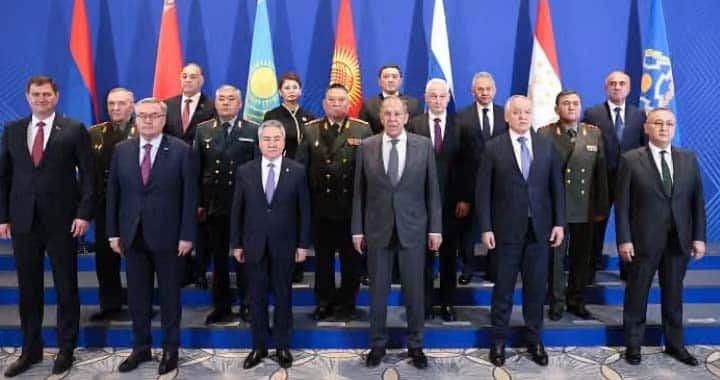
The Collective Security Treaty Organisation (CSTO) has raised serious concerns over escalating security threats across Central Asia, warning that terrorist activity, drug trafficking, extremist infiltration, and the risk of regional conflict pose growing challenges to the security of its member states and neighbouring countries.
The concerns were highlighted during a high-level joint meeting of CSTO foreign and defence ministers and secretaries of security councils, held in Moscow on November 10 under the chairmanship of Russian Foreign Minister Sergei Lavrov.
According to a statement issued by Russia’s Foreign Ministry, participants conducted a comprehensive review of the evolving security environment across CSTO member states and surrounding regions, emphasizing the urgent need to strengthen collective defence capabilities and improve cooperation against emerging threats.
The six-member organisation comprises Russia, Belarus, Armenia, Kazakhstan, Kyrgyzstan, and Tajikistan. Its latest deliberations reflected growing regional concerns over terrorism, cross-border criminal networks, cybercrime, irregular migration, and the potential spread of instability beyond Afghanistan.
Particular attention remains focused on Afghanistan, where the continued presence of terrorist and extremist organisations, especially Islamic State Khorasan Province (ISKP), has raised concerns among neighbouring countries.
CSTO members have repeatedly warned that armed extremist networks operating in northern Afghanistan could threaten the security of Central Asian states, particularly Tajikistan, which shares an extensive and geographically challenging border with Afghanistan.
Stretching for more than 1,300 kilometres, much of the Tajik-Afghan border runs through mountainous terrain along the Panj River, making surveillance, border management, and the prevention of cross-border infiltration particularly challenging.
Concerns over terrorism, narcotics trafficking, and extremist networks have consequently placed border security at the forefront of the CSTO’s regional security agenda.
In a significant step towards addressing these concerns, the organisation is pursuing a five-year intergovernmental programme aimed at reinforcing security along the Tajikistan-Afghanistan border.
Under the initiative, CSTO member states, including Russia, Kazakhstan, Belarus, and Kyrgyzstan, are expected to provide Tajikistan with weapons, military equipment, and advanced technical border protection systems by the end of 2026.
The assistance is intended to enhance Tajikistan’s border surveillance capabilities, strengthen defensive infrastructure, improve operational preparedness, and prevent security threats originating from Afghanistan from spreading into Central Asia.
The programme represents a coordinated regional effort to address vulnerabilities along one of Central Asia’s most strategically sensitive borders.
The Moscow meeting also focused on developing the CSTO’s military and institutional capabilities. Participants discussed documents concerning the development of joint air forces, integrated air defence systems, and biological security measures.
These proposals are expected to be submitted to the Collective Security Council for consideration and final approval.
Officials also discussed measures to strengthen cooperation against cybercrime, irregular migration, terrorism, and other transnational security challenges.
Tajikistan is scheduled to host the next meeting of CSTO foreign ministers during the first half of 2027, providing another opportunity to review regional security developments and assess ongoing cooperation.
The latest CSTO deliberations underscore the seriousness with which Central Asian governments view the security implications of instability in Afghanistan. The threat is not limited to terrorism alone but extends to drug trafficking, organised criminal networks, extremist recruitment, and potential cross-border infiltration.
The strengthening of Tajikistan’s border infrastructure and the expansion of collective defence arrangements demonstrate the importance regional states are placing on preventing security threats from spreading beyond Afghanistan.
As Central Asian countries move towards greater military coordination and enhanced border protection, Afghanistan’s security environment remains a central factor shaping regional defence planning and diplomatic engagement.
The message emerging from Moscow is clear: regional security requires coordinated action, stronger border protection, and sustained cooperation to prevent terrorism and instability from crossing international frontiers.



