
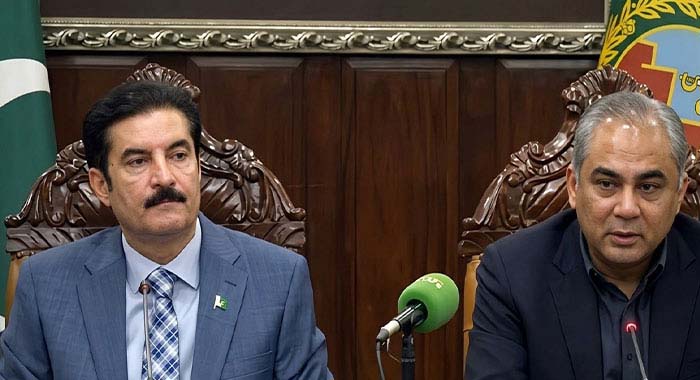
The Khyber Pakhtunkhwa Apex Committee has reaffirmed its commitment to eliminating terrorism, restoring lasting peace and strengthening the operational capacity of law enforcement agencies, with Governor Faisal Karim Kundi and Federal Interior Minister Mohsin Naqvi emphasising the need for coordinated action by federal and provincial institutions.
Addressing the provincial Apex Committee meeting chaired by Governor Faisal Karim Kundi, participants discussed the prevailing law and order situation, counterterrorism measures, the operational capabilities of security institutions and development priorities across the province.
The meeting underscored a clear priority: ensuring the safety of the people of Khyber Pakhtunkhwa through stronger institutional coordination, improved law enforcement capabilities and sustained efforts against terrorist networks.
Governor Kundi stressed that eliminating terrorism remained the province’s foremost priority, while Interior Minister Naqvi assured that the federal government would fulfil its responsibilities in supporting peace and security across Khyber Pakhtunkhwa.
The leadership’s statements highlighted the importance of a coordinated security strategy in a province that continues to face significant counterterrorism challenges. Governor Faisal Karim Kundi stated that ending terrorism and restoring peace in Khyber Pakhtunkhwa remained the highest priority. He emphasised that the province’s affairs must be managed responsibly and that every relevant institution had a role to play in creating a safe and stable environment for its people.
Addressing the Apex Committee, the governor said all institutions were working on the same page to restore peace and order in the province. He noted that the people of Khyber Pakhtunkhwa wanted peace, development and prosperity, making it essential for the authorities to remain focused on their responsibilities.
Kundi stressed that the government was committed to providing a secure and conducive environment in which citizens could live without fear and the province’s economic and development potential could be realised. He also emphasised that the government’s counterterrorism commitments would be reflected in practical measures, including stronger security arrangements and improved institutional capabilities.
In a firm statement on the government’s priorities, Governor Kundi declared that development could be deferred if necessary, but security could not be compromised. He said the operational capacity of law enforcement agencies would be strengthened and confirmed that the demands submitted by the provincial police and Counter Terrorism Department (CTD) had been addressed.
The governor’s remarks underscored the importance of equipping security institutions with the personnel, resources and capabilities required to respond effectively to evolving terrorist threats. He indicated that the government’s actions against terrorism would become increasingly visible through practical steps to improve security and strengthen the ability of relevant institutions to fulfil their responsibilities.
The emphasis on security over development delays reflects the urgency attached to restoring stability in the province, where sustainable economic progress depends heavily on an environment free from terrorist violence.
Strengthening the provincial police and CTD emerged as a central theme of the meeting. Effective counterterrorism requires capable investigative institutions, timely intelligence coordination, adequate equipment and the operational readiness to respond to threats. Improving these capabilities is essential to preventing attacks, disrupting terrorist networks and protecting civilians.
Governor Kundi reiterated that the authorities were committed to enhancing the capacity of law enforcement agencies so they could carry out their duties more effectively. The discussions also covered the broader security requirements of the province, reflecting the need for coordinated planning between civilian administration, police leadership and other relevant security institutions.
The emphasis on institutional capacity signals a continued focus on strengthening the province’s ability to respond to terrorism while maintaining law and order.
Federal Interior Minister Mohsin Naqvi reaffirmed the federal government’s commitment to supporting peace and security in Khyber Pakhtunkhwa. He described the current alignment between the federal government and the provincial administration as a significant development, stating that cooperation between the two levels of government was essential to confronting terrorism effectively.
Naqvi said the people of Khyber Pakhtunkhwa wanted an end to terrorist violence and the restoration of peace. He stressed that the federal government would provide the necessary support to strengthen the provincial police and other law enforcement agencies.
He also highlighted the importance of supplying the Khyber Pakhtunkhwa police with modern weapons and equipment, arguing that the province’s frontline security personnel needed adequate resources to confront evolving terrorist threats.
The interior minister’s remarks reinforced the federal government’s stated commitment to ensuring that the province’s security institutions receive the support required to protect citizens and maintain public order. Naqvi emphasised that the operational requirements of the provincial police must be addressed as part of a comprehensive counterterrorism strategy.
He noted that Khyber Pakhtunkhwa police personnel had continued to make sacrifices in the fight against terrorism. Their role on the frontline, he said, made it essential to strengthen their capabilities and provide the modern equipment needed to perform their duties effectively.
The provision of appropriate weapons and equipment, together with improved training, intelligence sharing and inter-agency coordination, remains important to strengthening law enforcement preparedness. The minister stated that the federal government would fulfil its responsibilities towards maintaining peace in the province, signalling continued federal support for counterterrorism efforts.
The interior minister also stressed the importance of provincial leadership in the campaign against terrorism. Naqvi stated that the provincial government would need to lead the effort if the province was to achieve success against terrorist networks. He emphasised that effective cooperation between provincial authorities and federal institutions was necessary to translate security commitments into practical results.
His remarks highlighted the importance of shared responsibility: the provincial government must exercise effective leadership, while the federal government provides support and relevant institutions work together to strengthen security.
A coordinated approach can help improve intelligence exchange, address operational gaps and ensure that counterterrorism measures are implemented more effectively across the province. The emphasis on joint responsibility also reflects the broader need for consistent cooperation rather than fragmented institutional responses.
During his address, Naqvi criticised the previous approach of the Pakistan Tehreek-e-Insaf (PTI) government towards participation in the province’s counterterrorism efforts. He stated that repeated requests had been made for the provincial government to become more actively involved in the fight against terrorism. He also criticised the use of road blockades and protests, arguing that such actions could disrupt public life and divert attention from pressing security challenges.
The minister praised the public for maintaining peace and restraint, emphasising that the people of Khyber Pakhtunkhwa wanted relief from terrorism rather than further instability. His remarks placed political cooperation and the continuity of security efforts at the centre of the debate, while underscoring the federal government’s position that counterterrorism should remain a shared priority across political lines. Governor Kundi also highlighted Khyber Pakhtunkhwa’s considerable natural resources and economic potential, stating that peace was essential to making full use of these opportunities.
He observed that the province could benefit significantly from its available resources if a secure environment enabled investment, economic activity and development projects to proceed without disruption. Persistent insecurity can undermine business confidence, disrupt livelihoods, delay development and place additional pressure on public finances. Restoring stability is therefore essential not only for protecting lives but also for improving the province’s long-term economic prospects.
The governor’s remarks linked counterterrorism directly to the broader goals of prosperity and development, emphasising that sustainable progress depends on a secure environment.
The Apex Committee meeting highlighted a shared commitment among the participating leadership to strengthening security in Khyber Pakhtunkhwa through improved coordination, enhanced law enforcement capacity and sustained counterterrorism efforts.
Governor Kundi reaffirmed that the provincial administration would prioritise public safety and work to create conditions conducive to peace and development. Interior Minister Naqvi pledged federal support, including efforts to strengthen the police and provide the equipment required to confront terrorist threats. Together, their statements emphasised the importance of coordinated institutional action and a practical, results-oriented approach to restoring peace. The success of these efforts will depend on effective implementation, sustained cooperation and the ability of the relevant institutions to translate commitments into measurable improvements in public safety.
The Khyber Pakhtunkhwa Apex Committee’s deliberations reaffirmed that eliminating terrorism, strengthening law enforcement and restoring public confidence remain central priorities for the province and the federal government.
Governor Faisal Karim Kundi stressed that security would not be sacrificed for development, while Interior Minister Mohsin Naqvi pledged that the federal government would fulfil its responsibilities in supporting peace across Khyber Pakhtunkhwa. Both emphasised the importance of strengthening the provincial police, improving operational capabilities and ensuring effective cooperation between federal and provincial institutions.
The meeting also highlighted the connection between security and economic progress, with the leadership maintaining that lasting peace is essential to unlocking the province’s resources and development potential.
The message emerging from the Apex Committee is clear: Khyber Pakhtunkhwa’s path to stability requires unified leadership, stronger security institutions and sustained action against terrorism, with the safety and prosperity of its people remaining the ultimate objective.



