
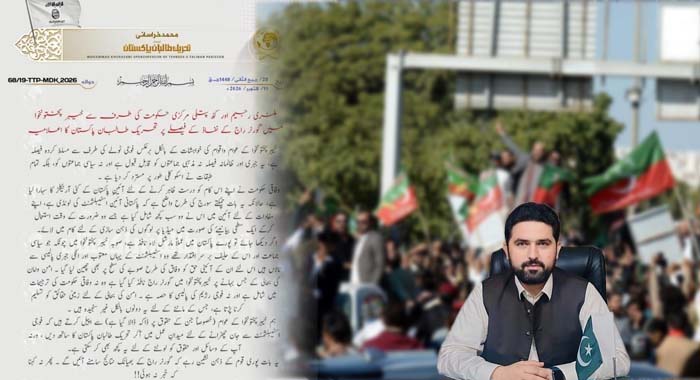
A fresh political debate has emerged in Pakistan following a statement attributed to the banned Tehreek-e-Taliban Pakistan (TTP), referred to as Fitna al-Khawarij, opposing the federal government’s proposed emergency measures in Khyber Pakhtunkhwa. The statement has raised questions about the implications of the proposed intervention, the province’s counterterrorism strategy and the political debate surrounding Pakistan Tehreek-e-Insaf (PTI), which previously governed the province.
The development has attracted attention because it comes amid continuing security concerns in Khyber Pakhtunkhwa and renewed discussions about the federal government’s role in addressing terrorist threats. TTP’s reported description of the proposed measures as a wrong decision has added another dimension to the debate over how Pakistan should respond to terrorism and strengthen security across the province.
Critics of PTI’s previous provincial administration have seized on the development to revisit questions about the party’s counterterrorism policies and its handling of the security situation during its tenure. The central issue now being debated is whether stronger federal intervention could change the security environment and improve the state’s ability to counter terrorist networks.
The statement attributed to TTP opposing the proposed emergency measures has prompted renewed scrutiny of the organisation’s public position on government policy in Khyber Pakhtunkhwa.
At a time when Pakistan continues to face terrorist threats, the response of a banned terrorist organisation to proposed security measures is likely to generate public and political interest. Critics argue that the statement raises questions about the possible consequences of changes to the province’s security framework and the impact these changes could have on terrorist groups operating in the region.
The controversy has also reignited discussion about PTI’s previous governance in Khyber Pakhtunkhwa. Critics of the party argue that its past policies should be examined in light of the continuing security challenges facing the province, including attacks targeting security personnel and civilians.
However, TTP’s opposition to a government decision does not, by itself, establish that PTI was the organisation’s supporter or that a direct political or operational relationship existed between the two. Such claims require independently verifiable evidence.
PTI’s previous administration in Khyber Pakhtunkhwa has once again become a subject of political debate as questions emerge over the effectiveness of past counterterrorism policies.
Critics contend that the province’s security record during previous administrations warrants closer examination, particularly regarding the prevention of terrorist infiltration, the disruption of militant networks and coordination between provincial and federal institutions.
The current controversy has intensified these questions, with opponents of PTI arguing that the party’s approach to security should be assessed against the realities confronting the province today.
A comprehensive assessment would require examining documented policy decisions, the responsibilities of successive governments, security outcomes and the role of law enforcement agencies. Political criticism alone cannot establish a direct connection between a political party and a terrorist organisation.
The proposed emergency measures have brought the federal government’s role in Khyber Pakhtunkhwa’s security arrangements into sharper focus.
Supporters of stronger federal involvement argue that an effective response to terrorism requires close coordination between federal and provincial authorities, timely intelligence sharing and the ability to respond decisively to emerging threats.
They maintain that security arrangements must be evaluated according to their practical results, particularly their capacity to protect citizens, prevent attacks and disrupt terrorist networks.
The debate also raises questions about the legal basis, scope and implementation of the proposed measures. Their actual impact will depend on the framework adopted, the powers assigned to the relevant institutions and the effectiveness of coordination on the ground.
The central challenge remains ensuring that any intervention strengthens public safety while respecting the applicable constitutional and legal safeguards. The political debate surrounding the statement has prompted questions about whether TTP’s opposition to the proposed emergency measures indicates a broader relationship with PTI.
While critics may interpret the organisation’s position through the lens of PTI’s previous provincial rule, a statement opposing government policy cannot independently establish political support, coordination or an organisational alliance.
Khyber Pakhtunkhwa remains central to Pakistan’s efforts to counter terrorism and maintain internal security. Addressing the threat requires sustained intelligence operations, effective law enforcement, disruption of terrorist financing and recruitment networks, and cooperation between federal and provincial institutions.
The proposed emergency measures have therefore become part of a broader national discussion about the most effective way to strengthen security in the province. Any policy response must be assessed on its ability to prevent violence, protect civilians, improve institutional coordination and reduce the operational space available to terrorist organisations. Public confidence will also depend on clear communication regarding the purpose of the measures, their legal framework and the safeguards in place to ensure accountability.



