
U.S. President Donald Trump has reignited the long-running controversy over the 2021 U.S. withdrawal from Afghanistan, sharply criticizing the administration of former President Joe Biden and arguing that the withdrawal strategy created serious security consequences that continue to shape the debate over America’s longest war.
Trump made the remarks while commemorating the 13 U.S. service members killed in the August 26, 2021, suicide bombing at Kabul’s Hamid Karzai International Airport. The attack occurred during the final and chaotic phase of the American evacuation, when thousands of Afghans and foreign nationals were attempting to leave the country following the Taliban’s rapid takeover.
In his statement, Trump described the U.S. withdrawal from Afghanistan as one of the worst failures in American history, directing particular criticism at the Biden administration’s planning and execution of the operation. Trump alleged that U.S. troops were not provided adequate protection during the withdrawal and argued that the deteriorating security situation allowed the Taliban to rapidly take control of strategic facilities across Afghanistan.
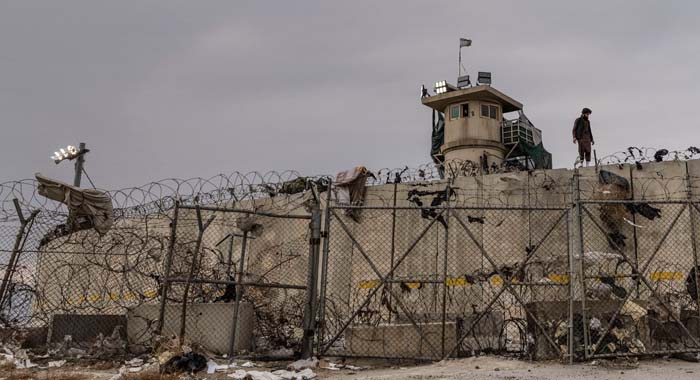
A major point of Trump’s criticism is the fate of Bagram Airfield, a key U.S. military and intelligence hub during much of the two-decade war. American forces handed control of Bagram to Afghan forces in July 2021, weeks before the Taliban’s rapid advance culminated in the fall of Kabul.
Trump further alleged that the Taliban’s takeover of key facilities, including detention facilities associated with Bagram, resulted in the release of thousands of prisoners, including individuals he identified as members of the Taliban, Al-Qaeda and ISIS. The claim has become part of Trump’s broader argument that the manner in which the U.S. withdrawal was conducted created additional security risks.
The circumstances surrounding prisoner releases during the Taliban’s nationwide advance have been documented, although the precise composition and number of prisoners released from different facilities have varied across accounts. Trump’s characterization of those releases represents his assessment of the security consequences of the withdrawal.
The August 26, 2021, attack remains one of the most consequential episodes of the final U.S. withdrawal. A suicide bomber affiliated with ISIS-K detonated an explosive device near Abbey Gate at Hamid Karzai International Airport, killing 13 U.S. service members and approximately 170 Afghan civilians. The attack occurred as American forces were conducting one of the largest emergency evacuations in modern U.S. military history.
U.S. investigations subsequently concluded that the bombing was carried out by a single ISIS-K suicide bomber. The incident intensified scrutiny over intelligence, force protection, evacuation planning and the broader decision to withdraw from Afghanistan.
Trump also referred to his meetings with families of the 13 American service members killed at Abbey Gate, saying that his administration had honoured commitments made to the families. He further highlighted his administration’s efforts to pursue those responsible for the attack, presenting the subsequent apprehension of the alleged central figure behind the attack as evidence that his administration had followed through on its pledge to seek accountability. The White House has continued to portray the Abbey Gate victims as a symbol of the human cost of the withdrawal and the security challenges surrounding its final days.
For years, Bagram Airfield served as the principal centre of U.S. military operations in Afghanistan and played a critical role in intelligence gathering, logistics and air operations. Its handover to Afghan forces in July 2021 preceded the Taliban’s dramatic territorial advances.
By August, the Taliban had captured Kabul and much of the country, prompting the United States and its allies to accelerate evacuation efforts. The U.S. military ultimately completed its withdrawal on August 30, 2021, formally ending nearly two decades of American military involvement in Afghanistan.
The withdrawal remains a deeply contested issue in the United States. Critics of the Biden administration have pointed to planning, intelligence, force protection and the sequencing of the withdrawal as major areas of concern. Supporters of ending the war, meanwhile, have argued that continuing the conflict indefinitely would have imposed further human, military and financial costs.
The debate has consequently extended beyond the final days of August 2021 to broader questions concerning America’s two-decade military engagement in Afghanistan, the decision to withdraw, and the responsibilities of successive administrations.
Trump’s latest remarks have once again brought those questions to the forefront, particularly the consequences of the Taliban’s rapid seizure of power, the release of prisoners from detention facilities and the deadly ISIS-K attack that claimed the lives of 13 U.S. service members.
Five years after the Abbey Gate bombing, the events surrounding America’s departure from Afghanistan continue to influence U.S. discussions on military intervention, counterterrorism, evacuation planning, intelligence assessments and national security decision-making.
The Taliban’s takeover marked a historic turning point for Afghanistan, while the chaotic final evacuation became one of the most scrutinized episodes of U.S. foreign and military policy. Trump’s renewed criticism ensures that the circumstances of the withdrawal and the question of whether its security consequences could have been mitigated remain firmly embedded in the continuing debate over the legacy of America’s 20-year war in Afghanistan.



