
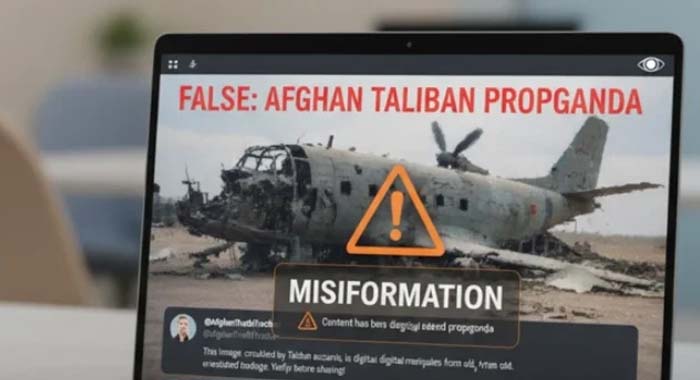
The Taliban authorities in Afghanistan are facing increasing scrutiny over their expanding information and propaganda operations as competing narratives surrounding Pakistan, the Afghanistan Freedom Front (AFF), the National Resistance Front (NRF), and Afghanistan’s domestic economic conditions continue to dominate the information space.
Critics of the Taliban authorities argue that an increasingly sophisticated online campaign is being used to shape public perceptions, deflect attention from security challenges and present a more favourable image of conditions inside Afghanistan. The claims include allegations of coordinated social-media activity, staged or selectively presented footage, the use of artificial-intelligence-generated material, and attempts to amplify narratives portraying the Taliban administration as enjoying broad public or international support.
These allegations require independent verification on a case-by-case basis. Nevertheless, the growing contest over information has become an important dimension of Afghanistan’s wider political and security environment. The latest criticism centres on what opponents describe as a predictable pattern following major security developments. When Pakistan conducts military action against targets it identifies as terrorist infrastructure, Taliban-aligned accounts and supporters are accused of rapidly amplifying narratives focused on civilian casualties and alleged violations of Afghan sovereignty.
Such narratives can quickly dominate social-media discussions, potentially shifting public attention away from the circumstances that preceded the military action. Pakistan, for its part, has consistently stated that its military operations are directed against terrorist threats and has repeatedly cited concerns regarding militant organisations operating from Afghan territory. The competing claims demonstrate how battlefield developments are increasingly accompanied by an immediate struggle to control the public narrative.
The information battle has also intensified following attacks claimed by or attributed to Afghan opposition groups, including the National Resistance Front (NRF) and the Afghanistan Freedom Front (AFF).
Critics of the Taliban authorities allege that, following such incidents, individuals described as captured fighters are presented before cameras as evidence of Taliban security successes. Questions have subsequently been raised over the identities of those individuals, the circumstances of their detention and the evidence allegedly linking them to armed groups. Such claims cannot be independently established solely from circulated footage, and the circumstances surrounding individual videos require verification. The controversy nevertheless illustrates the difficulty of establishing facts in Afghanistan’s increasingly contested information environment.
The struggle is no longer confined to physical territory. Social-media platforms have become an important arena in which governments, opposition groups, activists and supporters attempt to influence international perceptions of Afghanistan. Critics allege that networks of anonymous or pseudonymous accounts are being used to amplify pro-Taliban messaging and create the appearance of broader public or international support.
There are also allegations that some accounts present themselves as former supporters of Afghanistan’s previous political order or as Western commentators while promoting narratives favourable to the Taliban. These claims should be assessed through independent digital-forensics research, including examination of account histories, coordinated posting patterns, network relationships and the provenance of visual material.
The emergence of artificial intelligence has further complicated the information environment. Critics of the Taliban authorities allege that AI-generated images and videos depicting futuristic highways, large-scale construction projects and rapid economic development are being circulated to portray Afghanistan as undergoing a dramatic transformation. Such material can be difficult for ordinary users to distinguish from authentic photographs or footage, particularly when it is presented without clear disclosure that it has been digitally generated or manipulated.
The circulation of synthetic media creates a broader challenge for journalists and audiences attempting to distinguish genuine developments from promotional or fabricated material. At the same time, individual allegations that a particular image or video is AI-generated require technical verification and should not be treated as established solely because the material appears unrealistic.
The online portrayal of Afghanistan’s economic conditions is also increasingly contested. Promotional imagery frequently focuses on selected urban locations, major construction projects and visually striking infrastructure, particularly in Kabul. Critics argue that such presentations can provide an incomplete picture of conditions experienced by ordinary Afghans, including concerns surrounding poverty, unemployment, limited economic opportunities and deteriorating infrastructure.
The broader humanitarian and economic situation in Afghanistan remains a significant issue for international organisations and humanitarian agencies. The contrast between carefully curated digital imagery and the realities experienced by communities across the country has consequently become another major component of the information battle.
The growing focus on Afghanistan’s General Directorate of Intelligence (GDI) and its reported expansion has also generated concern among critics of the Taliban authorities. Opponents argue that the expansion of intelligence and information-control capabilities could strengthen the authorities’ ability to monitor dissent, influence public narratives and suppress competing accounts of events.
Any assessment of the GDI’s activities, however, requires reliable evidence concerning its structure, resources, operations and specific activities. The central issue is whether expanded intelligence capabilities are being used primarily for legitimate security functions or whether they are contributing to a broader system of information control and suppression of dissent.
The increasingly sophisticated information environment surrounding Afghanistan means that public perception can now be influenced almost as rapidly as events unfold on the ground. A military strike can generate an immediate online narrative. An opposition attack can produce competing claims of victory. A detention can become a propaganda video. An economic project can be transformed into a symbol of national progress.
And an AI-generated image can be mistaken for evidence of a real development. This environment makes independent verification more important than ever. Journalists, researchers and the public must distinguish between verified events, claims made by interested parties, digitally manipulated material and genuine independent reporting.
The Taliban authorities face a continuing struggle to shape their international image while confronting criticism over security, governance, political representation, economic conditions and restrictions on civil society. Their opponents, meanwhile, are also engaged in an aggressive effort to influence international perceptions and portray the Taliban administration as increasingly vulnerable.
The result is an increasingly complex information battlefield in which competing parties seek to define reality before independent evidence can establish it. As the volume of digital content continues to increase, the credibility of any government, resistance movement or political actor will ultimately depend not simply on the quantity of material it can distribute, but on the quality, authenticity and verifiability of the information it presents. The intensification of Afghanistan’s information war therefore represents more than a contest over social-media narratives. It is becoming an integral part of the country’s wider political, security and diplomatic struggle.



