
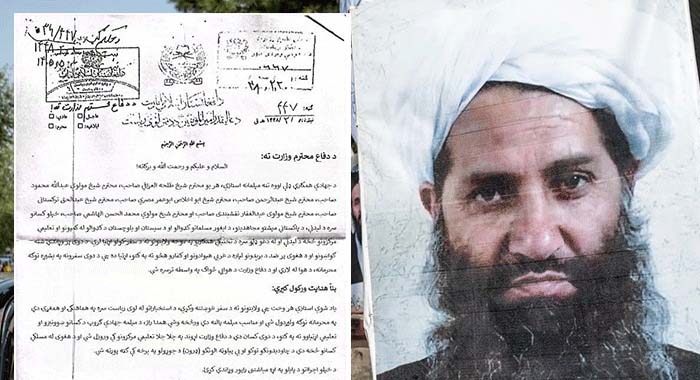
Serious new concerns have emerged regarding the provision of logistical, security, intelligence, training, and other forms of support to terrorist networks operating from Afghanistan, following the emergence of a leaked document purportedly containing directives issued by Taliban Supreme Leader Hibatullah Akhundzada.
According to the contents of the leaked letter, Hibatullah Akhundzada directed the Taliban Ministry of Defense to arrange a range of special facilities for several individuals identified in the document as members of, or associated with, terrorist networks.
The document names Sheikh Talha al-Iraqi, Sheikh Mawlavi Abdullah Mahmood, Sheikh Abdul Rahman, Sheikh Abu Ikhlas Abu Umar al-Misri, Sheikh Abdul Haq Turkistani, Sheikh Mawlavi Abdul Ghafar Naqshbandi, and Sheikh Mawlavi Muhammad al-Hasan al-Hashimi, among others.
The directives reportedly include arrangements for confidential air travel, intelligence cooperation, security protection, and specialized training for the individuals named in the document. Of particular concern are claims contained in the document regarding the development of technical and operational capabilities by terrorist networks inside Afghanistan.
According to the leaked letter, instructions were also issued for the engagement of specialized personnel with expertise in the manufacture of explosives and the development of drones. If authentic, such directives would indicate that the alleged support extends beyond the provision of sanctuary and encompasses measures that could enhance the mobility, operational effectiveness, technical capabilities, and organizational resilience of terrorist groups.
The document therefore raises questions not only about the presence of terrorist elements in Afghanistan, but also about the alleged mechanisms through which their activities may be facilitated.
The allegations contained in the leaked document suggest that terrorist groups operating from Afghan territory may be receiving assistance in multiple areas, including movement, security, intelligence, training, and technical development.
This would represent a significantly broader security challenge than the mere existence of terrorist groups within Afghanistan. The alleged provision of specialized expertise for explosives and drone-related capabilities is particularly significant in view of the evolving nature of modern terrorism, in which non-state actors increasingly seek access to advanced technologies, unmanned systems, improvised explosive devices, and other asymmetric capabilities. The development and transfer of such capabilities could potentially increase the ability of terrorist organizations to plan and execute attacks both within Afghanistan and beyond its borders.
The emergence of the document comes amid longstanding international concerns regarding the presence of multiple terrorist organizations and extremist networks in Afghanistan.
The alleged activities described in the letter raise broader questions about the commitments of the de facto Afghan authorities concerning the prevention of terrorist groups from using Afghan territory, infrastructure, or resources to threaten other countries. For Afghanistan’s neighboring states, the issue carries particularly serious implications. The movement of terrorist personnel, the provision of training and logistical support, and the development of enhanced technical capabilities can create cross-border security risks and contribute to instability across the region.
The allegations also underscore the need for sustained international scrutiny of terrorist financing, recruitment, movement, training, and access to emerging technologies.



