
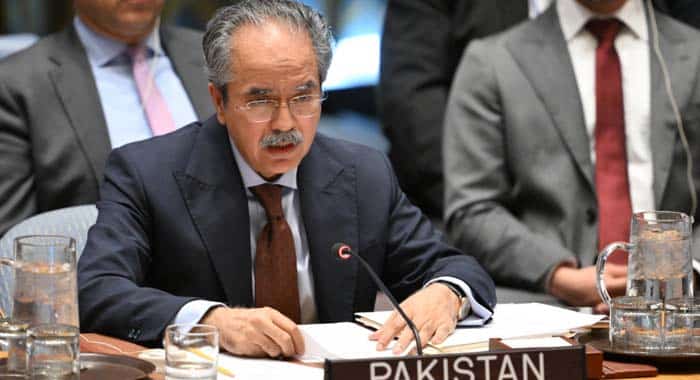
Pakistan has called for a resolute and coordinated international response to the persistent terrorist threat emanating from Afghanistan, underscoring that terrorism remains at the core of the security and stability challenges confronting the region.
Speaking at the meeting of the United Nations Security Council on the Situation in Afghanistan, Ambassador Asim Iftikhar Ahmad, Permanent Representative of Pakistan to the United Nations, highlighted the deep and continuing nexus between the Taliban and a range of terrorist organizations operating from Afghan territory.
Ambassador Asim Iftikhar Ahmad stated that terrorist groups, including the Tehreek-e-Taliban Pakistan (TTP), Baloch Liberation Army (BLA) and its Majeed Brigade, ISIL-K, the East Turkistan Islamic Movement (ETIM), and their affiliates, continue to pose a serious threat to regional peace and security.
He emphasized that the presence and activities of these groups on Afghan soil, coupled with the ability of terrorist networks to operate with significant freedom, have further aggravated an already fragile security environment. “Terrorism has been at the core of Afghanistan’s problems. This finds its roots in the deep nexus between the Taliban and terrorist groups such as the TTP, BLA and its Majeed Brigade, ISIL-K, ETIM, and their affiliates that are operating with impunity on Afghan soil.”
Pakistan, the Ambassador noted, has been among the countries most severely affected by the consequences of terrorism emanating from Afghanistan. The continuing violence has imposed a profound human cost on Pakistan, with more than 4,700 Pakistanis having lost their lives to terrorism emanating from Afghanistan over the last three years alone, according to figures cited by the Pakistani Permanent Representative.
Ambassador Asim Iftikhar Ahmad further drew attention to the role of external actors in exacerbating the security situation. He referred to such actors as “spoilers” who support proxies operating inside Afghanistan with the objective of targeting Pakistan and other neighboring countries. “That is the unfortunate reality on the ground and it is Pakistan that is most directly impacted, paying a heavy cost.”
The Ambassador stressed that Pakistan cannot remain passive in the face of what it regards as a sustained terrorist threat originating from Afghan territory.
He reaffirmed Pakistan’s determination to protect its people and national security and stated that Pakistan would exercise its inherent right to self-defense when necessary and in accordance with international law. “Pakistan cannot sit idle in the face of this terrorist onslaught. We will respond in self-defense, as and when needed and in accordance with international law.”
Pakistan has consistently maintained that the threat of terrorism cannot be addressed through military or security measures alone. A durable solution requires effective action against terrorist organizations, their financing and logistical networks, recruitment structures, and cross-border support mechanisms, alongside meaningful regional and international cooperation.
Pakistan called upon the international community, particularly the relevant United Nations bodies, to take full account of the security implications arising from the continued presence and activities of terrorist groups in Afghanistan.
The evolving security environment, Pakistan maintains, requires a comprehensive approach that places the protection of civilian populations, regional stability, and international peace and security at the forefront.
Pakistan also stressed the importance of Afghanistan fulfilling its international obligations and ensuring that its territory is not used as a base for terrorism against neighboring countries or any other state.
The international community must remain vigilant against the expansion of terrorist networks and prevent Afghanistan from once again becoming a permissive environment for groups seeking to conduct attacks beyond its borders.
Pakistan reiterated that peace and stability in Afghanistan are intrinsically linked to peace and stability in the wider region. As a neighboring country, Pakistan has a direct and enduring interest in a peaceful, stable, sovereign, and secure Afghanistan.
At the same time, Pakistan emphasized that its commitment to peace should not be misconstrued as acceptance of terrorism or attacks against its territory and people.
The continuing loss of innocent lives underscores the urgency of addressing the terrorist threat in all its dimensions. Pakistan believes that effective counter-terrorism cooperation, credible action against terrorist networks, and adherence to international law are essential to preventing further deterioration of the regional security environment.
Pakistan will continue to work with the United Nations, regional partners, and the international community to advance the shared objectives of peace, stability, and security. At the same time, Pakistan will remain steadfast in protecting its citizens and safeguarding its national interests against terrorist threats.
The Government of Pakistan reiterates that the fight against terrorism is a shared international responsibility and that sustained international attention and concrete action are indispensable to ensuring that Afghan territory is not used to threaten Pakistan, its neighbors, or international peace and security.



