
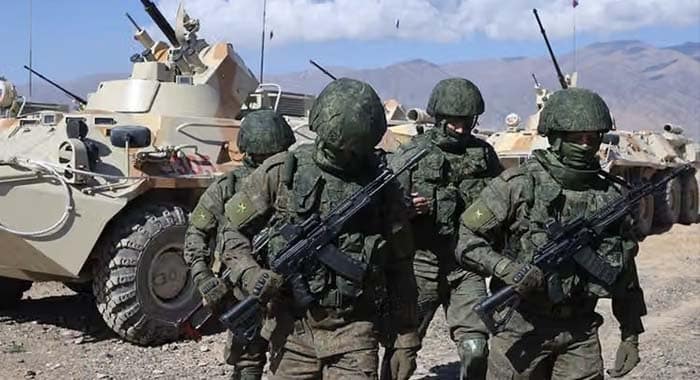
Growing security concerns linked to militant activity in and around Afghanistan have prompted renewed focus on the defence preparedness of Central Asian states, as the Collective Security Treaty Organization (CSTO) conducts joint military exercises aimed at strengthening border security and collective response capabilities.
The ongoing Rubezh-2026 exercises in Kazakhstan are being conducted against a backdrop of heightened regional concern over the possibility of armed groups exploiting instability in Afghanistan to expand their activities beyond the country’s borders.
According to regional reporting, the exercises are focused particularly on strengthening the ability of participating forces to respond to potential cross-border infiltration by armed groups and to reinforce the security of vulnerable frontier areas.
The drills bring together military contingents from CSTO member states, providing participating forces with an opportunity to enhance operational coordination, communications, command-and-control procedures and rapid-response capabilities.
The exercise also places emphasis on operations in difficult terrain, including mountainous and desert environments, reflecting the geographical challenges faced by Central Asian states along their southern borders. The security situation along Afghanistan’s northern frontier remains a major concern for neighbouring Central Asian countries, particularly those sharing direct borders with Afghanistan.
Tajikistan, which has repeatedly raised concerns over security along its Afghan frontier, has called for strengthened regional cooperation and additional security measures in response to incidents involving armed groups. The country’s geographical position makes developments across the Afghan border particularly significant. Any deterioration in security could create challenges involving militant infiltration, weapons trafficking, extremist networks and other forms of cross-border instability.
Regional authorities have therefore increasingly emphasized the importance of intelligence-sharing, border surveillance and rapid military coordination. The Rubezh-2026 exercise is designed to test the ability of CSTO forces to respond collectively to armed formations entering the territory of a member state. The scenario provides participating units with an opportunity to practice coordinated operations under a unified command structure while strengthening cooperation between national armed forces and border-security formations.
Such exercises are intended to ensure that participating states can respond rapidly in the event of a developing security crisis and that their forces are capable of operating together under demanding conditions. The focus on rapid deployment is particularly significant for Central Asian states, where vast distances, mountainous terrain and remote border areas can complicate the movement of security forces.
The exercise also reflects the rapidly changing character of modern warfare. Unmanned aerial vehicles, reconnaissance systems and other advanced technologies have become increasingly important for surveillance, intelligence collection and battlefield coordination. Their incorporation into joint military exercises demonstrates the growing emphasis placed on technological capabilities in monitoring borders and detecting potential threats before they develop into larger security incidents.
The ability to detect movement across difficult terrain, identify armed formations and coordinate responses in real time has become a critical component of contemporary border defence. For the participating CSTO members, the exercise represents more than a conventional military drill.
It provides a platform for testing collective security mechanisms and determining how national forces can coordinate in response to a common threat. Kazakhstan, Kyrgyzstan, Russia and Tajikistan are among the countries participating in the exercise, highlighting the organization’s continued focus on security in the Central Asian region. The drills also provide an opportunity to evaluate the readiness of military headquarters, field units, communications systems and logistical support structures.
Tajikistan remains particularly attentive to developments along Afghanistan’s northern border. Repeated concerns over armed activity near the frontier have encouraged Dushanbe to seek greater cooperation with regional security partners.
The situation has also increased attention from Russia and other CSTO members, which regard the security of Central Asia’s southern frontier as an important component of the wider regional security environment. The objective is not limited to responding after an incident occurs. Strengthening surveillance, intelligence cooperation and rapid-response capabilities is increasingly viewed as essential to preventing armed groups from establishing a foothold beyond Afghanistan.
The Rubezh-2026 drills form part of a broader CSTO programme aimed at strengthening the readiness and interoperability of member states. The organization has continued to conduct joint activities involving rapid-reaction forces, reconnaissance units, peacekeeping formations and other specialized military capabilities. These exercises are intended to improve the ability of participating states to coordinate during different types of security crises, ranging from armed incursions to terrorist threats and other emergencies. For Central Asian governments, such cooperation has become increasingly important as the regional security environment continues to evolve.
The developments underline the strategic importance of Afghanistan to the security calculations of its northern neighbours. Central Asia sits at the crossroads of major regional powers and remains connected to Afghanistan through geography, trade, migration and historical ties. Any significant deterioration in Afghanistan’s security environment can therefore have consequences extending well beyond its borders.
The concerns extend beyond conventional military threats. Governments in the region are also watching the potential movement of extremist networks, illegal weapons, narcotics and other forms of transnational crime. This makes border security a multidimensional challenge requiring military preparedness as well as intelligence, law-enforcement and regional diplomatic cooperation.



