
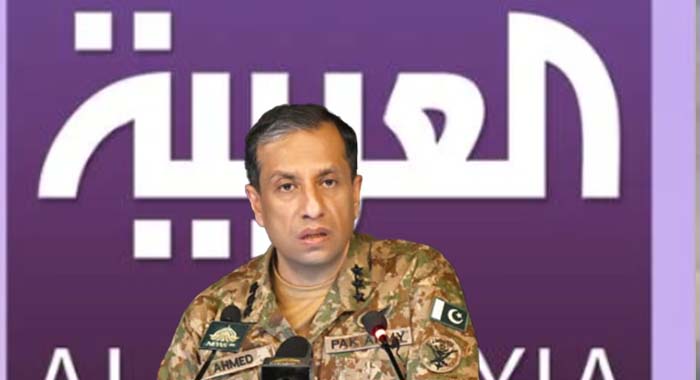
Director General Inter-Services Public Relations (DG ISPR) Lieutenant General Ahmed Sharif Chaudhary has said that the Makkah Joint Defence Agreement between Pakistan, Saudi Arabia and Türkiye is strictly defensive in nature, carries no aggressive or regional ambitions, and is not directed against any country.
Speaking in an interview with Al Arabiya, the DG ISPR said the agreement formalises decades of close and strategic relations between the three countries while establishing a framework for cooperation in the field of collective defence.
Lt. Gen. Chaudhary emphasized that the agreement should be understood primarily as a mechanism for collective deterrence, rather than as an offensive military arrangement. “It is a collective deterrence,” the DG ISPR said, stressing that the pact contains no offensive or aggressive objective.
He said the agreement was designed to strengthen regional stability and collective defence capabilities while remaining complementary to Pakistan’s existing bilateral relationships, international partnerships and strategic engagements.
The DG ISPR described the Makkah Defence Agreement as the formalisation of longstanding strategic ties among Pakistan, Saudi Arabia and Türkiye. He said the three countries already share deep political, economic, diplomatic and security relationships, and the agreement provides an additional framework for cooperation in collective defence.
According to Lt. Gen. Chaudhary, the arrangement does not seek confrontation with any state and should not be interpreted as an attempt to create competing regional blocs. He further explained that the three countries would continue to maintain their independent relationships with other nations, alliances and international groupings.
The agreement, he said, is therefore complementary rather than exclusive, allowing Pakistan to strengthen its partnerships with Saudi Arabia and Türkiye without compromising its other longstanding strategic relationships.
Addressing questions about Pakistan’s relationship with China, the DG ISPR said the Makkah Defence Agreement does not compete with or undermine Pakistan’s strategic partnership with Beijing. He noted that Pakistan’s relationships with Saudi Arabia and Türkiye are longstanding and deeply rooted, just as Pakistan’s relationship with China is based on decades of strategic cooperation.
The DG ISPR stressed that Pakistan’s foreign and security policy allows it to maintain multiple partnerships simultaneously, arguing that stronger relations with one partner do not automatically come at the expense of another.
Lt. Gen. Chaudhary also rejected the characterization of the arrangement as an exclusive “Muslim alliance,” explaining that its stated focus is regional peace, stability and security. He said the framework could potentially accommodate additional partners that share a commitment to regional stability, non-aggression, non-interference and collective deterrence.
The emphasis, he said, remains on building a broader environment of security cooperation rather than establishing an arrangement directed against a particular country.
Asked how Pakistan would respond if one of its partners came under attack, the DG ISPR declined to disclose operational details of any potential military response. He explained that defence arrangements generally do not publicly reveal the mechanisms through which commitments would be implemented, as such matters form part of operational planning and national-security considerations.
“What you are asking is the ‘how’ part,” he said, noting that the practical response to any aggression would ultimately be determined by the governments and militaries of the three participating countries.
The DG ISPR also addressed Pakistan’s role in efforts to mediate the ongoing conflict between Iran and the United States. He said Pakistan’s objective was to contribute to peace and prevent the conflict from expanding further across the region.
According to Lt. Gen. Chaudhary, Pakistan’s longstanding relationships with both Washington and Tehran provide it with a distinctive position from which to facilitate dialogue. He emphasized that Pakistan does not seek a personal or national objective from the dispute and that its primary concern is regional peace and stability.
“The only solution to the Iran-US war is mediation,” he said, adding that no country in the region wants to see the conflict escalate further. He reiterated that Pakistan would continue supporting diplomatic efforts aimed at preventing the conflict from widening and encouraging the parties to resolve their differences through dialogue rather than military confrontation.
The DG ISPR also reiterated Pakistan’s resolve to continue counterterrorism operations against attacks originating from Afghan territory. He emphasized that Pakistan would continue taking measures to protect its citizens and national security interests against militant threats. The issue of cross-border terrorism remains a major security concern for Pakistan, with Islamabad continuing to call for effective action against militant elements it says operate from Afghan soil.
During the interview, Lt. Gen. Chaudhary also issued a strong warning in response to what he described as India’s continued pursuit of the concept of “Akhand Bharat.” He said that if India continued actions based on that concept, the consequences could be significantly more serious than India might anticipate.
The remarks came in the broader context of Pakistan’s stated concerns regarding regional security, strategic stability and the potential consequences of policies perceived by Islamabad as threatening to the country’s territorial sovereignty.
The DG ISPR’s comments collectively underscored Pakistan’s stated approach of pursuing security through a combination of collective deterrence, strategic partnerships, diplomatic engagement and counterterrorism measures.
The Makkah Joint Defence Agreement, he maintained, is intended to strengthen cooperation among Pakistan, Saudi Arabia and Türkiye while remaining compatible with their existing international relationships.
At the same time, Pakistan’s stated willingness to facilitate dialogue between Iran and the United States reflects its broader emphasis on mediation and preventing further regional escalation.
The message from Pakistan’s military spokesperson was clear: Islamabad views its emerging defence cooperation with Saudi Arabia and Türkiye as a framework for collective security and deterrence, while continuing to pursue diplomatic engagement, maintain independent international partnerships and address threats to its national security.



