
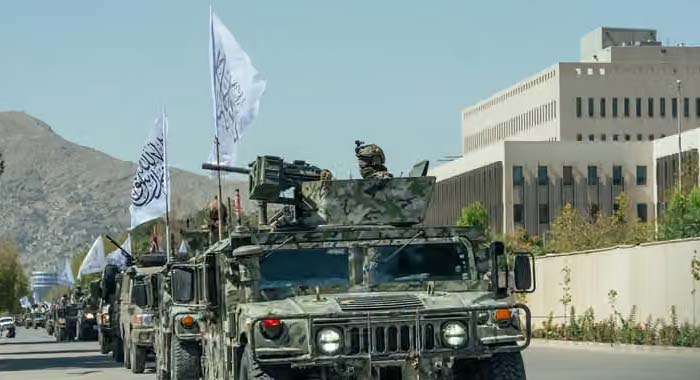
The Taliban government has rejected demands from the United States for the return of American weapons and military equipment left behind in Afghanistan following the withdrawal of U.S. forces in 2021, declaring that the equipment is now considered the property of the Afghan state.
Taliban Foreign Ministry spokesman Abdul Qahar Balkhi, speaking to CBS, said that weapons and military equipment left behind after the U.S. withdrawal would not be returned. He maintained that the equipment had become state assets belonging to Afghanistan and indicated that the Taliban would not enter negotiations over their ownership.
The issue has resurfaced amid renewed criticism in Washington over the U.S. withdrawal from Afghanistan and the substantial quantity of military hardware that remained in the country following the collapse of the former Afghan government and its security forces.
Asked about U.S. President Donald Trump’s demand that American military equipment left in Afghanistan be returned, Balkhi reportedly rejected the prospect of negotiations over the equipment. He described the weapons and military hardware as state assets, signaling that the Taliban considers the matter settled and does not view the equipment as subject to return negotiations.
During the CBS interview, the reporter pointed out that the equipment had been purchased with money from American taxpayers. In response, Balkhi referred to the consequences of the U.S. military intervention in Afghanistan, arguing that Americans had killed large numbers of people and caused extensive destruction across the country. His response reflects the Taliban’s broader position that the legacy of the two-decade U.S. military presence cannot be separated from the human and material costs of the conflict.
The dispute centers on a substantial inventory of weapons, vehicles and military equipment that remained in Afghanistan after the rapid collapse of the former Afghan security forces in 2021. According to figures released by the U.S. Department of Defense, approximately $7 billion worth of weapons and military equipment fell into Taliban hands following the collapse of the former Afghan security forces.
The equipment included military vehicles and other hardware supplied by Washington to Afghanistan’s former security institutions during the years of international military involvement. Five years after the withdrawal of U.S. forces, Taliban personnel continue to operate and display some of this equipment.
In a report from Kabul, CBS noted that Taliban forces continue to use armoured vehicles, weapons and other military equipment that had previously been supplied by the United States to the security forces of the former Afghan government. The Taliban has also showcased some of the captured equipment during military ceremonies in recent years, turning hardware originally supplied as part of the U.S.-backed Afghan security structure into symbols of the Taliban’s takeover and its control over the country’s security apparatus.
The continued use of the equipment demonstrates the lasting material legacy of the two-decade U.S. military campaign in Afghanistan and the dramatic transformation of Afghanistan’s security institutions following the Taliban’s return to power.
President Donald Trump has repeatedly criticised the manner in which U.S. forces withdrew from Afghanistan under former President Joe Biden. Trump has argued that billions of dollars worth of American military equipment were left behind following the withdrawal and has repeatedly demanded that the equipment be returned. The Taliban’s latest position, however, suggests that Kabul is not prepared to comply with that demand.
By characterizing the equipment as Afghan state property and rejecting negotiations over its return, the Taliban has effectively challenged Washington’s claim to ownership and signaled that the issue could remain a point of disagreement between the two sides.
The controversy comes against the backdrop of one of the longest wars in modern U.S. history. The U.S. military campaign in Afghanistan began following the September 11, 2001 attacks in the United States and continued for approximately two decades. The withdrawal of U.S. forces in 2021 brought the military campaign to an end and was followed by the collapse of the former Afghan government and its security forces.
The Taliban subsequently took control of Kabul and established its authority across most of the country. The enormous quantity of military equipment that remained behind became one of the most visible legacies of the withdrawal. For Washington, the equipment represents billions of dollars of U.S.-funded military assets. For the Taliban authorities, the same equipment is now regarded as part of Afghanistan’s state resources and military capability.
The dispute over the equipment extends beyond the question of ownership. It has become a symbol of the broader consequences of the U.S. withdrawal and the Taliban’s transformation from an insurgent movement into Afghanistan’s de facto governing authority. Equipment once intended to strengthen the former Afghan security forces is now being operated by the very force that defeated those institutions. The Taliban’s continued possession and use of the equipment also illustrates the speed and scale of the collapse of the former Afghan security architecture in 2021.
The CBS report was published ahead of the 25th anniversary of the September 11 attacks, giving the issue additional historical significance. The September 11 attacks triggered the U.S. intervention in Afghanistan and set in motion a conflict that lasted roughly 20 years. A quarter-century after the attacks, the question of what the United States left behind in Afghanistan remains closely linked to the legacy of that war.
The continued presence of U.S.-supplied military hardware under Taliban control highlights the extraordinary reversal of circumstances: equipment provided to support a U.S.-backed Afghan government is now being used and controlled by the Taliban authorities.
The Taliban’s refusal to return U.S. weapons and military equipment left behind in Afghanistan has opened a new chapter in the long-running debate over the legacy of America’s two-decade war. While Washington continues to regard the equipment as American-funded military assets and President Trump has demanded their return, Taliban authorities maintain that the equipment is now the property of the Afghan state and is not subject to negotiation.
With approximately $7 billion worth of weapons and military equipment reportedly falling into Taliban hands after the collapse of the former Afghan security forces, the issue represents one of the most significant unresolved material legacies of the U.S. withdrawal.
The dispute also underscores the broader transformation of Afghanistan since 2001 from the starting point of a prolonged U.S.-led military campaign following the September 11 attacks to a country now governed by the Taliban, with large quantities of former U.S.-supplied military hardware remaining under its control.
As the 25th anniversary of September 11 approaches, the controversy over the abandoned equipment serves as a reminder that the consequences and unresolved questions of the Afghanistan war continue to shape regional and international affairs.



