
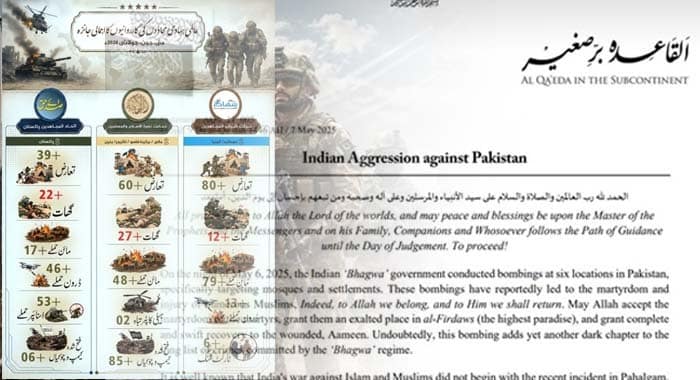
Twenty-five years after the September 11 attacks fundamentally transformed the global counterterrorism landscape, Al-Qaeda in the Indian Subcontinent (AQIS) has neither disappeared nor returned to the highly centralized model associated with Al-Qaeda before 2001. Instead, the organization has adapted to South Asia’s fragmented and constantly changing militant environment by developing a more dispersed model based on small cells, partner organizations, shared personnel, ideological influence, logistical networks and propaganda infrastructure.
This evolution is particularly visible in Afghanistan and Pakistan, where AQIS has maintained leadership and organizational infrastructure while deepening its relationship with Tehrik-e-Taliban Pakistan (TTP) and emerging militant coalitions. Its broader regional reach also extends toward India, Kashmir and Bangladesh, where propaganda, recruitment and localized networks provide additional avenues for influence.
The United Nations’ 38th Analytical Support and Sanctions Monitoring Team report, circulated in August 2026, assessed that AQIS had evolved from what it described as a “fragmented organization” into “a regional terrorist entity.” The report further assessed that the group had developed logistical and financial networks and was increasingly operating through small, scattered cells rather than large militant formations.
The emerging picture is therefore not of an Al-Qaeda revival identical to the organization that existed before 2001, but of a more adaptive and networked organization seeking to preserve and expand its influence through partnerships, dispersed structures and interconnected militant ecosystems.
AQIS was formally announced by Al-Qaeda leader Ayman al-Zawahiri in September 2014, with Asim Umar, also known as Sana-ul-Haq, appointed as its first emir. An Indian-origin Al-Qaeda operative, Umar led the organization until 23 September 2019, when he was killed during a joint U.S.-Afghan operation in Musa Qala, Helmand Province.
His death, however, did not dismantle AQIS. Usama Mahmood, who had served as an important spokesman and media figure, subsequently assumed leadership, while Atif Yahya Ghouri has served as his deputy. The continuity of AQIS leadership following the deaths of Umar and, later, Zawahiri illustrates the organization’s ability to absorb the loss of senior figures without necessarily losing its broader network and organizational identity.
Rather than depending entirely on a single leader or centralized command structure, AQIS has demonstrated an ability to preserve its wider infrastructure through leadership succession, dispersed personnel and relationships with other militant organizations.
Afghanistan remains fundamental to this resilience. According to the latest UN assessment, AQIS leadership figures including Usama Mahmood and Atif Yahya Ghouri remained in Kabul, where they had reportedly been issued tazkiras, or Afghan identity documents, by Taliban authorities.
The reported presence of AQIS’s senior leadership in Kabul is significant because Afghanistan provides the organization with a physical environment from which leadership, training, communications, propaganda and relationships with other militant organizations can be maintained. The latest UN report also recorded a Member State assessment that Al-Qaeda trainers had trained elements of the Balochistan Liberation Army alongside TTP personnel.
Afghanistan consequently functions as a common operating environment in which several militant networks maintain overlapping connections, potentially allowing the transfer of personnel, training and organizational expertise across groups.
Al-Qaeda’s relationship with the TTP is longstanding. During the TTP’s formative years, Al-Qaeda provided ideological guidance, training and operational support to Pakistani Taliban factions. That relationship has subsequently become more organizationally interconnected, particularly following the TTP’s consolidation of numerous factions after 2020.
One important manifestation of this relationship has been the movement of experienced AQIS personnel into TTP structures. Chaudhry Muneeb ur Rehman Jatt, also known as Commander Muneeb, is a prominent example. A former AQIS operative, Muneeb took charge of the TTP’s Umar Media apparatus in 2021.
His involvement has been identified as an important factor behind the improvement of the TTP’s propaganda and recruitment capabilities. The latest UN assessment further states that Al-Qaeda continued to provide the TTP with ideological guidance, training and support.
This relationship reflects a growing convergence in which the TTP retains its Pakistan-focused insurgent identity while benefiting from Al-Qaeda’s transnational ideological and organizational resources. The movement of experienced personnel between the two organizations also demonstrates how capabilities developed within one militant structure can be transferred into another.
A second major development in AQIS’s regional evolution has been the emergence of Ittihad-ul-Mujahideen Pakistan (IMP) in 2025. The coalition brought together Lashkar-e-Islam, Tehreek-e-Taliban Ghazwah-e-Hind (TTG), also known as the Hafiz Gul Bahadur Group, and Harakat Inqilab-e-Islami Pakistan (HIIP).
The emergence of IMP represents another mechanism through which AQIS-linked influence can potentially operate within Pakistan’s militant landscape. Rather than relying exclusively on attacks conducted under its own name, AQIS can project influence through a broader coalition of organizations with their own local structures and operational capabilities.
AQIS’s own media activity has provided further indications of its relationship with IMP. In the latest issue of the organization’s Urdu publication, Nawa-i-Ghazwa-e-Hind, an infographic featured attacks attributed to IMP during May, June and July, alongside attacks associated with other regional Al-Qaeda affiliates, including Jamaat Nusrat al-Islam wal-Muslimin (JNIM) and Harkat Shabaab al-Mujahideen.
More significantly, the latest UN assessment states that AQIS formed the “backbone” of IMP and attributed several attacks to the organization operating through this network. This assessment is particularly important because it suggests that AQIS’s regional influence cannot be measured solely by attacks directly claimed in its own name.
The organization can potentially operate through coalitions and partner structures, allowing its ideology, personnel, expertise and organizational capabilities to circulate through a wider militant network.
Another development of concern is the reported nexus between IMP and Jamaat-ul-Ahrar (JuA), an organization associated with urban attacks. A broader AQIS–IMP–JuA nexus could potentially provide militant networks with additional geographic reach and complementary capabilities, presenting another layer of complexity for Pakistan’s security environment.
The concern is reinforced by JuA’s reported operational activity. In August 2026, the organization claimed responsibility for three attacks in Karachi and three additional attacks in Punjab.
The reported activity highlights the possibility that relationships between separate militant formations could allow organizations to exploit different geographic environments while benefiting from overlapping ideological, organizational or operational networks.
Bangladesh remains a secondary theatre in AQIS’s regional strategy, but developments there provide an important indication of how the organization seeks to exploit political and social upheaval. One of the most significant recent Bangladesh-focused developments occurred in August 2024, when Usama Mahmood issued a statement through As-Sahab following the ouster of Sheikh Hasina.
Rather than immediately calling for participation in government, Mahmood advocated a longer-term approach centered on Da’wah, or preaching, building the capacity for resistance and revolution, and developing social influence. The statement portrayed Bangladesh’s political upheaval as an opportunity for Islamic mobilization.
The latest UN report subsequently expressed concern that AQIS was attempting to exploit Bangladesh to establish cells. This assessment, however, should be understood as an assessment of intent and activity rather than evidence that AQIS has established a large operational network in Bangladesh. The distinction remains important when evaluating the actual scale of the organization’s presence there.
India and Kashmir remain important primarily because they provide AQIS with a longstanding ideological and mobilizational focus. The organization’s Ghazwa-e-Hind narrative and Nawa-i-Ghazwa-e-Hind publication have sought to connect Kashmir and perceived grievances among Indian Muslims with Al-Qaeda’s wider transnational agenda.
Following Operation Sindoor in May 2025, AQIS issued messaging portraying India’s strikes as an attack on Muslims and calling for jihad against India. The organization appeared to use the India-Pakistan confrontation as an opportunity to reassert itself following a period of relatively low visibility.
The India dimension acquired further significance following the November 2025 Red Fort attack in Delhi. The UN’s 38th report states that the attack was officially attributed to AQIS.
The finding is significant because it places AQIS’s India strategy beyond the realm of propaganda and ideological messaging. At the same time, the organization’s overall structure remains decentralized and does not resemble the large territorial networks associated with earlier jihadist organizations.
AQIS’s significance cannot be assessed solely through the number of attacks conducted under its own name. Its propaganda infrastructure remains a central component of its regional strategy. Through publications such as Nawa-i-Ghazwa-e-Hind and media operations associated with As-Sahab, AQIS can disseminate ideological narratives across national borders and attempt to connect geographically separate conflicts to a broader transnational framework.
The movement of experienced AQIS personnel into TTP media structures further demonstrates how media expertise can become a transferable capability within the regional militant ecosystem. Commander Muneeb’s role in the TTP’s Umar Media apparatus is particularly significant in this regard.
Propaganda therefore functions not merely as a communication mechanism but as a means of maintaining ideological cohesion, shaping recruitment narratives, strengthening organizational relevance and connecting local conflicts with Al-Qaeda’s wider ideological agenda.
The evolution of AQIS is best understood as a transformation rather than a straightforward return of the Al-Qaeda model that existed before 2001. The earlier Al-Qaeda relied heavily on centralized leadership, established training infrastructure and relatively large organizational formations. Today’s AQIS operates in a markedly different environment, relying increasingly on dispersed cells, partner organizations, shared personnel, ideological influence, propaganda networks, and logistical and financial structures.
This decentralized approach can provide resilience against conventional counterterrorism pressure. The elimination of an individual leader or the disruption of one cell does not necessarily eliminate the broader network when personnel, ideology, communications and organizational expertise remain distributed across multiple locations and partner organizations.
AQIS’s adaptation therefore appears to be based less on territorial control and more on maintaining relationships and influence across an interconnected militant environment. The geographical scope of AQIS’s activities and influence is equally significant. Afghanistan provides the reported strategic rear base and leadership environment. Pakistan remains the most important operational arena in terms of AQIS’s relationship with the TTP and emerging militant coalitions such as IMP.
Meanwhile, India and Kashmir provide a longstanding ideological and mobilizational focus, while Bangladesh represents another arena in which AQIS has sought to exploit political developments and establish influence, although the scale of any operational presence there remains uncertain.
This geographic spread illustrates the organization’s broader adaptation to South Asia’s militant environment. Rather than attempting to dominate a single territory, AQIS can seek to connect multiple local conflicts to a common ideological narrative while relying on local organizations to provide operational access.
For Pakistan, the evolution of AQIS presents a particularly complex counterterrorism challenge because the threat is no longer necessarily defined by a single organization operating under a single command structure. Instead, it can emerge through relationships among multiple militant groups, with ideological guidance, trained personnel, media capabilities and logistical expertise potentially circulating between organizations.
The AQIS–TTP relationship remains central to this environment, while the emergence of IMP and its reported relationship with JuA introduces an additional layer of complexity. The possibility of shared expertise and interconnected networks among organizations operating in different parts of Pakistan could allow militant groups to adapt rapidly and exploit new geographic and operational opportunities.
The reported presence of AQIS leadership in Kabul further adds a cross-border dimension to the security challenge, particularly given the organization’s reported links with other militant formations operating in the region.
The latest UN assessment suggests that AQIS has evolved into a regional terrorist entity rather than remaining merely a fragmented collection of militants. Its significance therefore cannot be measured exclusively by the number of attacks conducted directly under the AQIS name. Its continuing leadership presence, reported infrastructure in Afghanistan, longstanding relationship with the TTP, movement of personnel into TTP structures, transfer of media expertise, reported role within IMP, ideological and mobilizational activities relating to India and Kashmir, attempts to exploit political developments in Bangladesh, and development of logistical and financial networks collectively demonstrate a broader model of influence.
The organization increasingly appears capable of functioning through dispersed cells and partner organizations, allowing it to maintain relevance even when its direct operational footprint is limited.
This networked model presents a significant challenge to regional counterterrorism agencies because targeting individual militant organizations may not, by itself, eliminate the wider ecosystem through which ideology, personnel, training, logistics and propaganda capabilities continue to circulate.
Twenty-five years after 9/11, AQIS has demonstrated that the disappearance of Al-Qaeda’s pre-2001 centralized model does not necessarily mean the disappearance of its regional influence. The organization has instead adapted to South Asia’s fragmented militant environment by relying on dispersed structures, partner organizations and interconnected networks.
Afghanistan provides the reported strategic rear base; the TTP remains its most important Pakistan-focused militant partner; IMP offers another coalition through which AQIS can project influence; while India, Kashmir and Bangladesh provide additional ideological, political and mobilizational arenas.
Its relationship with the TTP encompasses a history of ideological and training support, the movement of experienced personnel into TTP structures, and increasingly visible cooperation in organizational and media domains. Its reported role in IMP further indicates that AQIS’s influence may extend through militant coalitions rather than solely through operations conducted under its own organizational banner.
AQIS’s importance consequently cannot be measured simply by counting attacks attributed directly to the group. Its continued leadership presence, reported infrastructure in Afghanistan, decentralized cells, logistical and financial networks, role within militant coalitions, transfer of media expertise and ability to connect conflicts across Pakistan, Afghanistan, India, Kashmir and Bangladesh demonstrate a model based on networked resilience rather than centralized power.
For regional counterterrorism authorities, the challenge is therefore not simply to dismantle AQIS as an independent organization. It is also to disrupt the relationships, personnel flows, training structures, logistical channels and propaganda networks through which its ideology and capabilities can continue to circulate across the broader Af-Pak and South Asian militant ecosystem.
The evolution of AQIS serves as a reminder that terrorist organizations can survive major leadership losses and profound changes in the regional security environment by adapting their structures, partnerships and methods.
The Al-Qaeda of 2001 may no longer exist in the same form but its networks, ideology and organizational legacy continue to shape the militant landscape of South Asia.



