
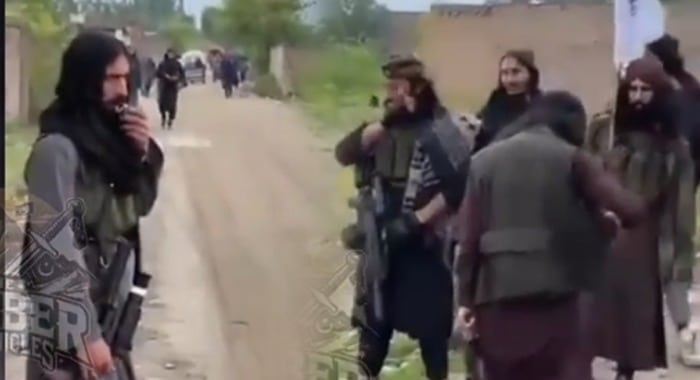
A video emerging from Khyber district has once again exposed a disturbing tactic employed by terrorists, using the presence of the local population to complicate security operations and potentially create the very civilian harm that they later seek to exploit for propaganda.
The footage, reviewed in connection with the incident, appears to show a group of armed men moving along a populated rural area alongside local people. Several individuals carrying weapons can be seen moving among civilians, while the group proceeds through an area containing homes and other signs of civilian habitation.
The significance of the footage goes far beyond the movement of a few armed men.
It raises a fundamental question about whom these terrorists actually consider their enemy.
For years, terrorist groups have attempted to portray themselves as defenders of local communities, religion, tribal interests or the rights of ordinary people. Their actions, however, repeatedly tell a profoundly different story. When terrorists deliberately operate from populated areas, move among civilians or seek to use local residents as cover, it is the people themselves who are placed in danger.
The tactic is a cruel double-edged strategy.
On one side, terrorists seek to shield themselves from direct action by security forces by embedding their movement within civilian surroundings. The presence of families and ordinary residents makes any security response considerably more difficult, because security personnel must constantly balance the need to eliminate the terrorist threat with the imperative of protecting innocent people.
On the other side, the same terrorists can attempt to exploit any civilian suffering resulting from such confrontations for propaganda purposes.
If a security operation causes damage or casualties because terrorists deliberately positioned themselves among civilians, the terrorists can then attempt to blame the state, conceal their own role and portray security forces as the source of the suffering.
That is not resistance.
It is the weaponization of civilians.
The People Are Paying the Price
The most important question, therefore, is not simply why security forces conduct operations against terrorists.
It is why terrorists continue to place ordinary people directly in the line of danger.
The answer lies partly in the terrorists’ growing difficulty in operating openly.
A group that enjoys genuine public support does not need to hide behind civilians. It does not need to move through populated areas with weapons, intimidate residents or turn homes and communities into protective cover.
The increasing reliance on such tactics can instead be viewed as a sign of pressure.
Terrorists need territory, concealment, information and local access to survive. But the more openly they expose communities to danger, the greater the likelihood that those same communities will turn against them.
And that appears to be increasingly happening across Khyber Pakhtunkhwa.
Recent developments have produced several visible indications of public rejection of terrorism. In Upper Dir, residents came out in support of police personnel following attacks on law-enforcement positions, with people moving towards affected areas rather than allowing terrorists to isolate the security forces from the community.
In Khyber itself, tribal elders have also announced a grassroots movement against terrorism, highlighting the impact of kidnappings, intimidation and violence on local residents and calling for lasting peace.
These reactions matter because terrorism ultimately depends not only on weapons but also on an environment in which terrorists can find space, sympathy, silence or assistance.
That environment appears to be shrinking.
The Narrative Is Losing Its Audience
The terrorists’ propaganda machine may continue to describe them as defenders of the people, but the people themselves are increasingly becoming the strongest contradiction to that narrative.
A mother whose children cannot safely travel because terrorists have occupied an area does not see a defender.
A shopkeeper whose business is disrupted by threats and extortion does not see a liberator.
A family forced to live under intimidation does not see a representative.
And a community used as a human shield certainly has little reason to regard those hiding behind it as protectors.
This is where the terrorists’ strategy becomes self-defeating.
They may believe that provoking security action will generate anger against the state. They may calculate that civilian hardship can be converted into propaganda. They may hope that every difficult security operation creates another opportunity to portray Pakistan as hostile to its own citizens.
But such calculations depend on one critical assumption: that the population will continue to believe the terrorists’ version of events.
There is increasingly little evidence that this assumption can be taken for granted.
The public reaction across different parts of KP suggests that many communities are drawing a much simpler conclusion: terrorism itself is the threat.
A Failing Strategy
The Khyber video should therefore be viewed within this wider context.
The terrorists are not merely attempting to evade security forces. They appear to be operating in a manner that places civilians between themselves and the state, creating the possibility of a deadly confrontation while preserving an opportunity to manipulate its aftermath.
That strategy may once have offered terrorist organizations tactical advantages.
Today, it increasingly exposes their vulnerability.
Every time terrorists use civilians as cover, they demonstrate that they cannot stand openly against the security forces. Every time they endanger local residents, they weaken their own claim to represent those residents. And every time communities protest against terrorism, cooperate with law-enforcement agencies or publicly stand beside security personnel, the terrorists lose another layer of the social space on which their survival depends.
The most consequential battlefield, therefore, may not be the physical terrain of Khyber at all.
It may be the relationship between terrorists and the population they claim to fight for.
And on that battlefield, the signs are increasingly unfavorable for the terrorists.
They may still possess weapons.
They may still possess hideouts.
They may still be capable of inflicting violence.
But the most valuable asset for any terrorist organization, public acceptance, appears to be slipping away.
Perhaps that is why civilians are increasingly being treated not as the people terrorists claim to defend, but as the shield behind which they themselves must hide.



