
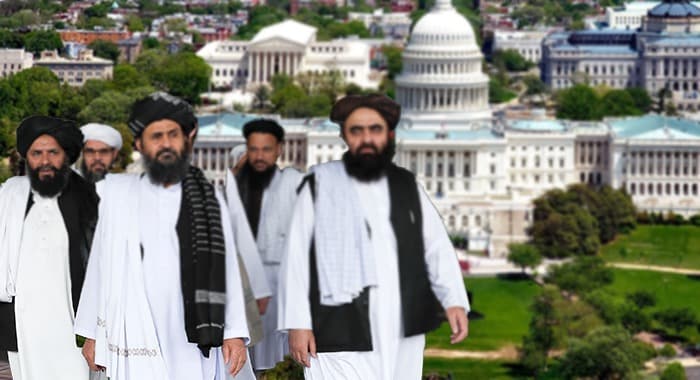
The Taliban’s latest outreach to Washington may sound like a call for normal diplomatic relations, but the details suggest something considerably broader.
Kabul wants the United States to reconsider its policy towards the Taliban, reopen its embassy, invest in Afghanistan, ease sanctions and help unlock Afghan assets frozen abroad. That is quite a list for a government that spent two decades fighting the United States and only days ago celebrated what it described as America’s defeat.
The question, therefore, is not simply why the Taliban wants better relations with Washington. The more revealing question is: What does the Taliban actually want from America?
Foreign Minister Amir Khan Muttaqi has provided some answers.
In his recent interviews, he urged Washington to abandon what he described as a confrontational approach and said Afghanistan wanted relations based on mutual respect and shared interests. He invited American investment in mining, infrastructure, agriculture and trade and called for the reopening of the US embassy in Kabul. He also said the Taliban wanted the issue of Afghanistan’s frozen assets addressed and argued that sanctions had failed to achieve their intended objectives.
The Taliban is therefore not merely seeking a handshake.
It is seeking access.
The Price of Engagement
Afghanistan’s economic needs are enormous. The country remains among the world’s poorest, while millions of Afghans face acute food insecurity. The Taliban has an obvious incentive to attract foreign capital and regain access to international financial channels.
But Washington has its own concerns.
The United States has not recognized the Taliban government, and President Donald Trump has shown little enthusiasm for simply returning to the relationship that existed before the Taliban takeover. Trump has instead raised the possibility of regaining access to Bagram Air Base, a proposal the Taliban has rejected.
That leaves Kabul with a difficult diplomatic equation.
It wants American money without American political conditions.
It wants American diplomats without accepting the political baggage that comes with renewed engagement.
It wants access to frozen assets without conceding that international pressure remains linked to the Taliban’s conduct.
And it wants investment in its mineral wealth while continuing to resist demands for fundamental changes in its domestic policies.
This is where the Taliban’s diplomatic strategy becomes particularly interesting.
Engagement Without Concessions
The Taliban increasingly appears to favor a model of international engagement in which countries cooperate with Kabul while accepting the regime’s internal political system as a separate matter.
That strategy has produced some results.
China, Iran, India, Qatar, Central Asian states and others have expanded contacts with Kabul. European governments have also engaged the Taliban on issues including migration and security. Russia went further, becoming the first country to formally recognize the Taliban government in July 2025.
But formal recognition remains overwhelmingly absent.
That distinction matters.
A country can speak to the Taliban without recognizing its government.
It can trade with Afghanistan without endorsing Taliban rule.
It can cooperate on border security without accepting Kabul’s political legitimacy.
The Taliban, however, wants these incremental relationships eventually converted into something much larger: normalization.
And Washington remains the most important prize.
Why America?
Because American engagement would carry consequences far beyond dollars.
If Washington reopened its embassy, expanded economic engagement and moved towards normalization, the Taliban could present that development as evidence that its isolation was ending. That would have enormous political value for the regime. It could say to regional governments and potential investors: If America is willing to deal with us, why shouldn’t you?
This is why the US question is not simply about an embassy building in Kabul.
It is about legitimacy.
It is about international confidence.
It is about access to global financial networks.
And it is about whether the Taliban can transform itself from an authority that controls Afghanistan into a government that the international system accepts as Afghanistan’s government.
But What Does Washington Get?
That is the question the Taliban’s diplomatic messaging does not answer convincingly.
What would the United States receive in return for normalizing relations?
Would the Taliban offer verifiable guarantees against terrorist groups using Afghan territory?
Would it make measurable progress on women’s and girls’ rights?
Would it create a more inclusive political structure?
Would it provide greater transparency over foreign investment and mineral contracts?
Would it permit independent monitoring?
Would it address concerns over arbitrary detention and other rights abuses?
These are not theoretical questions. UN experts have warned against normalizing the Taliban authorities without demonstrated progress on human rights, particularly the rights of women and girls.
Muttaqi’s argument is essentially that the past should be left behind and future cooperation should take its place.
But diplomacy does not erase history simply because one side would prefer a new chapter.
The United States may have withdrawn its forces. The Taliban may have regained control of Kabul. But Washington still has interests, concerns and leverage.
And that explains the urgency behind Kabul’s current charm offensive.
The Taliban once demanded that America leave Afghanistan.
Now it is asking America to come back, not with soldiers, but with diplomats, investors and money.
That is not necessarily hypocrisy by itself. Former enemies can become partners.
But before the United States accepts the invitation, one question deserves an answer:
What exactly is the Taliban prepared to offer in return?
So far, Kabul’s list of requests is remarkably clear.
Its list of concessions remains considerably harder to find.



