
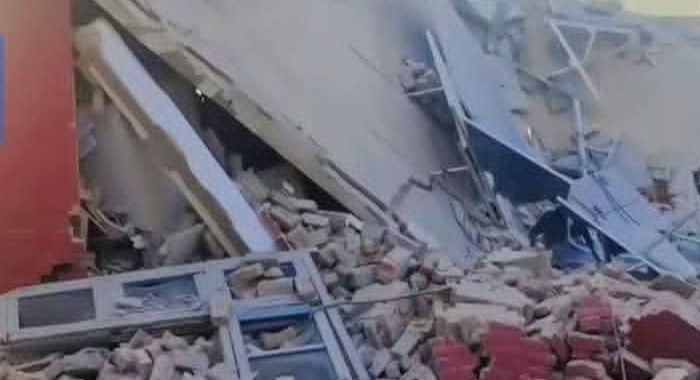
A government primary school was destroyed in a late-night terrorist attack in Kot Gullan, an area located between Tank and Jandola in Khyber Pakhtunkhwa’s Tank district, in yet another assault on the province’s educational infrastructure.
According to initial information, terrorists planted explosive material at the Government Primary School in Kot Gullan and detonated it during the night. The blast destroyed the school building and caused extensive damage to its classrooms and boundary walls.
No casualties were reported as the school was closed when the explosives were detonated.
Police and security personnel reached the site after the explosion, secured the area and launched an investigation into the attack.
The incident is not an isolated occurrence in Tank, the southern districts or Khyber Pakhtunkhwa as a whole. Terrorists have repeatedly targeted educational institutions, while healthcare facilities have also come under attack, demonstrating a broader pattern aimed at disrupting basic public services.
Recent attacks elsewhere in the province underline the scale of the threat. A government girls’ middle school in Shah Hassan Khel, Lakki Marwat, was destroyed in a late-night terrorist attack after explosives were planted at the facility. The blast caused extensive damage to classrooms and parts of the school building, including its boundary walls.
On July 21, terrorists affiliated with Fitna al-Khwarij destroyed the Government Middle School in Loi Kharki, Bajaur, using explosive devices. Earlier, on July 2, terrorists attempted to blow up a government girls’ middle school in Bannu, although the attack caused less destruction.
Schools in Tank, Lakki Marwat, North Waziristan, South Waziristan and other southern districts have repeatedly been targeted, highlighting a sustained campaign against educational institutions and the communities they serve.
A War Beyond Security Targets
The destruction of a school should not be viewed merely as another security incident.
A school in a remote community is far more than a building made of concrete and bricks. It is one of the most visible links between the state and its citizens. The same is true of a Basic Health Unit or other rural healthcare facility.
When terrorists attack these institutions, they are attacking the state’s ability to provide education, healthcare and basic development to ordinary people.
The pattern in Tank is particularly disturbing.
The destruction of the Government Boys Primary School in Kot Gullan, followed by the bombing of a Government Girls Primary School in Jandola, and attacks on other public facilities indicate a pattern that cannot simply be dismissed as isolated acts of violence.
The targets have social value rather than military value.
Destroying a school frightens families and disrupts children’s education. Damaging a health facility places entire communities at greater risk, particularly pregnant women, children, elderly people and families who cannot afford to travel long distances for medical treatment.
The consequences therefore continue long after the explosion.
Why Schools Matter
Tank occupies a strategically important position linking southern Khyber Pakhtunkhwa with the former tribal areas and routes toward the Afghanistan border.
In such an environment, education is particularly important because it provides young people with an alternative to the narratives propagated by terrorist organizations.
Every functioning classroom represents a future beyond violence.
Every child who remains in school represents an opportunity for the state to build a generation less vulnerable to extremist recruitment.
Every girl able to attend school represents a direct challenge to ideologies that seek to push women and girls out of public life.
This is precisely why educational institutions can become attractive targets for terrorists.
The objective is not simply to destroy a building. It is to create fear among parents, interrupt children’s education and make communities believe that normal life cannot continue.
The Real Target Is Normal Life
The same logic applies to attacks on healthcare facilities.
In rural districts already struggling with development challenges, a health center may be the only accessible source of medical care for an entire population. Destroying it increases hardship and deepens the sense of abandonment among local communities.
This is how terrorism attempts to undermine governance without necessarily occupying territory.
The objective is to make ordinary life increasingly difficult.
Schools become unsafe.
Healthcare becomes inaccessible.
Businesses become uncertain.
Families become frightened.
And eventually, confidence in the state’s ability to protect and serve its citizens begins to erode.
That is why the response cannot end with rebuilding a damaged school.
The state must ensure that terrorists fail in the larger objective behind such attacks.
Security forces and law enforcement agencies have intensified counterterrorism operations across southern Khyber Pakhtunkhwa following the recent surge in terrorist violence. In recent days, security personnel also foiled a vehicle-borne suicide attack in Tank, while clearance and intelligence-based operations have continued in Bannu and adjoining districts against Fitna al-Khwarij terrorists.
The message from the state must therefore extend beyond counterterrorism operations.
Schools will be rebuilt.
Healthcare facilities must remain functional.
Children must return to classrooms.
And communities must be assured that terrorists cannot decide whether ordinary people are allowed to live normal lives.
The people of Tank have already endured years of insecurity.
The real battle is now about protecting the institutions that give those communities a future.
For terrorists, a school may be another target.
For the people of Tank, it is a doorway to tomorrow.



