
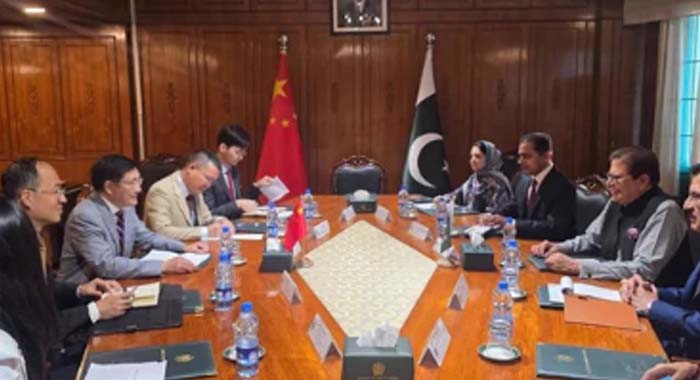
Pakistan and China have once again reaffirmed their shared commitment to addressing the growing security challenges posed by terrorist organizations operating from Afghan soil, emphasizing the need for enhanced bilateral coordination, intelligence cooperation, and collective efforts to safeguard regional peace and stability.
In this regard, Chinese Special Representative for Afghanistan Ambassador Yue Xiaoyong and his delegation visited Islamabad, where they held important discussions with Pakistan’s Special Representative for Afghanistan Ambassador Mohammad Sadiq and officials from the Ministry of Foreign Affairs. The high-level engagement focused on regional security developments, emerging threats, and measures to strengthen cooperation against terrorism.
During the meeting, both sides exchanged views on the security challenges posed by terrorist organizations, including the Tehreek-e-Taliban Pakistan (TTP) and the East Turkestan Islamic Movement (ETIM), which continue to operate from Afghan territory and pose serious threats to regional security and stability.
Ambassador Mohammad Sadiq, while commenting on the discussions, stated that the two sides agreed to further strengthen bilateral coordination and deepen cooperation to counter terrorist threats and protect regional peace, security, and stability.
The latest engagement comes amid heightened concerns over cross-border terrorism and the continued activities of terrorist groups seeking to use Afghan soil for attacks against neighboring countries. Pakistan has repeatedly highlighted the threat posed by such elements and has emphasized the importance of effective measures to prevent terrorist organizations from operating freely from Afghan territory.
Pakistan and China have consistently maintained that terrorism in any form remains a common challenge requiring collective and coordinated action. Both countries have called for more “visible and verifiable” steps to eliminate terrorist organizations based in Afghanistan and ensure that Afghan territory is not used for militant activities against any country.
The two countries stressed that terrorist groups operating from Afghanistan continue to pose serious threats to regional and global security, underscoring the urgent need for effective mechanisms to prevent these organizations from planning and executing attacks beyond Afghanistan’s borders.
China has remained actively engaged with regional stakeholders to promote stability and security, including facilitating dialogue between Pakistan and Afghan authorities aimed at addressing border security concerns and counterterrorism challenges. However, concerns remain regarding the continued presence and activities of groups such as TTP and ETIM.
For Pakistan, the TTP remains a major security challenge due to its involvement in terrorist activities, while China has expressed serious concerns over threats posed by ETIM, particularly in relation to the safety of Chinese citizens, investments, and strategic projects in the region.
Earlier engagements between Pakistan and China have also reaffirmed Beijing’s support for Pakistan’s counterterrorism efforts and its measures to protect Chinese nationals and projects linked to the China-Pakistan Economic Corridor (CPEC) and the broader Belt and Road Initiative (BRI).
Both countries reiterated that lasting peace, regional connectivity, and economic development can only be achieved through a secure environment free from terrorism. Pakistan and China reaffirmed their determination to continue working closely through diplomatic, security, and intelligence channels to counter common threats and contribute to regional peace and stability.
The two sides emphasized that preventing the misuse of Afghan territory by terrorist organizations remains essential for ensuring a peaceful, secure, and prosperous future for the entire region.



