
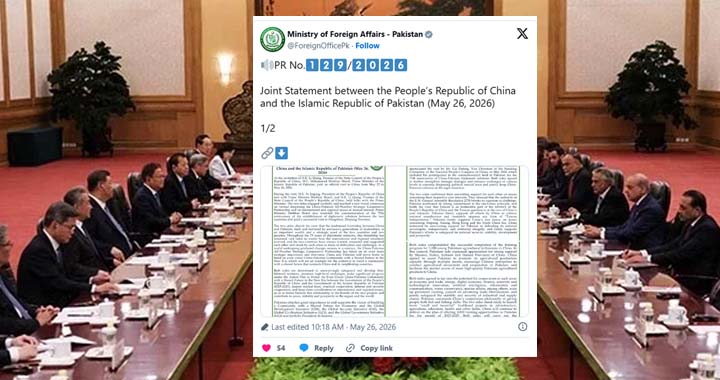
A comprehensive joint communiqué has been issued by Pakistan and China following Prime Minister Shehbaz Sharif’s official visit to China from May 23 to 26, underscoring deepening strategic cooperation, enhanced counterterrorism alignment, and expanded economic and technological collaboration between the two long-standing partners.
During the visit, Prime Minister Shehbaz Sharif held high-level meetings with Chinese President Xi Jinping and Premier Li Qiang. The engagements coincided with commemorations marking 75 years of diplomatic relations between the two countries, reflecting what both sides described as a historic and enduring partnership grounded in mutual trust and shared strategic interests.
The joint statement emphasized a firm and unified stance on counterterrorism, with both sides agreeing that no group will be permitted to use any territory to conduct or support activities that threaten regional security. The communiqué specifically referenced organizations including the proscribed Tehrik-i-Taliban Pakistan (TTP) and the East Turkestan Islamic Movement (ETIM), reaffirming a shared commitment to preventing militant exploitation of regional spaces and strengthening coordinated efforts against terrorism in all forms.
Both countries reiterated their opposition to double standards in counterterrorism efforts and reaffirmed support for the central role of the United Nations in maintaining global peace and security. They also underscored the importance of stability in South Asia and expressed alignment on key regional security concerns, including developments in Afghanistan, with an agreement to maintain close coordination on related issues.
On sovereignty and core political principles, Pakistan reaffirmed its commitment to the One China policy and extended full support to China’s position on Taiwan. In return, China reiterated its unwavering support for Pakistan’s sovereignty, territorial integrity, and security concerns.
The two sides also agreed to further strengthen the China–Pakistan Economic Corridor (CPEC) under its next phase of development, often referred to as CPEC 2.0, with a shared vision of high-quality growth and regional connectivity. Key infrastructure projects, including the phased completion of the Karakoram Highway Thakot–Raikot section and enhanced connectivity through the Khunjerab Pass, were highlighted as strategic priorities aimed at improving regional trade and transportation networks.
The communiqué noted plans to expand industrial cooperation in sectors including textiles, home appliances, minerals, and hydrocarbons, alongside efforts to deepen collaboration in agriculture and improve access for Pakistani agricultural exports to Chinese markets. Both sides also agreed to expand cooperation in emerging fields such as artificial intelligence, the digital economy, and advanced technology.
China committed to providing 3,000 training opportunities for Pakistani professionals between 2025 and 2029, while also advancing cooperation in space technology. A landmark agreement was reached regarding the training of two Pakistani astronauts in China, with the possibility that they may become among the first foreign astronauts to participate in missions linked to China’s space station program.
Security cooperation was also a central focus of the visit, with both sides agreeing to enhance defense collaboration and strengthen counterterrorism coordination. China reiterated its support for the safety and security of Chinese nationals and development projects in Pakistan, while both countries committed to further reinforcing protective measures for ongoing bilateral initiatives.
In addition, China expressed support for Pakistan’s upcoming presidency of the Shanghai Cooperation Organization (SCO) and acknowledged Pakistan’s constructive role in international diplomacy, including efforts related to regional de-escalation initiatives.
The communiqué concluded by reaffirming the shared commitment of Pakistan and China to peace, development, and regional connectivity, describing their partnership as a cornerstone of stability in South Asia and beyond.



