
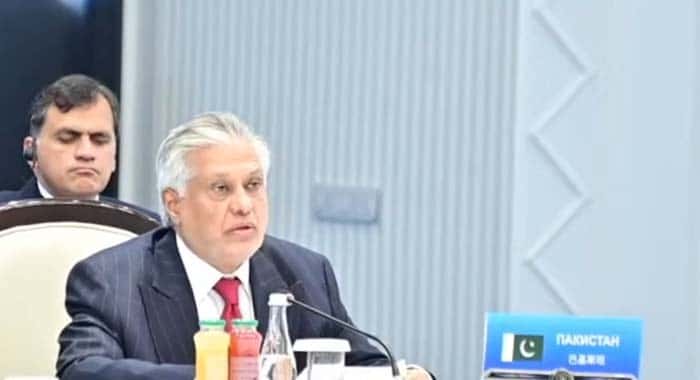
Pakistan has called for stronger regional cooperation to counter cross-border terrorism, reaffirming its commitment to regional peace, stability, and diplomatic engagement during the Meeting of the Council of Foreign Ministers of the Shanghai Cooperation Organization (SCO) held in Kyrgyzstan.
Addressing the gathering, Deputy Prime Minister and Foreign Minister Senator Ishaq Dar described terrorism emanating from Afghan territory as one of Pakistan’s most significant security challenges. He stated that the proscribed Tehreek-e-Taliban Pakistan (TTP) and the banned Balochistan Liberation Army (BLA) continue to operate from Afghan soil, posing a persistent threat to Pakistan’s national security.
At the outset of his remarks, the Deputy Prime Minister congratulated the SCO on its Silver Jubilee, describing the milestone as a source of pride for all member states. He also commended Kyrgyzstan for successfully hosting the ministerial meeting.
Highlighting the growing role of the SCO, Senator Dar stated that the organization has evolved into a comprehensive platform promoting economic cooperation, cultural exchange, regional peace, and sustainable development. He emphasized that the SCO continues to play a vital role in strengthening peace, security, and stability across the region.
Referring to the organization’s guiding principles, he said the “Shanghai Spirit” remains firmly rooted in mutual trust, mutual benefit, equality, consultation, respect for cultural diversity, and constructive diplomacy, providing an effective framework for regional cooperation.
The Deputy Prime Minister reiterated that Pakistan seeks a peaceful, stable, and prosperous Afghanistan, stressing that long-term peace in the region is closely linked to stability within Afghanistan.
At the same time, he underscored that terrorist activities originating from Afghan territory remain a major security concern for Pakistan. According to Senator Dar, the banned TTP and BLA continue to operate from Afghan soil, while expressing concern over the reported involvement of Afghan nationals in terrorist incidents targeting Pakistan.
He noted that cross-border attacks have continued despite repeated concerns raised by Pakistan. Referring to the country’s security situation, Senator Dar stated that more than 2,000 terrorist attacks had taken place during the current year, resulting in the martyrdom of over 560 Pakistanis.
He further asserted that the Afghan Taliban have been providing a permissive environment for terrorist elements, enabling them to continue carrying out attacks against Pakistan.
Calling for a collective regional response, Senator Dar urged the Shanghai Cooperation Organization to encourage the Afghan Taliban to fulfill their commitments regarding counterterrorism and prevent Afghan territory from being used for activities that threaten neighboring countries.
He emphasized that effective implementation of these commitments is essential for strengthening regional security, promoting mutual confidence, and ensuring long-term peace across South and Central Asia.
In addition to addressing security issues, the Deputy Prime Minister highlighted Pakistan’s continued commitment to diplomacy and peaceful conflict resolution.
He called upon the international community to seize the opportunity created by the ongoing negotiations between the United States and Iran, encouraging all stakeholders to work toward a permanent and peaceful resolution of outstanding issues.
According to Senator Dar, dialogue, diplomacy, mutual respect, and constructive engagement remain the only sustainable means of resolving disputes and establishing durable peace and security.
The Deputy Prime Minister referred to the negotiations held in Islamabad in April and the subsequent signing of the Islamabad Memorandum of Understanding (MoU), describing the development as a historic diplomatic achievement.
He stated that this progress had been made possible through Pakistan’s close engagement with both parties involved, together with sustained diplomatic efforts carried out in coordination with regional and international partners.
Senator Dar urged the international community to capitalize on the momentum generated by the Islamabad MoU and the ongoing technical negotiations between the concerned parties to facilitate a comprehensive, peaceful, and lasting settlement of the dispute.
The Deputy Prime Minister cautioned against elements seeking to undermine regional stability and disrupt ongoing peace initiatives.
He warned that such actors would continue attempting to exploit every opportunity to sabotage the peace process and reverse the progress achieved through diplomatic engagement.
Emphasizing the importance of vigilance and coordinated international action, he called upon regional partners to remain united against forces seeking to destabilize the region.
Concluding his address, Senator Dar stressed that achieving lasting peace, stability, and prosperity requires collective action by the international community.
He reaffirmed Pakistan’s commitment to constructive diplomacy, regional cooperation, counterterrorism collaboration, and peaceful coexistence, emphasizing that sustainable development and security can only be achieved through mutual trust, dialogue, and coordinated international efforts.
Pakistan reiterated its resolve to continue working closely with SCO member states and the broader international community to strengthen regional security, combat terrorism, promote economic cooperation, and advance lasting peace throughout the region.



