
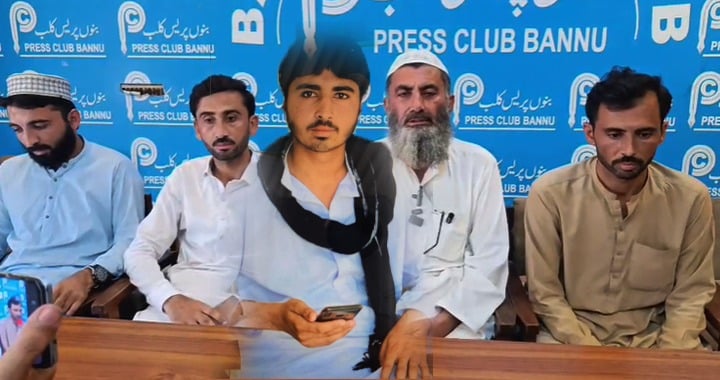
Another resident of Bannu has publicly announced complete disassociation from his son, stating that he will neither keep him at home nor accept responsibility for any of his actions after the young man allegedly left the family and became associated with terrorist elements.
Speaking at a press conference at Bannu Press Club, Sher Aslam, a resident of Kinger Jan Bahadur area of Bannu’s Mandan police station jurisdiction, announced that he has severed all ties with his son Sabah Khan.
Sher Aslam said that he has seven sons and that Sabah Khan left home some time ago. He added that the family has no information about his current whereabouts or any group with which he may be associated.
He made it clear that Sabah Khan is no longer connected with the family and that he does not want him to return home. He also stated that neither he nor the rest of the family should be held responsible for any activity carried out by his son.
“The purpose of this announcement is to clarify our position before the public and relevant institutions,” Sher Aslam said, adding that any action required by law should be taken against his son if he is found involved in any unlawful activity.
The latest declaration comes amid a growing number of similar public announcements by families in Bannu, where parents and relatives have stepped forward to distance themselves from individuals who allegedly joined terrorist networks.
Earlier this year, several families from different areas of Bannu publicly announced separation from their sons, brothers and relatives after they were reportedly linked with terrorist organizations or anti-state activities.
In one such case, a father from Kirk Painda Khel announced disassociation from his son Nazirullah, stating that despite repeated efforts, he was unable to bring him back from the path he had chosen and that the family would support lawful action by the state.
Similarly, families from Domel, Mamikhel, Bazin Khel, Sara Darga, Feroz Fateh Khel, Mamkhel\, and other areas also made public declarations, maintaining that they had no connection with the activities of their relatives and would cooperate with law enforcement institutions.
Security observers say such public statements reflect the growing rejection of terrorist recruitment at the community level, where families affected by radicalization are increasingly choosing to distance themselves from individuals involved with extremist networks.
These declarations also highlight the social consequences of terrorist recruitment, where families often face difficult circumstances when relatives abandon lawful lives and become associated with violent groups.
Authorities have repeatedly urged citizens to cooperate with law enforcement agencies and report suspicious activities, emphasizing that public cooperation remains essential in efforts to prevent terrorist organizations from exploiting local communities.



