
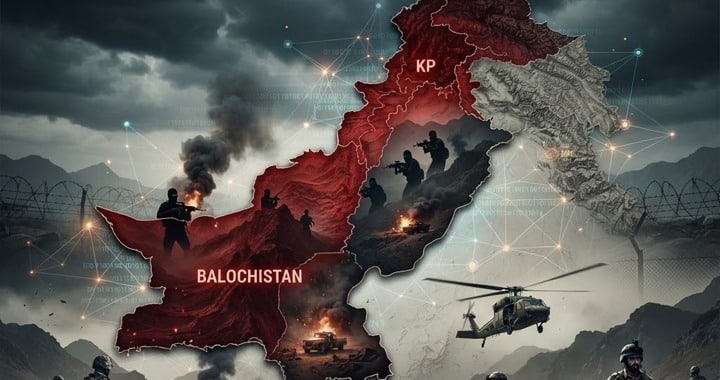
The recent wave of terrorist attacks and security operations in Khyber Pakhtunkhwa and Balochistan has once again brought the two strategically important provinces into focus, raising critical questions about the evolving nature of terrorism, the challenges faced by Pakistan’s security institutions, and the country’s continued efforts to restore lasting peace and stability.
Pakistan has reiterated its unwavering resolve to eliminate terrorism, dismantle militant networks, and protect its citizens while simultaneously advancing development initiatives aimed at addressing long-term challenges in affected regions.
The latest security developments follow a deadly terrorist assault on a joint security checkpoint in Tank district of southern Khyber Pakhtunkhwa, where 15 personnel embraced martyrdom in an attack carried out by terrorists identified by Pakistani authorities as belonging to the group referred to as “Fitna al-Khawarij.”
According to the Inter-Services Public Relations (ISPR), the attack took place during the night of 23–24 July at the Manji Khel joint check post in Tank. The attackers attempted to breach the security perimeter; however, the alertness, professionalism, and immediate response of security forces prevented them from achieving their objective.
Security forces engaged the attackers effectively, eliminating 12 terrorists who attempted to flee after the assault. During the attack, the terrorists also used an explosive-laden vehicle, which was rammed into the outer wall of the checkpoint, causing significant structural damage.
The attack resulted in the martyrdom of 15 personnel, including 12 soldiers of the Pakistan Army, two police officials, and one official of the Forest Department.
The incident highlighted the continuing security pressures faced by Khyber Pakhtunkhwa and Balochistan, where law enforcement agencies and security forces remain engaged in intelligence-based operations against terrorist groups, their facilitators, and support networks.
Alongside operations in Khyber Pakhtunkhwa, security forces have continued targeted actions against terrorist elements in Balochistan. In an intelligence-based operation in the Khad Koocha area of Mastung district, security forces reportedly eliminated four terrorists belonging to the group described by authorities as “Fitna al-Hindustan,” while several others were injured. Security personnel also recovered a significant quantity of weapons and other equipment during the operation.
Authorities further reported the arrest of several suspected facilitators allegedly involved in providing support to terrorist activities. In another incident in Khuzdar, a vehicle belonging to a Baloch civilian carrying diesel was reportedly set on fire, highlighting the broader security challenges affecting communities in parts of the province.
Pakistan has repeatedly maintained that terrorist organizations operating in the country receive support through external networks and that militant groups continue to exploit instability along the region’s security environment. Prime Minister Muhammad Shehbaz Sharif, while addressing participants of the “Balochistan National Workshop” in Islamabad, stated that terrorism in Pakistan was being supported by hostile elements and emphasized the need for collective national efforts to counter the threat.
The Prime Minister urged the Afghan interim government to ensure that its territory is not used against Pakistan and called for effective action against terrorist organizations operating from Afghan soil.
He stated that terrorism had been significantly reduced during previous years but had resurfaced through organized efforts involving external support and resources. According to the Prime Minister, confronting this challenge requires national unity, stronger coordination, and continued resolve.
Pakistan has also highlighted concerns regarding the presence of terrorist organizations and their affiliated networks in the region. International institutions, including the United Nations, and several countries have previously expressed concerns about terrorist groups operating in Afghanistan and their potential impact on regional security.
Pakistan remains among the countries most affected by terrorism, having faced decades of suicide attacks, bombings, and militant violence. Thousands of Pakistani citizens, security personnel, and law enforcement officials have sacrificed their lives in the fight against terrorism. The country’s security institutions continue operations to protect national sovereignty, public safety, and regional stability.
Despite the immense challenges, Pakistan continues to pursue a dual approach eliminating terrorist threats while creating economic opportunities, improving infrastructure, and promoting development in vulnerable regions.
The federal government has emphasized that sustainable peace in Khyber Pakhtunkhwa and Balochistan requires not only effective security measures but also accelerated economic and social development. Prime Minister Shehbaz Sharif announced that the Karachi-Chaman N-25 National Highway dualization project, worth Rs300 billion, is expected to be completed within the next one-and-a-half to two years.
The Prime Minister described the project as a transformative initiative that would help convert the “road of bloodshed” into a “road of peace” by improving connectivity, trade, and economic activity. Recognizing Balochistan’s vast geography and developmental needs, the Prime Minister stated that the province requires greater resources and continued support. He appreciated provincial cooperation under the 2010 National Finance Commission (NFC) Award and noted that Punjab has transferred Rs150 billion to Balochistan.
The government is also implementing several major development initiatives, including:
- Conversion of 27,000 agricultural tube wells in Balochistan to solar energy at a cost of Rs75 billion, with Rs50 billion contributed by the federal government.
- Priority completion of the Kachhi Canal project to strengthen agricultural productivity.
- Allocation of Rs368 billion during the current fiscal year for water-related projects.
- An additional 10 percent quota for Balochistan students in laptop distribution and scholarship programs.
- Establishment of nine Danish Schools to provide quality and free education to underprivileged and orphaned children.
The government has emphasized that equal development opportunities across all provinces are essential for strengthening national unity and economic growth. In parallel with security and development efforts, Pakistan has continued advancing toward technological modernization. Prime Minister Shehbaz Sharif and Field Marshal Syed Asim Munir inaugurated Pakistan’s largest data center and artificial intelligence cloud platform, “Sky 47 Karakoram One.”
Addressing the inauguration ceremony, the Prime Minister stated that the project represents a major step toward positioning Pakistan in the modern era of artificial intelligence and advanced technology. He described the initiative as a symbol of a progressive and technologically empowered Pakistan, emphasizing that the country continues its journey of innovation despite economic and security challenges.
The security situation in Khyber Pakhtunkhwa and Balochistan reflects a complex challenge involving terrorism, regional instability, and developmental needs. Pakistan maintains that defeating terrorism requires a comprehensive strategy combining security operations, intelligence coordination, economic opportunity, education, and social development.
Authorities have reaffirmed that terrorist groups and their facilitators will continue to face determined action, while the state remains committed to transforming affected regions into centers of peace, progress, and prosperity.



