
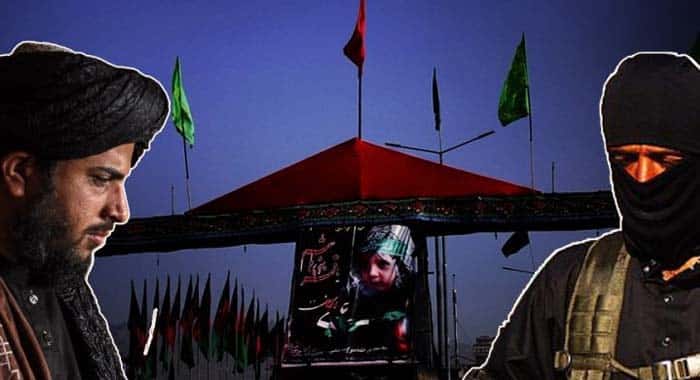
Reports emerging during the first ten days of Muharram in Afghanistan indicate that restrictions were imposed on Shia religious ceremonies and Ashura observances, with reports of the removal or confiscation of symbols associated with Muharram from certain public spaces, particularly in major cities including Kabul, Herat, Ghazni, and Mazar-e Sharif.
The reported measures have triggered widespread criticism and concern among members of the Shia community, religious observers, political figures, and human rights advocates, who have described the restrictions as unjustified limitations on religious practices and freedom of expression.
The Taliban authorities have reportedly justified these actions on security grounds, citing concerns over potential attacks by Islamic State Khorasan Province (ISKP) during Muharram gatherings. However, analysts argue that the central issue is not only whether a threat exists, but also how that threat is defined, constructed, and used to justify decisions that affect religious and social life.
According to the framework of critical security studies, particularly the Copenhagen School approach, “securitization” refers to the process through which an issue is transformed from an ordinary political or social matter into an existential security threat, allowing extraordinary measures beyond normal administrative practices.
From this perspective, observers question whether the Taliban’s approach has remained focused on managing genuine security risks or whether religious rituals and symbols are increasingly being absorbed into a broader security narrative.
Security experts explain that if the threat from ISKP is considered the primary concern, security policies would typically focus on reducing operational vulnerabilities. Such measures generally include enhanced protection of religious sites, controlled access routes, coordination with event organizers, management of gatherings, and improved emergency response mechanisms.
However, analysts argue that restrictions extending beyond security arrangements particularly those targeting religious symbols and public expressions represent a broader shift in the logic of security governance. They claim that the issue has moved from preventing attacks toward regulating religious identity and public presence.
The Taliban have repeatedly highlighted the threat posed by ISKP during Muharram. At the same time, since returning to power in 2021, the Taliban have repeatedly claimed that ISKP has been eliminated or does not pose a significant threat inside Afghanistan. Analysts and security experts, however, point to continued attacks attributed to ISKP as evidence that the group remains an active security challenge.
Observers have also noted that several attacks against the Hazara community between 2002 and 2021, while sometimes attributed to ISKP, have also been the subject of wider debate regarding the involvement or responsibility of other armed actors, including Taliban elements.
At the same time, Taliban members have historically criticized Muharram mourning ceremonies based on ideological and religious differences, with some describing such practices as unacceptable innovations. Analysts argue that this position has become increasingly visible through restrictions reportedly imposed on Shia religious gatherings.
According to findings published by the Bolaq Analysts Network in 2023, the Taliban permitted only a limited number of mosques and Husseiniyas in Kabul to conduct Muharram ceremonies, despite the existence of numerous religious centers across the city. Reported restrictions included prohibitions on holding ceremonies outside mosques and Husseiniyas, restrictions on loudspeakers, and limitations on participation by Sunni followers.
Similar restrictions were reportedly observed during Muharram ceremonies in 2024 and 2025, leading to reactions from Shia communities, political figures, and human rights organizations.
This year, however, observers described the reported restrictions as more severe than previous years. In addition to limiting venues for ceremonies, reports indicated that Taliban authorities restricted the public display of traditional Ashura symbols across parts of Afghanistan.
Reports further claimed that individuals displaying mourning symbols, including flags and saqakhanas (traditional water-distribution points), were detained. Some reports also alleged that individuals who attempted to approach officials to seek the release of detainees were themselves arrested or threatened.
Analysts argue that when restrictions move beyond direct security management and enter the area of cultural symbols, the nature of securitization changes. In this situation, security becomes not only a mechanism for preventing violence but also a tool that influences public space, identity, and social expression.
Security researchers describe this as “over-securitization” a situation where security logic expands into areas that do not represent direct threats but are redefined as security concerns.
Experts warn that one major consequence of such policies is the increase of perceived insecurity among affected communities. This form of insecurity extends beyond physical danger and includes fears related to identity, traditions, symbols, and social belonging.
Analysts further state that when security policies are perceived as targeting a particular religious group, the distinction between protection and restriction becomes blurred. As a result, public trust and cooperation may decline, weakening the effectiveness of security measures themselves.
Researchers also highlight the possibility of what security studies describe as the “security paradox” where policies intended to reduce threats may unintentionally create new social and psychological tensions, contributing to instability rather than reducing it.
This issue becomes particularly important in diverse societies where ethnic and religious identities carry deep historical and cultural significance. Political sociologists emphasize that religious symbols are not merely ritual objects but represent collective memory, historical experiences, and community identity.
Therefore, interventions affecting religious symbols may have consequences beyond law enforcement, including increased social divisions, weakened community relationships, and the strengthening of protest narratives.
From the perspective of security governance, experts emphasize the need to maintain a balance between addressing genuine threats and preserving religious and cultural pluralism. Comparative experiences suggest that sustainable security depends on distinguishing between actual security risks and social or cultural practices.
Observers further argue that the Taliban’s relationship with Afghanistan’s Hazara and Shia communities has historically remained complex, influenced by ideological, religious, and ethnic tensions. They suggest that current restrictions represent not an isolated administrative decision but part of a broader approach toward governance, identity, and social control.
The central challenge, analysts conclude, is not denying the existence of security threats but ensuring that responses to those threats do not transform security mechanisms into tools for restricting religious freedoms and redefining social identities.
A sustainable path toward stability, according to observers, requires security policies that protect civilians, respect diversity, and strengthen trust among all communities in Afghanistan.



