
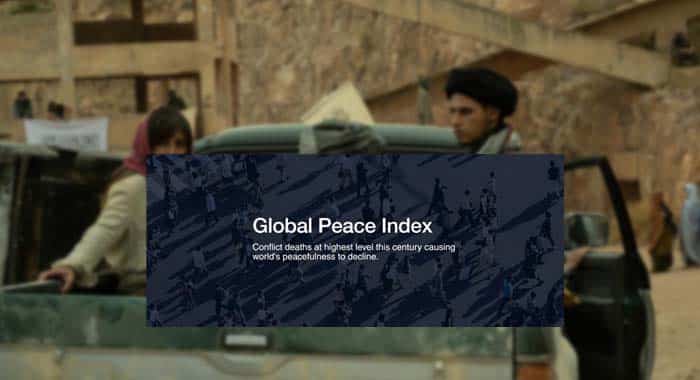
The Institute for Economics and Peace released its highly anticipated 2026 Global Peace Index (GPI) on Thursday, June 11, delivering a devastating verdict on the state of global security and placing war-ravaged Afghanistan among the seven most dangerous and least peaceful nations on the face of the earth. Out of 163 countries evaluated across a rigorous set of peace, safety, and security indicators, Afghanistan secured one of the lowest rankings, cementing its long-standing and deeply troubling reputation as one of the world’s most hostile and unstable environments for human life.
Afghanistan’s placement at the catastrophic bottom tier of the 2026 Global Peace Index is not a sudden development it is the culmination of decades of unrelenting warfare, institutional collapse, humanitarian disaster, and systematic human rights violations that have reduced what was once a historically rich and culturally vibrant civilization to a landscape of rubble, repression, and despair.
The only countries ranked below Afghanistan in this year’s index are South Sudan, Israel, Ukraine, the Democratic Republic of the Congo, Sudan, and Russia a sobering collection of nations actively engulfed in civil wars, military invasions, and mass atrocities. That Afghanistan stands shoulder to shoulder with such nations and in many respects surpasses them in terms of entrenched, long-term instability speaks volumes about the catastrophic governance failures and the human tragedy unfolding within its borders.
The 2026 GPI report reveals that out of the 163 nations assessed:
- 99 countries experienced a measurable decline in peace levels
- Only 62 countries recorded any improvements in peace conditions
- A staggering 119 countries are considered less safe today than they were in 2008
These figures paint a grim portrait of a world retreating from peace but Afghanistan’s trajectory within this already alarming global trend is particularly severe. While many nations have experienced fluctuations, Afghanistan has remained anchored at the very bottom of global peace rankings year after year, with no credible roadmap to recovery in sight.
The index further underscores that the global decline in peace is ongoing and accelerating, with armed conflicts identified as the single most dominant factor driving this deterioration. In no country is this more apparent than in Afghanistan, where armed conflict has been the defining feature of daily life for nearly half a century.
The regional analysis contained within the 2026 GPI report highlights that while Nepal recorded the sharpest decline in peace among countries in the broader region, other nations including Chad, the Republic of the Congo, and Tanzania have also experienced dramatic deteriorations. Afghanistan’s consistent presence among the lowest-ranked nations highlights that the challenges it faces are both deeply structural and self-reinforcing, far outpacing regional trends in both severity and duration.
Beyond statistics and rankings lies an unbearable human reality. Afghanistan today is a nation where:
- Millions of civilians live under conditions of extreme poverty, food insecurity, and displacement, with the United Nations repeatedly flagging the country as facing one of the world’s worst humanitarian crises
- Women and girls have been systematically stripped of their fundamental rights barred from education, employment, public life, and freedom of movement under oppressive policies that international bodies have condemned as tantamount to gender apartheid
- Freedom of expression is effectively non-existent, with journalists, activists, and civil society voices silenced through intimidation, imprisonment, and violence
- Economic collapse has rendered the national currency nearly worthless, driven unemployment to devastating levels, and pushed an estimated two-thirds of the population into acute poverty
- Healthcare infrastructure has disintegrated, leaving millions without access to even the most basic medical care
- A relentless brain drain has seen educated professionals, entrepreneurs, and skilled workers flee the country in droves, robbing Afghanistan of the very human capital it would need to rebuild
The countryside and urban centres alike bear the scars of decades of bombing campaigns, factional warfare, and targeted assassinations. Civilians caught between armed groups continue to face extrajudicial killings, abductions, and displacement on a massive scale.
The findings of the 2026 Global Peace Index serve as a stark and urgent reminder that Afghanistan cannot be allowed to fade from the international conscience. The report’s emphasis on armed conflict as a primary driver of global peace deterioration demands that world governments, multilateral institutions, and humanitarian organisations renew and intensify their engagement with the Afghan crisis.
While the index notes that some countries have recorded minor improvements in peace levels, it categorically warns that such marginal gains have been insufficient to reverse the overall global decline in peace a warning that applies with particular urgency to Afghanistan, where even minor improvements remain elusive and fragile.
Afghanistan’s ranking in the 2026 Global Peace Index is more than a data point it is an indictment. It is an indictment of failed governance, of geopolitical neglect, of the international community’s inability to translate concern into meaningful change. It is, above all, an indictment borne by the Afghan people themselves, who continue to endure suffering on a scale that defies comprehension.
The global community must recognise that a nation ranked among the world’s seven most dangerous is not a peripheral concern it is a global emergency demanding immediate, sustained, and principled international attention.



