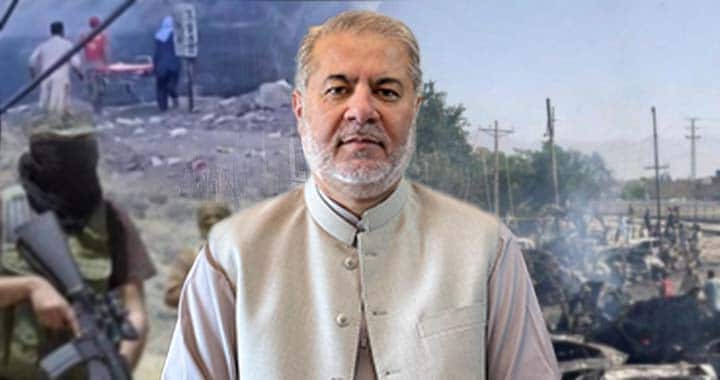
(Mushtaq Yusufzai)
The attack on the Jaffer Express before Eid was not merely another terrorist incident in Pakistan’s long and painful history of violence. It was a calculated message. A message written in blood, fear, and timing. Once again, ordinary Pakistanis travelling to celebrate Eid with their families became soft targets in a conflict that has now entered a far more dangerous phase.
For years, the Jaffer Express route has remained vulnerable. Yet every time such an attack occurs, the national response follows a predictable pattern: condemnation, promises of action, intelligence alerts, funerals, and then silence until the next tragedy. But this latest attack demands a more serious national conversation because it reveals something deeper than a security lapse. It exposes the return of organised militant planning, the failure of governance in conflict-hit regions, and the widening disconnect between the Pakistani state and its citizens.
The most disturbing reality is not merely that terrorists managed to strike again. The real concern is how accurately they planned the attack, how confidently they executed it, and how deeply they understood the movement of their targets.
Passenger transport systems anywhere in the world are vulnerable. Buses, trains, schools, and public spaces are soft targets because they cannot function like military compounds. But the Jaffer Express attack was not random violence. It was intelligence-based terrorism. It required surveillance, coordination, logistics, explosives, reconnaissance, and most importantly, insider information.
The attackers reportedly used around 35 kilograms of explosives planted inside a vehicle parked near the railway station area. According to initial information, they waited for buses carrying passengers travelling onward for Eid. The moment the buses approached, the explosives were detonated. One bus was destroyed completely while surrounding vehicles, nearby flats, and civilians also suffered devastating damage.
This was not an operation planned in a few hours.
Such attacks require safe houses, handlers, financial support, transportation networks, reconnaissance visits, communication channels, and logistical preparation. Someone had to know the route, the timing, the passenger movement, and the vulnerability points. Someone had to identify where the buses would stop and how security could be bypassed. This level of coordination indicates that militant networks are not scattered remnants anymore; they are reorganising with sophistication.
And this is precisely where Pakistan faces its biggest challenge.
The state often focuses on eliminating militants physically, but militancy does not survive merely through weapons. It survives through networks, local facilitators, ideological narratives, fear, and governance failures. When information from within society starts reaching armed groups, security operations alone become insufficient.
Pakistan has fought terrorism for decades. Thousands of soldiers, policemen, journalists, tribal elders, and civilians have sacrificed their lives. Entire regions in Khyber Pakhtunkhwa and the tribal districts witnessed military operations that dismantled organised militant infrastructure. Yet today, the resurgence of violence suggests that military success was not matched with long-term political and governance reforms.
This is especially visible in Balochistan.
The tragedy of Balochistan is that it remains Pakistan’s richest province in resources but one of the poorest in governance indicators. Roads remain broken, unemployment remains high, educational opportunities remain limited, and political alienation continues to grow. Militant organisations exploit these frustrations. They present themselves as defenders of deprived populations even when their methods are brutal, criminal, and anti-human.
Groups like the Baloch Liberation Army have repeatedly targeted civilians, workers, passengers, and labourers. In previous incidents, passengers travelling through Balochistan were stopped, identity cards checked, and individuals belonging to Punjab singled out and murdered. Such attacks are not acts of resistance; they are acts of terrorism designed to spread ethnic fear and national division.
Targeting civilians can never be justified politically, morally, or religiously.
Islam explicitly forbids the killing of women, children, elderly people, and non-combatants. Even during warfare, Islamic teachings prohibit harm to innocent civilians and destruction of civilian life. Therefore, any organisation claiming legitimacy while targeting unarmed passengers stands outside both morality and faith. But condemning terrorism alone is not enough. Pakistan must ask difficult questions about why militant recruitment and facilitation continue to exist.
One cannot ignore the geopolitical dimensions surrounding Pakistan’s security environment. Insurgencies are expensive enterprises. Militancy requires money, communication systems, weapons, transport, and propaganda machinery. No armed movement sustains itself for years without external financial channels and strategic support. Pakistan has repeatedly alleged foreign involvement in destabilising activities, particularly from hostile intelligence networks seeking to disrupt projects linked to Gwadar and regional connectivity.
The strategic significance of Gwadar has transformed Balochistan into a geopolitical battleground. Pakistan’s partnership with China through the China-Pakistan Economic Corridor has unsettled several regional and international actors who view Pakistan’s growing strategic relevance with suspicion. At the same time, Pakistan’s evolving diplomatic role in regional negotiations including sensitive backchannel engagements involving Iran and the United States has added another layer of complexity to its security landscape. Whenever states become strategically important, they also become vulnerable to proxy conflicts.
However, blaming foreign hands alone would be dangerously simplistic.
External actors can exploit instability, but they cannot manufacture instability where governance is strong, institutions are trusted, and citizens feel represented. Pakistan’s internal weaknesses create openings that hostile actors exploit. The real battle, therefore, is not only at the borders but within the state structure itself.
One of Pakistan’s biggest failures has been the inability to bridge the gap between the people and the governing system. In many remote districts, citizens feel abandoned by politicians, neglected by bureaucracy, and disconnected from state institutions. Development funds disappear, projects remain incomplete, and public service delivery collapses under corruption and inefficiency.
This vacuum becomes fertile ground for militant narratives.
When a young unemployed man sees no opportunity, no justice, and no access to power, extremist organisations step in with slogans of dignity, nationalism, revenge, or religion. Some groups manipulate ethnic grievances; others manipulate religious sentiment. But the pattern remains the same: they exploit deprivation and alienation. Pakistan’s political leadership must understand that counterterrorism is not merely a military exercise. It is fundamentally a governance challenge.
Security forces can clear territory, but only governance can hold it. For too long, civilian administrations have treated security as someone else’s responsibility while failing to deliver education, healthcare, jobs, local representation, and justice. The burden cannot remain solely on soldiers and policemen while politicians continue power struggles in Islamabad and provincial capitals.
The bureaucracy also bears enormous responsibility. One of the most painful realities in Pakistan is the growing distance between public servants and the public itself. Officials who are supposed to serve citizens often become inaccessible behind protocols, vehicles, offices, and administrative barriers. Ordinary people cannot reach decision-makers. Complaints remain unresolved. Frustrations accumulate silently until they are weaponised by extremists.
This disconnect is dangerous.
No counterinsurgency strategy succeeds when citizens stop trusting the state emotionally. Nations are not held together merely through force; they survive through legitimacy and inclusion. Pakistan also needs to rethink its communication strategy regarding terrorism. Every major attack now immediately triggers competing narratives on social media: propaganda videos, misinformation campaigns, ethnic polarisation, and conspiracy theories. Militant groups understand the power of psychological warfare. Their objective is not only to kill people but to create hopelessness and distrust within society.
Unfortunately, Pakistan often responds reactively rather than strategically. A serious national counterterrorism framework must combine intelligence coordination, cyber monitoring, local policing reforms, economic inclusion, political dialogue, and regional diplomacy. There must also be greater investment in community-based intelligence systems because local populations are the first line of defence against militancy.
Dialogue, despite being unpopular in emotionally charged moments, remains essential. Not everyone carrying anger against the state is irreconcilable. Many communities simply want dignity, participation, development, and justice. The state must separate hardcore terrorists from politically alienated populations. Genuine grievances should be addressed politically, while violent actors funded for destabilisation must face decisive action.
History shows that no conflict is solved entirely through bullets. Even globally, successful counterinsurgency models relied on political engagement alongside security operations. Pakistan itself witnessed how dialogue with tribal elders, local communities, and political stakeholders often produced more durable peace than force alone.
However, dialogue must not be confused with weakness. There are armed actors whose agenda is not reform but destruction. Those involved in attacks on civilians, women, and children cannot be romanticised under any political slogan. The state has both the right and obligation to protect innocent lives.
What Pakistan urgently requires is clarity.
Clarity that terrorism in all forms is unacceptable.
Clarity that governance failures are national security failures.
Clarity that ethnic hatred will destroy the federation from within.
Clarity that deprived citizens deserve justice before militants exploit them.
And clarity that security cannot be outsourced solely to the military while civilian institutions remain dysfunctional.
The attack on the Jaffer Express before Eid should become a national turning point. If it is treated merely as another isolated incident, Pakistan will continue moving in circles — mourning victims, issuing condemnations, and waiting for the next attack. The country has already paid too high a price for complacency.
Behind every bombing statistic is a family that never reached home for Eid. Behind every destroyed bus is a child waiting for a father who will never return. Behind every funeral is a nation slowly becoming emotionally numb to tragedy. That numbness may be the most dangerous outcome of all.
Pakistan cannot afford another decade where terrorism becomes routine and governance failures become normalised. The battle against militancy will not be won only in mountains, checkpoints, or intelligence operations. It will be won when citizens believe the state belongs to them, listens to them, and protects them equally.
Until then, trains will continue carrying not only passengers but also the fear that someone, somewhere, is already planning the next explosion.