
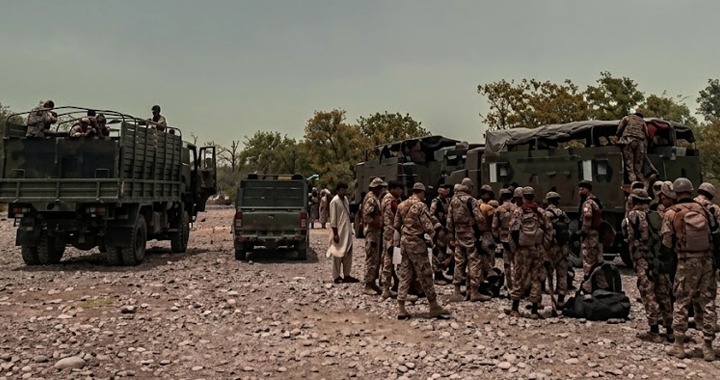
Security sources have stated that the Indian-backed terrorist network referred to as “Fitna-al-Hindustan” has suffered significant operational losses following the reported failure of its so-called “Operation Herof 2.0,” launched on January 31, 2026, with the alleged objective of projecting control and influence across Balochistan.
According to security officials and informed sources, the operation has largely collapsed under sustained counterterrorism pressure from Pakistani security forces, resulting in the deaths of more than 600 terrorists so far this year, including several high-profile commanders associated with militant activities in the province.Sources claim that during the failed “Herof 2.0” campaign alone, at least 344 terrorists were killed and hundreds more injured in a series of intelligence-based operations (IBOs) carried out across multiple districts of Balochistan.
Officials say security forces have significantly increased the frequency and scale of intelligence-led operations throughout the province, with more than 200 intelligence-based operations reportedly being conducted daily to dismantle militant infrastructure, disrupt logistical networks, and prevent attacks on civilians and state institutions.
According to the latest reports, over 45 terrorists were killed during operations conducted in the past two days alone. Security authorities maintain that the operations are part of a broader counterterrorism strategy aimed at neutralizing militant safe havens and restoring long-term stability in Balochistan.
Among the most notable militant figures reportedly eliminated this year are:
- Saqib Marri alias “Shaida” — killed on February 2
- Naeem alias “Doctor” — killed on March 5
- Suhail Baloch alias “Gurg Baloch” — killed on March 17
- Mehran Lashari — killed on April 25
- Sangat Salal alias “Major Nora” — killed on May 2
Security officials describe these individuals as highly wanted commanders allegedly involved in orchestrating attacks on civilians, security personnel, and infrastructure projects in the province.
Following the reported collapse of “Operation Herof 2.0,” sources indicate that terrorist groups have increasingly shifted toward “hit-and-run” tactics, targeting soft civilian objectives rather than engaging in sustained armed confrontations.
Officials state that Balochistan’s vast geography, sparse population density, and long transportation corridors create operational challenges that militant groups attempt to exploit. Militants reportedly move disguised as shepherds or ordinary civilians, use unconventional routes, and blend into local populations to evade detection.
Security analysts say these groups frequently record small-scale attacks and amplify them on social media platforms to create the perception of operational success despite suffering heavy battlefield losses. “Much of the campaign now revolves around propaganda and psychological operations rather than tangible strategic gains,” one security source stated.
Authorities further allege that, after failing to achieve broader operational objectives, militant groups have increasingly turned toward attacks on vulnerable civilian and economic targets, including the burning of cargo trucks, bank robberies, kidnappings of laborers, and attacks on commercial activity. Sources also claim that the groups have become involved in the abduction of Baloch citizens, citing the recent kidnapping of the Vice Chancellor of Gwadar University as part of a growing pattern of intimidation and coercion.
Officials describe these activities as “anti-public” and “anti-development,” arguing that such attacks are undermining economic progress, regional connectivity, and public confidence in militant narratives. According to officials and local observers, public sentiment in Balochistan has increasingly shifted against militant organizations due to continued violence targeting civilians, workers, and public infrastructure.
Security sources point to growing participation in state-supported initiatives, public rallies, and community programs in favor of Pakistan and regional development as evidence that local communities are rejecting extremist violence and criminal intimidation.
“The people of Balochistan are increasingly distancing themselves from these violent elements and foreign-backed proxies,” a source familiar with the security situation said. Officials further linked the ongoing information and propaganda campaigns against Pakistan to broader geopolitical developments, arguing that Pakistan’s increasing diplomatic relevance in the region has unsettled hostile external actors.
According to security assessments, anti-Pakistan media campaigns and coordinated narratives are being used alongside proxy militant groups such as “Fitna-al-Hindustan” and “Fitna-al-Khawarij” to create instability and internal unrest. Despite these challenges, security officials reaffirmed that Pakistan’s armed forces and law enforcement agencies remain fully prepared to counter all threats to national security.
“State institutions are fully aware of the designs of hostile elements and remain committed to bringing all anti-state actors to justice,” officials stated.



