
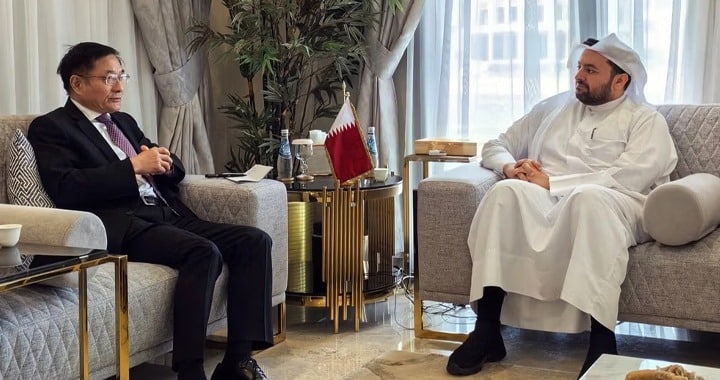
China and Qatar have stepped up diplomatic engagement aimed at reducing escalating tensions between the Afghan Taliban and Pakistan amid a sharp rise in militant violence along the Pakistan-Afghanistan border region, according to diplomatic sources and official statements released this week.
Chinese Special Envoy for Afghanistan, Yue Xiaoyong, held separate high-level meetings in Doha with Qatari Minister of State for Foreign Affairs Mohammed bin Abdulaziz Al Khulaifi and Suhail Shaheen, the Taliban’s representative in Qatar, to discuss the deteriorating regional security environment, developments in Afghanistan, and efforts to preserve stability through dialogue and diplomacy.
According to a statement issued Friday by Qatar’s Ministry of Foreign Affairs, discussions between Al Khulaifi and the Chinese envoy focused on recent political and security developments in Afghanistan and the importance of strengthening coordinated international efforts to support peace, security, and regional cooperation.
The Qatari official emphasized the urgent need for peaceful engagement between Pakistan and the Taliban administration in Kabul, stressing that diplomatic channels remain essential to preventing further instability in the region. “The importance of resolving tensions through peaceful means and reinforcing regional peace and stability was underscored during the meeting,” the statement noted.
The Chinese envoy similarly highlighted ongoing diplomatic efforts aimed at reducing friction between Islamabad and Kabul, reaffirming Beijing’s support for dialogue-based conflict resolution mechanisms. The latest diplomatic engagements come as China continues to position itself as a key regional mediator between Pakistan and the Taliban administration. In April 2026, Beijing hosted informal talks between representatives of both sides in the western Chinese city of Urumqi in an attempt to de-escalate mounting tensions.
Although the negotiations concluded without a formal agreement, Chinese officials described the Urumqi discussions as a constructive framework for future engagement and confidence-building between the two neighboring sides. Earlier this week, Yue Xiaoyong visited Kabul and met Afghan Foreign Minister Amir Khan Muttaqi, where both sides reportedly reviewed the progress of the Urumqi process and discussed mechanisms for sustaining diplomatic communication despite rising security concerns.
Writing on X following the meeting, the Chinese envoy stated that both sides viewed the Urumqi process positively and expressed readiness to work collectively for “regional peace, security, and development.” Diplomatic observers say China’s growing involvement reflects Beijing’s increasing strategic concerns regarding regional instability, border security, trade connectivity, and the broader implications of militant violence on regional economic initiatives.
Yue Xiaoyong also held talks with Suhail Shaheen, the Taliban’s envoy in Doha, where discussions reportedly focused on bilateral relations between Afghanistan and China, political developments, economic cooperation, and Chinese humanitarian assistance to Afghanistan. In a statement, the Taliban embassy in Qatar said both parties exchanged views on strengthening diplomatic and economic ties while also discussing broader regional developments. The Chinese envoy later stated that he was encouraged to see Afghanistan’s regional engagement expanding despite ongoing political and security challenges.
The renewed diplomatic activity comes at a time of increasing militant attacks inside Pakistan’s tribal districts, particularly in Khyber Pakhtunkhwa province, where Tehreek-e-Taliban Pakistan (TTP) militants have intensified operations in recent weeks.
Among the deadliest incidents was a suicide bombing and armed assault in Bannu on 9 May, followed by another attack in Bajaur. Pakistani authorities say the attacks have raised serious concerns regarding the future of ongoing negotiations and regional security cooperation. Islamabad has repeatedly accused the Afghan Taliban administration of providing sanctuary to militant groups operating against Pakistan, including the TTP allegations consistently denied by Taliban officials.
The deteriorating security environment has further strained diplomatic relations between the two sides. On 29 April, the Taliban administration summoned Pakistan’s chargé d’affaires in Kabul over bilateral concerns, while Pakistan has repeatedly summoned Taliban representatives in Islamabad, including following the Bannu attack that reportedly killed 15 police officers. Pakistan’s Foreign Ministry spokesperson declined this week to elaborate on the future of the Urumqi dialogue process when questioned by reporters, fueling speculation over the uncertainty surrounding ongoing diplomatic initiatives.
Security analysts warn that continued tensions between Pakistan and the Taliban administration could have far-reaching consequences for regional stability, border security, counterterrorism coordination, and economic integration efforts across South and Central Asia.
With China and Qatar increasingly engaged in diplomatic mediation, regional observers believe the coming weeks may prove critical in determining whether dialogue can prevail over confrontation.



