
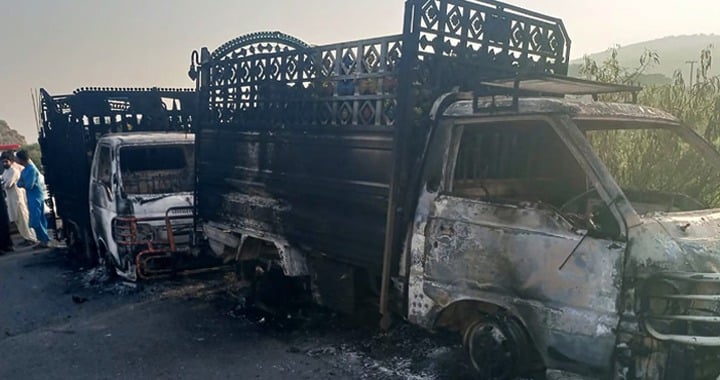
Bajaur district, already under pressure from rising India-sponsored and Afghan-backed terrorist threats from within and across the border, witnessed another attack on civilians after terrorists opened fire on two vehicles and set them ablaze in the troubled tribal region, sources said.
According to sources, the attack took place in the Zarmandari area of Bajaur, where terrorists targeted two vehicles transporting vegetables, fruit and wood.
As a result of the firing, two individuals identified as Shahabuddin and Azeemullah sustained serious injuries.
Sources said the attackers later set both vehicles on fire before fleeing the area.
Security forces swiftly cordoned off the area and launched a search operation to trace the fleeing terrorists.
The latest attack comes amid a surge in violence in Bajaur, where terrorists have recently intensified attacks on civilians, security forces and border communities.
In a recent incident, a major disaster was averted after the Bomb Disposal Squad of Bajaur police recovered and neutralized explosive materials planted by terrorists in the Taranano area of Salarzai tehsil.
Similarly, terrorists recently attacked Police Post Badam-2, injuring an Elite Force constable, while a returning police convoy also came under heavy fire in a second assault.
Bajaur has also witnessed repeated cross-border aggression in recent days.
In the Katkot area, cross-border shelling struck civilian homes, martyring three members of a family, including two children, and injuring several others.
The security environment in the district has become more complicated with the presence of multiple terrorist actors.
The regional branch of Islamic State Khorasan Province (ISKP) has recently claimed responsibility for target killings in Bajaur, while the banned Tehreek-e-Taliban Pakistan (TTP), also referred to as Fitna al-Khwarij, remains active in the area.
The situation gets even more complex as security sources recently recovered bodies of Afghan terrorists from border areas of Bajaur months after cross-border operations, indicating continued infiltration attempts and the presence of foreign-origin fighters.
Security analysts also point to emerging tactical patterns in the region, including the misuse of mosques by terrorists as operational cover. Such practices are aimed at securing shelter, influencing local sentiment, and complicating counterterror responses by exploiting religious sensitivities.
Another factor worsening the picture is internal infighting among terrorist factions in Bajaur’s Wara Mamund area near the border, where disputes between Afghan-origin and locally based terrorists have reportedly escalated, adding to instability in the already volatile district.



