
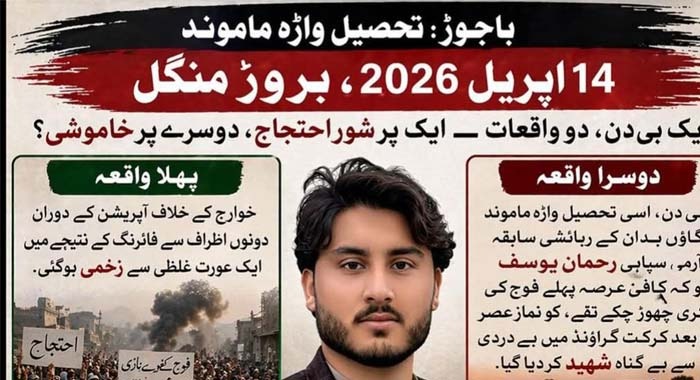
There is something unsettling about silence when it chooses its moments. Not the peaceful kind, but the selective kind, the kind that speaks louder than slogans ever could.
In Bajaur District, a troubling contradiction has surfaced, one that cuts deeper than the immediate tragedy. A woman injured during an ongoing operation becomes the rallying point for protests, amplified and weaponized to demand a halt to counterterror efforts. Yet, when a former soldier, a son of the same soil, is brutally martyred, the streets fall eerily quiet. No chants. No outrage. No reckoning.
This is not just a contradiction; it is a fracture in moral clarity.
Pakistan today stands at a critical crossroads. On one side, it is engaged in an unrelenting fight against terrorism, particularly threats emanating from across the border in Afghanistan, where safe havens continue to challenge regional peace. On the other, it is playing a delicate and increasingly vital role in easing tensions in a volatile region, especially amid the shadowboxing between United States and Iran.
The stakes are enormous. The region resembles a coiled spring, every move, every signal, every misstep carrying the potential to spiral into a wider conflict. In such a moment, Pakistan’s efforts are not merely national, they are global in consequence. It is attempting to steady both its internal front and contribute to external de-escalation, a balancing act that demands unity at home.
And yet, this is precisely where the fault lines appear.
When protests are orchestrated to stall operations against terrorists, especially under the influence or narrative of elements like the so-called “Fitna al-Khwarij,” it does more than delay tactical progress. It chips away at collective resolve. It sends a fragmented message, both internally and to the world, that consensus against terrorism is negotiable, conditional, even selective.
A Nation Tested by Its Own Echoes
The real battle, then, is not only against those who carry out acts of terror. It is also against the quiet justifications, the selective outrage, and the dangerous ambivalence that allow such elements to breathe.
National unity cannot be situational. Grief cannot be selective. Justice cannot be partisan.
If the loss of an innocent civilian rightfully stirs conscience, so must the martyrdom of a soldier who stood between chaos and order. If one tragedy demands protest, the other demands at least equal, if not greater, resolve.
The people of Bajaur, and indeed all of Pakistan, face a defining choice. To stand divided by narratives that serve hidden hands, or to rise above and present an unambiguous front against terrorism in all its forms.
Because peace is not built merely by operations on the ground. It is built in the hearts of people who refuse to let hypocrisy dictate their response.
And in times like these, unity is not just a virtue. It is a necessity, almost a shield, against forces that thrive on division.



