
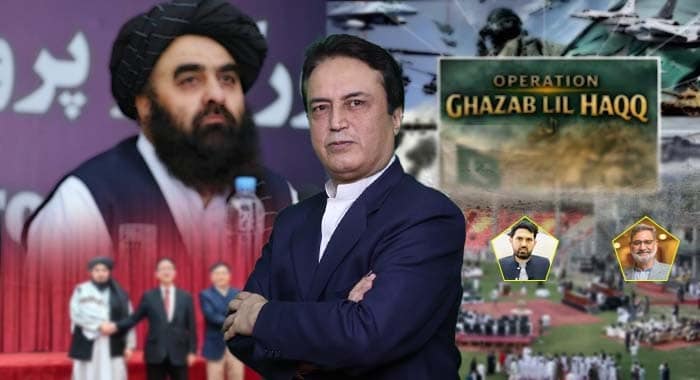
The Pak-Afghan struggle is ongoing, and in the meantime, we are witnessing misguided and contradictory statements from the Afghan Taliban.
On one hand, Afghanistan’s acting foreign minister, Ameer Khan Muttaqi, has expressed concern over the threat of a dangerous war in the region. He has spoken of peace talks, a complete ceasefire, and the need for dialogue between Pakistan and Afghanistan. On the other hand, Noorullah Noori, another senior Taliban minister, has alleged that foreign intelligence agencies are interfering in Afghanistan’s internal affairs and destabilizing the country. He has also launched criticism against opposition and anti-Taliban groups, both inside Afghanistan and abroad.
As far as I see it, Ameer Khan Muttaqi appears to be one of the more rational figures among the officials and ministers of the Islamic Emirate of Afghanistan, especially when compared to former commanders and hardline elements who often use harsh and inflammatory language while speaking on local, regional and international matters.
At a recent event, Muttaqi said there should be a permanent ceasefire and no war between Pakistan and Afghanistan. He emphasized the need for dialogue between the two neighboring countries. I listened carefully to his speech. He was speaking in the language of peace. He said Afghanistan wants to maintain friendly relations with all of its neighbors for the sake of peacebuilding and regional stability.
This, in my view, is a rational statement.
As foreign minister, he occupies a responsible office. Naturally, he is expected to speak of peace rather than conflict. He understands that if there is no permanent ceasefire, and if Pakistan and Afghanistan move towards confrontation instead of dialogue, then both sides will suffer losses.
When such responsible Afghan officials speak of the risk of war, their words reflect deeper realities. Their objective, at least in such statements, appears to be moving towards peace.
However, to understand these statements, one must understand the various factions within the Islamic Emirate.
The Islamic Emirate did not emerge as a monolithic organization. It began with a limited group, but over time expanded to include multiple factions, former jihadist commanders, fighters who battled Soviet forces, and later those who fought against the United States and NATO. Many of these individuals have spent decades on the battlefield.
This internal composition creates pressure within the Afghan Taliban government.
Certain elements within the Tehreek-e-Taliban Afghanistan and associated circles tell the Islamic Emirate leadership that Pakistan is bombing Afghan territory, that civilians are being killed, and that the Afghan government must respond instead of continuing what critics call a policy of compromise.
At the same time, sporadic incidents continue on the border. We saw clashes just last week. Tensions remain alive across the Durand Line. Security personnel on both sides remain on high alert. Afghan Taliban forces are deployed, and the Pakistani military is also fully alert.
Any major incident can trigger a wider conflict.
This is why some within the Afghan Taliban warn of a large-scale war.
The Islamic Emirate’s security personnel are also under pressure from hardliners to abandon compromise. These are people who have fought for years. They negotiated with the United States in Qatar, but at their core many remain warriors shaped by war rather than diplomacy.
That is why they often issue harsh statements, partly to address the sentiments of their own supporters.
This is where the contradiction becomes obvious.
On one side, Ameer Khan Muttaqi speaks of peace and ceasefire. On the other, figures like Noorullah Noori deliver lengthy interviews filled with harsh accusations.
In his interview, Noorullah Noori accused Pakistan of repeatedly raising the Durand Line issue to pressure the Islamic Emirate and create a war-like environment.
In the last few weeks, there has been intense debate inside Afghanistan over the Durand Line.
Mullah Yaqoob, the defence minister and son of Mullah Omar, has previously said the issue should not be raised with the Islamic Emirate, nor should Afghans or Pakistanis debate it for now. He suggested leaving it to time and to the people living across the border.
Noorullah Noori has echoed similar sentiments in the past.
At the same time, Taliban officials are now alleging infiltration by foreign intelligence agencies. They claim the United Nations is refusing to grant them proper recognition while accusing Afghanistan of hosting 22 terrorist organizations, including Al-Qaeda and Daesh.
They also allege that anti-Taliban groups such as the Afghan National Resistance Front are being facilitated abroad, in places like Dubai and elsewhere, to foment rebellion.
Whether these claims are true or exaggerated is another debate.
But one thing is clear: Afghanistan today appears to be a battlefield not only for armed groups, but also for intelligence agencies and competing narratives.
Afghan intelligence, through its Grand Directorate of Intelligence, may believe that foreign agencies are working to destabilize the Islamic Emirate. And in the world of clandestine operations, such contests are not uncommon.
The Taliban leadership now openly says Afghanistan is being destabilized and weakened.
Recent attacks on Shia communities and other targeted incidents inside Afghanistan have further reinforced this narrative.
Taliban officials even accuse certain institutions and foreign actors of engineering instability.
But here lies the most important question: if Afghanistan’s rulers believe instability in their country will create wider regional losses, then what practical steps are they taking to prevent that instability?
Do they have a way out?
If Pakistan repeatedly tells them that Afghan soil is being used against Pakistan, then the Islamic Emirate must convincingly prove otherwise.
According to information coming from across the border, the Taliban have established a Reform Commission. This commission is reportedly working on disciplining or mainstreaming elements, including Afghan Taliban fighters who cooperate with TTP terrorists in attacks inside Pakistan.
There are also reports that Afghan security personnel have acted against such elements and taken some into custody.
If true, this would show that at least some corrective efforts are underway.
So, these are multi-faceted issues.
Afghanistan has spent the last two decades under war and foreign occupation. The situation remains fluid. Afghanistan’s internal stability remains fragile, and the security concerns of neighboring countries, especially Pakistan, are real and separate.
I believe that if the Islamic Emirate moves forward with a collective, thoughtful and responsible approach, it can address the concerns of the international community and reduce the security concerns of its neighbors, especially Pakistan.
Now coming to the second issue, I did not understand the logic behind the public assembly in Peshawar.
The public rejected it completely.
I applaud the people of Khyber Pakhtunkhwa and Peshawar for ignoring what appeared to be nothing more than a political stunt by PTI.
What was the need for shifting the assembly session to a stadium when the provincial assembly building already exists in Peshawar with proper halls and facilities?
The apparent purpose was to create a spectacle, to fill the galleries and project an image of massive public support before the world.
But the public did not come.
Even according to reports, only a few individuals came with personal issues to present before lawmakers. Students were allegedly brought in from colleges and universities to fill empty seats, yet many left after waiting for hours.
This gathering failed.
In my view, the Speaker of the Khyber Pakhtunkhwa Assembly, Babar Saleem Swati, should be held accountable.
An assembly has sanctity. It has decorum. The speaker is the custodian of the house.
If he fails in protecting that sanctity and allows the house to become a stage for political theatre, then serious questions arise regarding his fitness for office.
Large sums were reportedly spent. Thousands of police personnel were deployed. Chairs were moved. air conditioners and fans were installed in open grounds.
The question is: was this public service or self-promotion?
At a time when public representatives should focus on serving the people, they appear more interested in comfort, optics and political showmanship.
In my opinion, this entire exercise degraded the dignity of the assembly.
It broke its decorum.
And I believe the Peshawar High Court should take notice and ask why such an assembly was needed in a stadium when proper facilities already existed.
In the end, nature itself exposed the spectacle.
A storm disrupted the event. Reports suggest the speaker left his chair without formally concluding the session as strong winds shook the large billboard behind him.
If this was truly an official assembly session, then where is the complete record? Were the minutes properly documented? Were the proceedings formally concluded?
These questions remain unanswered.
So, I think that Pakistan Tehreek-e-Insaf, which wanted to play a political stunt, has failed 100 percent. It is stuck. And now Sohail Afridi is going to Kashmir to play a fresh stunt.



