
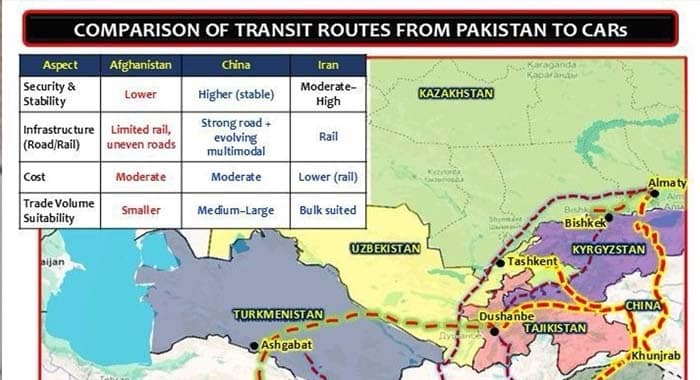
Pakistan is accelerating a strategic shift in its regional connectivity framework by operationalizing alternative transit corridors to Central Asia through China and Iran, reducing reliance on traditional routes via Afghanistan and positioning itself as a key regional trade hub.
According to recent assessments, evolving geopolitical and infrastructural developments have enabled Pakistan to leverage two viable and increasingly efficient corridors: a northern route via China’s western region and a southwestern route through Iran. These pathways are being developed to enhance trade access to Central Asian Republics (CARs), including Tajikistan, Kyrgyzstan, Kazakhstan, Uzbekistan, and Turkmenistan.
The China corridor has emerged as a particularly reliable gateway, offering shorter and more secure routes to key destinations. For instance, connectivity to Bishkek, Kyrgyzstan, via China is approximately 237 kilometers shorter and reduces transit time by up to three days compared to routes passing through Afghanistan. Similarly, routes to Almaty, Kazakhstan, are significantly shorter, while access to Dushanbe, Tajikistan, remains competitively efficient despite marginally longer distances.
Parallel to this, Pakistan has activated the Gabd–Rimdan border crossing with Iran in April 2026, establishing a new corridor linking to Turkmenistan and Uzbekistan. Initial shipments through this route have already been dispatched, marking a significant step toward diversifying trade pathways and improving logistical reliability.
Analysts note that while Afghan transit routes remain geographically relevant, they face persistent challenges that limit their practical utility. These include security risks, inconsistent border operations, higher transit costs, and underdeveloped infrastructure. Frequent delays at key crossings such as Torkham and Chaman, coupled with limited rail connectivity and logistical support systems, have further constrained their effectiveness for sustained trade flows.
In contrast, Pakistan’s emerging connectivity framework is being supported by major infrastructure initiatives. The ML-1 railway upgrade, spanning 1,872 kilometers from Karachi to Peshawar, is expected to enhance domestic freight efficiency, with groundbreaking anticipated in mid-2026. Under the China-Pakistan Economic Corridor (CPEC) Phase II, valued at approximately $62 billion, projects such as the dualization of the Karakoram Highway and the development of the Havelian Dry Port are aimed at strengthening cross-border trade capacity.
Additionally, Gwadar Port is being positioned as a deep-sea gateway capable of connecting Pakistan to all five Central Asian states without reliance on Afghan transit routes. The year-round operationalization of the Khunjerab Pass since October 2023 has further improved connectivity through the China corridor, enabling uninterrupted trade flows even during winter months.
Experts suggest that these developments collectively signal a transition in Pakistan’s economic geography from a terminal market to a transit and connectivity hub linking South Asia, Central Asia, and the Middle East. The diversification of routes is expected to enhance trade resilience, reduce logistical bottlenecks, and open new avenues for energy cooperation and regional integration.
Officials emphasize that Pakistan remains committed to promoting regional connectivity through peaceful and mutually beneficial economic engagement. The expansion of alternative corridors is viewed as part of a broader strategy to strengthen economic ties, improve supply chain efficiency, and contribute to long-term regional stability.



