
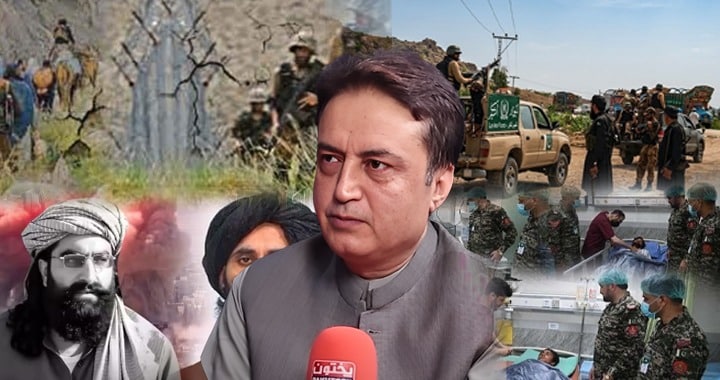
(Arif Yousafzai)
In the rugged mountains and valleys stretching from South Waziristan to Chitral, a harsh and enduring reality continues to unfold one that is often reduced to statistics but rarely understood in its full human and strategic complexity. Pakistan is not merely confronting sporadic militancy; it is engaged in a prolonged, evolving conflict that has seeped into the social, political, and psychological fabric of the state. At the heart of this conflict lies a deeply troubling paradox: civilians are both the shield and the victim.
On one side, militant groups embed themselves within local populations, drawing sustenance, shelter, and strategic advantage from the very communities they claim to represent. On the other side, military operations often necessary and sometimes unavoidable carry the risk of civilian casualties, fueling grievances and perpetuating cycles of mistrust. This dual vulnerability of civilians is not incidental; it is structural. And unless addressed with clarity and consistency, it will continue to undermine any meaningful progress toward peace.
It is no longer accurate to describe militancy in Pakistan as confined to border regions. What began in the early 2000s as localized insurgency has expanded into a diffuse, nationwide challenge. From the tribal districts of Khyber Pakhtunkhwa to the mountainous terrains of Balochistan, and even into urban centers, the manifestations of this conflict vary but its presence is unmistakable.
This is not a conventional war with clearly defined frontlines. It is a conflict of shifting strategies, evolving actors, and blurred distinctions between combatants and non-combatants. Militants claim to target security forces, yet civilians are frequently caught in the crossfire. The state, in its efforts to neutralize threats, often faces accusations of causing “collateral damage” a term that, while clinical in tone, carries profound human consequences.
The concept of collateral damage has become a central point of contention in conflict zones. While military doctrines worldwide acknowledge its unfortunate inevitability, its application in Pakistan’s context demands scrutiny. When entire families are wiped out in the name of targeting a handful of militants, the moral and strategic costs are immense.
Local populations often find themselves in an impossible position. In one instance, they may accuse militants of using them as human shields; in another, they may condemn state forces for indiscriminate strikes. The truth, as always, is more complex. In areas where militants are deeply embedded within communities, distinguishing between combatant and civilian becomes extraordinarily difficult.
The incident in Katlang, Mardan, serves as a stark example. While authorities claimed the elimination of militants, locals insisted that those killed were shepherds Gujjar families who had migrated seasonally with their livestock. Such discrepancies are not merely matters of narrative; they erode trust and deepen alienation.
One of the most critical yet often overlooked aspects of this conflict is the local composition of militant groups. Contrary to popular perception, today’s militants are not predominantly foreign fighters. They are, in large part, أبناء of the very regions in which they operate.
This shift has significant implications. When militants are drawn from local populations, they possess intimate knowledge of terrain, social networks, and cultural dynamics. More importantly, their funerals are attended by local communities not out of ideological alignment alone, but often due to kinship ties. This blurring of lines complicates counterinsurgency efforts and challenges simplistic narratives of “us versus them.”
Militant groups in Pakistan have demonstrated a remarkable ability to adapt. In earlier phases, their operations were characterized by high-intensity attacks targeting civilians bombings in markets, mosques, and schools. These attacks not only caused widespread devastation but also eroded whatever public sympathy they might have had.
In recent years, however, there has been a noticeable shift. Militants now claim to focus primarily on law enforcement agencies police, intelligence units, and military personnel. This recalibration is strategic. By avoiding mass civilian casualties, they aim to rebuild local support and legitimacy.
Simultaneously, their rhetoric has evolved. While religious justification remains central, it is increasingly supplemented by narratives of resource control and local autonomy. Militants speak of mountains, rivers, and mineral wealth arguing that these resources are being exploited without benefiting local populations. This blend of ideological and material grievances broadens their appeal and complicates counter-narratives.
Perhaps the most pressing issue is the inconsistency in Pakistan’s counter-militancy strategy. Over the past two decades, the state has oscillated between kinetic operations and peace negotiations, often without a coherent long-term framework. Each military operation is accompanied by declarations of success claims that the “back of terrorism has been broken.” Yet, time and again, militants regroup and re-emerge, sometimes stronger than before.
This pattern raises fundamental questions. Are these operations addressing root causes, or merely symptoms? Is the state’s approach reactive rather than strategic? And most importantly, does it inspire confidence among the very citizens it seeks to protect?
The lack of policy continuity has not only confused observers but also undermined credibility. When negotiations follow immediately after military offensives or vice versa it sends mixed signals to both militants and the public. It creates the impression of a state unsure of its own direction.
Another dimension that cannot be ignored is the perception of external influence. Whether real or exaggerated, the belief that Pakistan’s policies are shaped by foreign pressures weakens their legitimacy. In conflict zones, where trust is already fragile, such perceptions can be particularly damaging.
For any strategy to succeed, it must be seen as autonomous driven by national interest rather than external compulsion. This requires not only policy independence but also effective communication. The state must articulate its objectives clearly and consistently, ensuring that its actions align with its stated goals.
The debate between military action and negotiation is often framed as a binary choice. In reality, it is neither. Both tools have their place, but their effectiveness depends on timing, context, and execution. Pakistan has experimented with both approaches, with mixed results. Military operations have disrupted militant networks but often at significant human and economic cost. Negotiations, meanwhile, have sometimes provided temporary respite but failed to deliver lasting solutions.
The key lies in sequencing and sincerity. Dialogue should not be seen as a sign of weakness, nor should force be the default option. If channels of communication exist, they must be explored thoroughly. Only when all avenues for peaceful resolution are exhausted should kinetic measures be employed and even then, with utmost precision and accountability.
Global precedents offer valuable lessons. Even the most powerful nations have eventually turned to negotiation after prolonged conflict. The recognition that wars cannot be won solely through force is not a concession; it is an acknowledgment of reality.
Amid all strategic considerations, one principle must remain non-negotiable: the protection of civilians. This is not merely a humanitarian imperative; it is a strategic necessity. Every civilian casualty is not just a tragedy it is a potential recruitment tool for militant groups.
Protecting civilians requires more than restraint in military operations. It demands investment in intelligence, community engagement, and post-conflict rehabilitation. It requires listening to local voices, addressing grievances, and building trust.
Moreover, it calls for accountability. When mistakes occur and they inevitably will they must be acknowledged and addressed transparently. Denial or deflection only deepens mistrust.
If Pakistan is to move beyond this cycle of violence, it must adopt a comprehensive, consistent, and civilian-centric strategy. Such a strategy would include:
- Policy Consistency: A clear, long-term framework that integrates military, political, and socio-economic dimensions.
- Local Engagement: Empowering communities to play a role in peacebuilding, rather than treating them as passive subjects.
- Narrative Control: Countering militant propaganda with credible, inclusive narratives.
- Institutional Coordination: Ensuring alignment between various arms of the state.
- Regional Diplomacy: Addressing cross-border dynamics through sustained engagement.
There are no easy solutions to Pakistan’s militancy challenge. The terrain is difficult, the actors are complex, and the stakes are high. But one truth is clear: a strategy that fails to protect civilians is a strategy destined to fail. The path forward requires courage not just on the battlefield, but in policymaking. It requires the willingness to question assumptions, to admit shortcomings, and to prioritize long-term stability over short-term gains.
Most importantly, it requires a shift in perspective. Civilians are not collateral. They are the center. Until this principle is internalized by both the state and its adversaries the cycle of violence will continue, and peace will remain elusive. The choice, ultimately, is not between war and negotiation. It is between perpetuating a flawed status quo and forging a new path—one that places human dignity at its core.



