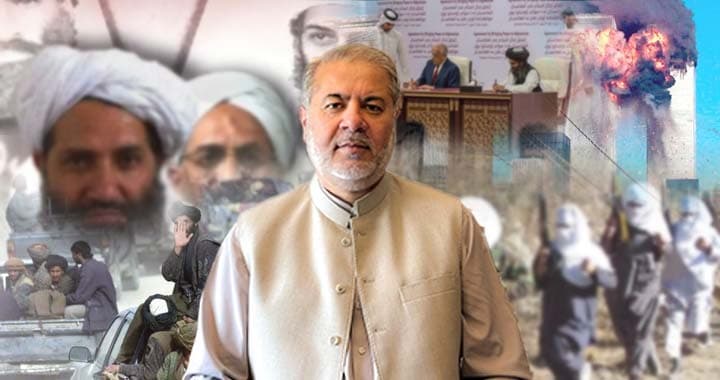
The recent report about Al-Qaeda’s re-emergence in Afghanistan, including the reported establishment of training camps, is a significant development that cannot be dismissed as a return to the past. Twenty-five years after the September 11, 2001 attacks, the continued presence and possible regeneration of Al-Qaeda-linked networks in Afghanistan raises serious questions about the commitments made by the Afghan Taliban and the security implications for the region.
The September 11 attacks in the United States were attributed to Al-Qaeda, whose leadership at the time, including Osama bin Laden and his deputy Ayman al-Zawahiri, was based in Afghanistan. The Taliban government under Mullah Muhammad Omar was pressured to hand them over to the United States, but refused. What followed was the US-led intervention in Afghanistan, the arrival of NATO forces and a transformation of the regional security landscape, particularly for Pakistan.
The Taliban returned to power in August 2021 following the US withdrawal. Before that, under the Doha agreement, the Taliban had committed that Afghan territory would not be used by militant groups against the United States, its allies or other countries.
Five years after the Taliban takeover, reports suggesting that Al-Qaeda has re-established training infrastructure in Afghanistan therefore carry considerable significance. If the reported camps are indeed operating, they indicate that Al-Qaeda is not simply a remnant of the past but retains leadership, manpower and the ability to develop new cadres.
For years, the United States and its Western allies spent billions of dollars fighting and dismantling Al-Qaeda. There was also an assumption that the organization had been largely neutralized after Osama bin Laden was killed and Ayman al-Zawahiri was killed in Kabul in July 2022. Zawahiri’s presence in a residential area of Kabul, reportedly alongside an important Taliban commander, had itself raised serious questions about the relationship between the Afghan Taliban and Al-Qaeda.
The emergence of reports about training camps suggests that the organization may have survived in a different form and retained the capacity to rebuild.
Hamza bin Laden and the Question of Al-Qaeda’s Survival
The recent appearance of footage associated with Hamza bin Laden, the son of Osama bin Laden, has added another layer to the discussion.
There have previously been reports that Hamza was hiding in Iran and that Al-Qaeda members and other Arab fighters used routes through Iran to reach Afghanistan. Over time, there were also reports that Hamza may have been killed. However, the status of figures associated with clandestine organizations is often difficult to establish independently.
I recall an incident from my own reporting career in North Waziristan in 2008 or 2009. During a meeting with Afghan Taliban figures, I encountered an elderly man who asked whether I recognized him. I did not. He later identified himself as Abu Qasha al-Iraqi, an Al-Qaeda leader.
What made the encounter striking was that Abu Qasha had already been reported killed twice in drone strikes in North Waziristan.
The incident demonstrated how difficult it can be to establish the actual fate of senior figures operating inside clandestine organizations. Sometimes media reports of deaths prove inaccurate. At other times, organizations themselves announce the death of a leader or commander to reduce pressure on the individual or the network.
That is why the possibility that Hamza bin Laden could still be alive cannot simply be dismissed without credible evidence. At the same time, the larger issue goes beyond one individual.
Jihadist organizations are not dependent entirely on a single leader. When a leader is killed, another usually takes his place. The Afghan Taliban itself survived the death of Mullah Omar and subsequently produced new leadership, including Mullah Mansour and Sheikh Hibatullah Akhunzada.
The same pattern has been seen among other jihadist organizations.
Al-Qaeda, the Afghan Taliban and TTP: An Old Relationship
The historical relationship between Al-Qaeda, the Afghan Taliban and the Pakistani Taliban is another reason for concern.
These organizations have maintained close ideological and operational links over the years. When Al-Qaeda members and other Arab fighters faced pressure and moved out of Afghanistan, they found support in Pakistan. The Pakistani Taliban provided houses, food, vehicles and other assistance, while also facilitating the movement and use of suicide bombers.
This was not a new relationship but one rooted in years of cooperation and ideological affinity.
Therefore, if Al-Qaeda is rebuilding its presence in Afghanistan and maintaining connections with the TTP, the threat is not confined to Afghanistan. It has direct implications for Pakistan and potentially for the wider region.
The reported presence of Al-Shabaab figures in Afghanistan further reinforces concerns about Afghanistan becoming a meeting point for transnational jihadist networks. UN reporting has referred to Al-Shabaab leaders visiting Afghanistan and meeting Afghan Taliban figures.
These developments need to be viewed against the broader network of relationships among jihadist organizations. Al-Qaeda, the Afghan Taliban, the Pakistani Taliban and Al-Shabaab have ideological and organizational links, while the Islamic State Khorasan Province remains an adversary of these groups.
The Afghan Taliban has focused heavily on ISKP, conducting operations that have resulted in the killing and arrest of its members. The reason is straightforward: ISKP has claimed numerous attacks against the Afghan Taliban in Afghanistan and has also targeted religious and political groups in Pakistan that are ideologically closer to the Afghan Taliban.
This creates a complicated landscape in which some jihadist organizations cooperate or maintain ties while simultaneously fighting ISKP.
Afghanistan Cannot Become a Safe Haven for Global Jihadist Networks
If reports of foreign jihadist figures travelling to Afghanistan and meeting Afghan Taliban officials are accurate, the Afghan Taliban faces a serious test.
The central commitment in the Doha agreement concerned the use of Afghan territory. The Taliban must therefore demonstrate that Afghanistan will not become a base from which transnational jihadist organizations can train, organize and prepare attacks against neighboring countries or the wider international community.
The danger is that Afghanistan could once again become a hub for international jihadist networks, much as it was in the 1990s.
If people from different countries begin travelling to Afghanistan for training and subsequently return to conduct attacks elsewhere, the consequences will extend far beyond Afghanistan’s borders. Such a development would also make it increasingly difficult for the Afghan Taliban to defend its claim that it can maintain security and control over its territory.
The history of the 1990s offers a clear warning. The Taliban government was in power at the time, but its rule was dismantled following the events of September 11 and the US-led intervention in 2001.
The Taliban’s Rise Also Carries Responsibilities
There is no question that the Afghan Taliban made sacrifices during its long struggle, and the Afghan people also endured enormous suffering. However, the Taliban’s return to power cannot be viewed separately from the political and diplomatic process that preceded it.
The agreement between the United States and the Taliban created the framework for the withdrawal of foreign forces. The collapse of the Afghan government and security forces in 2021 then allowed the Taliban to take control of the country with remarkably little organized resistance.
The United States had enormous influence over Afghanistan’s political and security structures at the time. Once that support was withdrawn, the Afghan state and its security institutions rapidly collapsed.
Pakistan also played a significant role in facilitating engagement between the Taliban and the United States. It provided diplomatic and logistical support that helped Taliban representatives travel, negotiate and participate in the political process that eventually produced the Doha agreement.
That history matters because the Taliban now has responsibilities that come with governing a country.
The Afghan Taliban cannot simultaneously seek international engagement and allow Afghanistan to become a sanctuary, training ground or organizational center for foreign jihadist networks.
If Afghanistan again becomes insecure, if the government’s writ weakens, or if foreign terrorist organizations establish themselves there and use Afghan territory to operate against other countries, the consequences will ultimately be borne by Afghanistan itself.
The lesson of the past is clear: Afghanistan cannot afford to become a launchpad for another generation of transnational jihadist violence.