
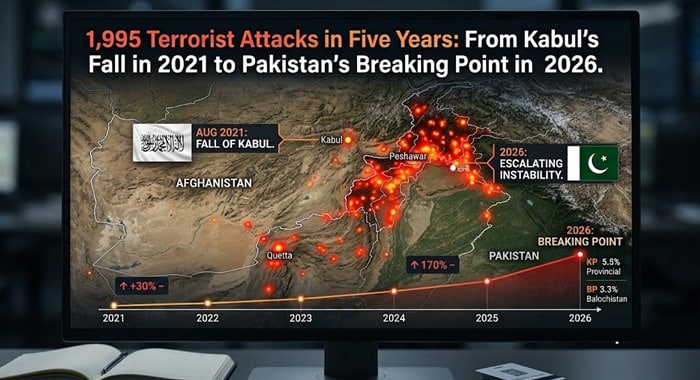
The current Pakistan–Afghanistan confrontation did not emerge suddenly, nor can it be understood in isolation from the events of the past five years. Pakistan maintains that it repeatedly chose dialogue, diplomacy, religious engagement, tribal mediation, economic cooperation and third-party facilitation before resorting to military action against threats emanating from Afghan territory.
When the Taliban took control of Kabul in August 2021, much of the international diplomatic presence in Afghanistan was withdrawn amid the unprecedented uncertainty surrounding the change of government. Pakistan, which had hosted millions of Afghans for more than four decades, nevertheless kept its diplomatic mission functioning and continued to engage with the new authorities in Kabul. During the chaotic withdrawal, Pakistan also played a role in facilitating evacuations and providing assistance to people seeking to leave Afghanistan.
Pakistan says that its approach after the Taliban takeover was guided by the belief that a peaceful, stable and economically viable Afghanistan was in the interest of both countries and of the wider region. Rather than immediately treating the new Afghan authorities as an adversary, Islamabad continued to engage with them and encouraged the international community to prevent Afghanistan from descending into economic and humanitarian catastrophe.
At the post-withdrawal international conferences and diplomatic forums dealing with Afghanistan, Pakistan repeatedly called for measures to alleviate the country’s economic crisis. Islamabad was among the countries pressing for greater humanitarian assistance and for mechanisms that would allow Afghanistan to access its frozen financial resources. Approximately $9 billion in Afghan assets had been frozen following the Taliban takeover. Pakistan repeatedly argued that the Afghan people should not be made to suffer for the political circumstances of their country and called for the release or appropriate use of Afghanistan’s frozen assets.
Pakistan also raised the issue through regional organisations, including the Economic Cooperation Organization, arguing that Afghanistan’s economic recovery was essential to regional peace, trade and stability. Islamabad’s position was that an economically isolated Afghanistan would create greater humanitarian suffering, increase displacement and potentially worsen the security challenges faced by neighbouring states. Pakistan therefore says that its early policy toward the Taliban authorities was one of engagement rather than confrontation.
According to Pakistan, the response from the Taliban authorities did not match that expectation. Islamabad increasingly accused the Afghan Taliban of allowing the Tehreek-e-Taliban Pakistan and other anti-Pakistan militant organisations to operate from Afghan territory. Pakistan maintains that these organisations have used Afghan soil for planning, recruitment, training, logistical support and launching attacks against Pakistan. The Taliban authorities have rejected Pakistan’s accusations and have maintained that the TTP problem is an internal Pakistani issue. The dispute over the presence and activities of the TTP in Afghanistan has consequently become the central security disagreement between Islamabad and Kabul.
Pakistan nevertheless argues that it did not immediately abandon diplomacy. Instead, it pursued virtually every available peaceful channel.
In July 2022, an eight-member Pakistani ulema delegation led by Mufti Muhammad Taqi Usmani travelled to Kabul. The delegation sought to use religious influence and dialogue to persuade the Taliban and the TTP to stop attacks and move toward a peaceful settlement. The initiative reflected Pakistan’s willingness to employ religious channels to address a conflict involving organisations that frequently invoke religious arguments. Islamabad hoped that respected Islamic scholars could convince the relevant actors that continued violence against Pakistan was unacceptable and damaging to the interests of both countries. Only a few days later, Pakistan pursued another traditional mechanism.
A 17-member tribal jirga travelled to Kabul to deliver the same basic message. The jirga sought to use tribal relationships, customary mechanisms and personal contacts to persuade the Taliban and the TTP to prevent further violence and find a negotiated solution. Pakistan therefore attempted religious engagement and tribal mediation before the crisis moved further toward direct state-to-state confrontation.
When these initiatives failed to produce a durable solution, Pakistan continued at the official level. On February 22, 2023, a high-level Pakistani delegation led by Defence Minister Khawaja Muhammad Asif and Director General Inter-Services Intelligence Lieutenant General Nadeem Anjum visited Kabul. Security concerns, including the activities of the TTP and the need to prevent Afghan territory from being used against Pakistan, were among the central issues raised during the engagement. The visit demonstrated that Pakistan was prepared to engage directly with the Taliban authorities even as terrorist attacks against Pakistan continued.
Pakistan did not abandon this approach in the following year. In July 2024, Interior Minister Mohsin Naqvi led another Pakistani delegation for discussions concerning security cooperation and bilateral relations. Islamabad continued to raise its concerns about terrorist organisations operating from Afghan territory and called for concrete measures to prevent cross-border attacks. Pakistan also continued participating in UN-sponsored and regional diplomatic processes concerning Afghanistan. Islamabad’s message remained consistent: normal relations between the two countries could not be sustained if militant organisations were permitted to operate from Afghan soil against Pakistan.
Security tensions did not stop Islamabad from pursuing economic engagement. Pakistan’s Special Representative for Afghanistan, Muhammad Sadiq, worked to strengthen bilateral economic relations, trade and regional connectivity. These efforts eventually contributed to the Early Harvest Programme between Pakistan and Afghanistan.
The programme reduced tariffs on eight key agricultural products and was intended to facilitate bilateral trade while creating a foundation for broader economic cooperation. Pakistan’s approach was therefore not limited to security concerns. Islamabad continued to believe that legitimate trade, economic interdependence and regional connectivity could provide incentives for stability and peace.
Against this extensive diplomatic record, Pakistan points to the continuing increase in terrorist violence. According to data from the Pakistan Institute for Peace Studies, Pakistan recorded 89 terrorist attacks in 2021, 262 in 2022, 306 in 2023, 521 in 2024 and 699 in 2025. PIPS recorded at least 1,034 people killed in terrorist violence during 2025. These figures represent a dramatic deterioration in Pakistan’s security environment. While the figures themselves document the scale of terrorism inside Pakistan, responsibility for individual attacks and the extent to which particular attacks were planned or facilitated from Afghanistan remain matters of dispute between Islamabad and Kabul. Pakistan nevertheless maintains that the growing TTP threat is directly connected to the sanctuary and operational space it says the organisation has obtained in Afghanistan.
Pakistan also points to the events of May 2025 as a particularly serious episode. During Pakistan’s four-day military confrontation with India, Pakistan alleged that Afghanistan became an additional security challenge on its western frontier. According to the Pakistani account, Afghanistan sent a 40-member TTP tashkeel toward Pakistan, allegedly including the son of a Taliban official, to conduct attacks from the western side while Pakistan was engaged in hostilities with India on its eastern front. Pakistan characterised this alleged mobilisation as a grave betrayal because it occurred at a moment when the country was already dealing with a major military crisis on another frontier. The allegation is part of Pakistan’s broader claim that militant groups operating from Afghanistan have repeatedly sought to exploit Pakistan’s security vulnerabilities.
The situation became considerably more dangerous in October 2025. Pakistan reported that 11 of its soldiers, including a lieutenant colonel and a major, were killed during an operation against TTP militants in Orakzai. Militants subsequently attacked the Police Training School in Dera Ismail Khan, where seven policemen were killed. The violence then expanded into direct fighting along the Pakistan–Afghanistan frontier. Pakistan reported that 23 of its soldiers were killed during the ensuing confrontation and claimed that more than 200 Taliban and affiliated fighters were killed.
The fighting ultimately resulted in a Qatar-mediated ceasefire. Pakistan accepted the ceasefire and subsequently participated in follow-up negotiations in Doha and Istanbul. Despite these efforts, the talks failed to produce a lasting agreement capable of resolving the underlying security dispute.
Even after the October 2025 confrontation, Pakistan continued to support diplomatic and humanitarian initiatives. Saudi Arabia subsequently became involved in mediation between the two sides. In February 2026, Saudi mediation resulted in the release of three Pakistani soldiers who had been captured by Afghanistan. Pakistan regarded such mediation as evidence that third-party diplomacy could still produce humanitarian outcomes even during periods of severe tension. At the same time, Islamabad maintained that individual confidence-building measures could not substitute for a permanent mechanism to prevent cross-border terrorism.
Even after the fighting and failed ceasefire arrangements, Pakistan once again agreed to negotiations. In April 2026, Pakistan and Afghanistan participated in China-mediated talks in Ürümqi. Islamabad again focused on the TTP and other militant organisations operating from Afghan territory. Pakistan’s demands, according to the account presented by Islamabad, were specific: the TTP should be designated as a terrorist organisation; its infrastructure should be dismantled; Afghan territory should no longer be used to launch attacks against Pakistan; and Kabul should provide verifiable evidence that these measures had actually been implemented. Pakistan argues that these were not demands for Afghan territory, regime change or political domination. They were presented as minimum security requirements for a normal relationship between two sovereign neighbours.
Yet the talks failed to produce a comprehensive and lasting settlement.
While diplomacy continued, the human cost of terrorism inside Pakistan remained exceptionally high. The Pakistani account places total fatalities during 2026 at 3,844 by mid-year, including more than 1,027 security personnel. Separately, data from the Pakistan Institute for Conflict and Security Studies recorded 434 security personnel killed during the first seven months of 2026. The figures come from different datasets and methodologies, but they illustrate the severity of the security crisis confronting Pakistan. July 2026 was particularly deadly. According to PICSS, 112 Pakistani security personnel were killed during the month, making it the highest monthly toll for security forces since January 2023. July also witnessed eight suicide attacks, according to the same source, representing the highest number of suicide attacks recorded in a single month in a decade.
Behind these statistics are individual human lives: soldiers, policemen and civilians, along with families who lost fathers, sons, husbands, brothers and loved ones. Pakistan maintains that these casualties cannot be treated as abstract statistics.
The latest escalation followed a series of deadly attacks in Khyber Pakhtunkhwa. A suicide bomber attacked a mosque located inside a police compound in Kohat. According to the Pakistani account, eight armed attackers subsequently stormed the compound. A battle lasting approximately 20 hours followed. At least 21 people were killed, most of them police officers, while more than 100 people were wounded.
Pakistan attributed the attack to the TTP and allied militant organisations operating from Afghan territory. The incident was followed by further violence in Hangu, where six Pakistani security personnel were killed, according to the Pakistani account. Islamabad attributed those attacks to the TTP and allied groups that it says operate from Afghan soil.
The issue was subsequently taken to the international stage. At the United Nations General Assembly, Foreign Minister Ishaq Dar stated that more than two dozen anti-Pakistan militant groups were present in Afghanistan. Pakistan’s message was that the problem had become larger than an isolated bilateral disagreement. Islamabad sought international attention to what it described as a transnational terrorism threat requiring effective action against militant sanctuaries and networks. Pakistan maintained that continued attacks from Afghan territory could not be separated from the wider question of regional peace and security.
On September 21, 2026, Pakistan carried out strikes against militant targets inside Afghanistan. According to the Pakistani account, the operation was intelligence-based, targeted and directed against identified terrorist positions. Pakistan stated that 28 terrorists were killed. Islamabad emphasised that the strikes were directed at militants and their infrastructure rather than the Afghan population.
Reports from Afghanistan and international organisations have also raised allegations concerning civilian casualties. Those accounts remain part of the competing narratives surrounding the operation. Pakistan’s stated position is that it acted against specific terrorist threats after repeated diplomatic efforts had failed to prevent attacks against Pakistan.
Pakistan says that the Afghan Taliban authorities did not respond to the strikes by taking visible action against the militant organisations Islamabad had repeatedly identified. Instead, according to Pakistan, Taliban forces escalated militarily. Pakistan reported that eight drones were launched toward Kohat and Torkham and that Taliban forces also shelled Pakistani border posts.
Pakistan’s forces reported that the drones were intercepted and neutralised. Islamabad subsequently responded by targeting the locations it identified as being involved in the drone attacks.
On September 24, Pakistan announced strikes against 10 sites that it said were being used to launch, store or support the drones employed against Pakistani territory. Pakistan described the operation as intelligence-based, targeted, calibrated and limited to identified military objectives. Islamabad characterised the response as proportionate to the threat and stated that its purpose was to protect Pakistani citizens and security personnel from further attacks.
Afghan authorities, meanwhile, have condemned Pakistan’s strikes as violations of Afghan sovereignty. The competing positions reflect the central disagreement between the two governments. Pakistan describes its actions as self-defence against cross-border terrorism and attacks originating from Afghan territory, while Kabul describes Pakistani military action as aggression against Afghanistan.
Pakistan argues that the events of September 2026 are part of a pattern already witnessed in October 2025. According to Islamabad’s account, Pakistani soldiers were killed in operations against TTP militants, Pakistani police facilities were attacked, and the violence eventually expanded into direct fighting between Pakistan and Taliban forces.
The subsequent Qatar-mediated ceasefire, Doha talks and Istanbul talks failed to establish a durable security mechanism. Pakistan therefore argues that temporary ceasefires without verification and enforcement mechanisms merely postpone the next confrontation.
Pakistan also points to recent diplomatic contacts as evidence that Islamabad has not abandoned dialogue. According to a Kandahar source cited in the Pakistani account, Taliban ministers told Türkiye’s intelligence chief that important issues could only be discussed in Kandahar. The Turkish side subsequently travelled there. According to the same account, the Taliban chief reportedly refused to meet at the last minute, allegedly describing the visitors as “Western.” The meeting was subsequently shifted to an alternative setting at the Mullah Omar Mosque, where discussions were held with the Kandahar governor.
The Turkish intelligence chief later reportedly told Pakistan that expecting “sensible behaviour” from the Taliban amounted to “fooling ourselves.” These details concern diplomatic interactions that are not publicly documented in full and should therefore be regarded as an attributed account rather than an independently established record. Pakistan nevertheless cites the episode as further evidence of the difficulties it has faced in establishing predictable and institutionalised dialogue with the Taliban leadership.
Islamabad’s argument is ultimately based on the cumulative record. Pakistan says it opened its doors to millions of Afghans for more than four decades. It kept its diplomatic mission open after the Taliban takeover. It facilitated evacuations during the 2021 withdrawal. It advocated the unfreezing of Afghan assets and international humanitarian assistance. It used regional forums, including the ECO, to promote support for Afghanistan. Pakistan then turned to religious diplomacy by sending an eight-member ulema delegation led by Mufti Taqi Usmani to Kabul in July 2022. It followed that initiative with a 17-member tribal jirga.
When those efforts failed to deliver a durable settlement, Pakistan sent Defence Minister Khawaja Asif and that time DG ISI Lieutenant General Nadeem Anjum to Kabul in February 2023. It continued security engagement in 2024 under Interior Minister Mohsin Naqvi and pursued economic cooperation through Special Representative Muhammad Sadiq, ultimately contributing to the Early Harvest Programme that reduced tariffs on eight agricultural products.
Pakistan subsequently accepted Qatar-mediated ceasefire arrangements, participated in negotiations in Doha and Istanbul, accepted Saudi mediation, welcomed the release of three Pakistani soldiers through Saudi efforts, and returned to negotiations through the China-mediated Ürümqi process in April 2026. According to Islamabad, all of these initiatives had the same ultimate purpose: preventing Afghanistan from becoming a base for attacks against Pakistan.
Pakistan maintains that its demands are limited and security-oriented. Islamabad wants the TTP to be formally treated as a terrorist organisation, its infrastructure dismantled, its ability to operate from Afghan territory eliminated, and verifiable evidence provided that these measures have actually been implemented. Pakistan also wants an effective mechanism to prevent cross-border infiltration and attacks and to establish meaningful security cooperation along the frontier. Islamabad says that these demands do not amount to a demand for Afghan territory, regime change or political control over Afghanistan. The stated objective is that Afghan territory should not be used to plan, prepare or launch attacks against Pakistan.
Pakistan’s position is that it does not seek conflict with the Afghan people and does not seek instability inside Afghanistan. Pakistan has historically maintained extensive social, cultural, economic and family ties with Afghanistan and has hosted millions of Afghans for decades. Islamabad’s dispute is therefore directed, in its stated position, not against the Afghan population but against militant organisations that Pakistan says use Afghan territory for attacks against Pakistan.
The challenge is now to determine whether a credible diplomatic framework can be established in which commitments are not merely announced but actually implemented and independently verified. Such a framework would need to establish whether militant organisations are operating from Afghan territory, whether their infrastructure has been dismantled, whether cross-border infiltration has stopped and whether commitments made during negotiations are being honoured.
Pakistan’s position is that diplomacy remains preferable to military confrontation. But Islamabad also maintains that diplomacy cannot succeed if terrorist attacks continue unchecked and if assurances are repeatedly provided without verifiable implementation. The history of the past five years demonstrates that Pakistan has repeatedly returned to negotiations. It has engaged through religious scholars, tribal elders, senior political officials, military and intelligence representatives, UN-sponsored mechanisms, Qatar, Saudi Arabia, Türkiye and China.
It has pursued trade and economic cooperation even while facing terrorist attacks. It has accepted ceasefires even after suffering major military losses. It has participated in talks after direct military confrontation. And it has repeatedly returned to the same fundamental demand: Afghan territory must not be used to attack Pakistan.
The Pakistan–Afghanistan crisis cannot therefore be reduced to the latest airstrike, the latest border clash or the latest exchange of accusations. The full chronology matters.
Pakistan says it responded to the Taliban takeover in 2021 with engagement rather than immediate confrontation. It kept its diplomatic mission open, assisted evacuations, hosted millions of Afghans, advocated international assistance and called for Afghanistan’s frozen financial assets to be made available to help the Afghan people.
It subsequently pursued religious diplomacy, tribal mediation, high-level political and security engagement, regional diplomacy and economic cooperation.
When terrorist attacks continued, Pakistan accepted ceasefires and participated in negotiations in Doha and Istanbul. When those efforts failed, it accepted further mediation, including Saudi efforts that resulted in the release of three Pakistani soldiers. Even after renewed fighting, Islamabad returned to the negotiating table through China-mediated talks in Ürümqi in April 2026.
At the same time, Pakistan faced a steadily worsening terrorist threat.
According to PIPS, terrorist attacks rose from 89 in 2021 to 699 in 2025, while more than 1,000 people were killed in terrorist violence during 2025. In 2026, Pakistani security forces continued to suffer heavy losses, with July alone recording 112 security personnel killed and eight suicide attacks according to PICSS. The September 2026 escalation followed deadly attacks in Kohat and Hangu, which Pakistan attributed to the TTP and allied organisations operating from Afghan territory. Pakistan then carried out strikes against militant targets on September 21, followed by further strikes on September 24 against sites it said were connected to drone attacks launched toward Pakistani territory.
Afghanistan disputes Pakistan’s account and condemns the strikes as violations of its sovereignty. The central issue is therefore not whether there should be peace between Pakistan and Afghanistan. There should. The central issue is what conditions are necessary for that peace to become sustainable. For Pakistan, the answer is that Afghan territory cannot be permitted to serve as a launching ground for terrorism against Pakistan. The future of the relationship therefore depends on whether Kabul and Islamabad can establish a mechanism capable of preventing cross-border militant activity, dismantling terrorist infrastructure, stopping infiltration and providing credible, verifiable evidence that commitments are being honoured.
Pakistan maintains that it has repeatedly demonstrated its willingness to talk. Its position is that it does not seek perpetual confrontation. It seeks security for its people, sovereignty over its territory, stability along its borders and an Afghanistan that is peaceful enough to become a constructive neighbour rather than a source of cross-border terrorism. The ultimate measure of any future agreement will therefore not be the words contained in a communiqué or the declarations made at a negotiating table. It will be whether the agreement prevents the next attack, protects Pakistani civilians and security personnel, and establishes a credible and verifiable foundation for lasting peace.



