
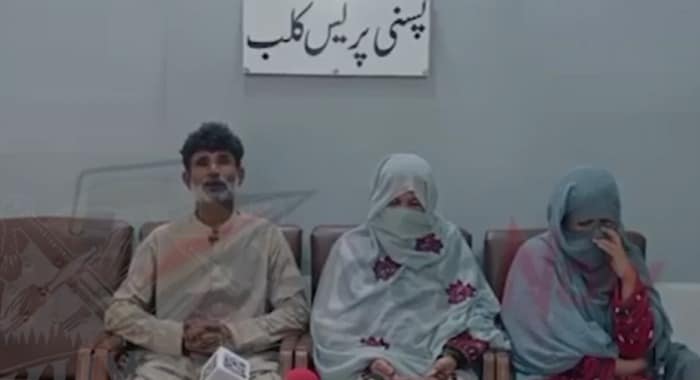
The reported distancing of families from individuals allegedly associated with the Baloch Yakjehti Committee (BYC) continues, with a resident of Pasni publicly announcing his disassociation from his own son and daughter, whom he says were allegedly taken and influenced by the organisation.
The resident, Wahid Bakhsh, a resident of the Zari Kor area of Pasni, has publicly stated that he no longer associates himself with his son, 17-year-old Sarfraz, and his 12-year-old school-going daughter, whom he alleges were taken away and influenced by individuals associated with the Baloch Yakjehti Committee.
According to Wahid Bakhsh, his children were allegedly persuaded and taken away by the organisation when they were still minors. He expressed deep concern over what he described as the exploitation of children for political and militant purposes.
Speaking about the circumstances surrounding his children, Wahid Bakhsh said that his 17-year-old son Sarfraz and 12-year-old daughter, who was still receiving an education, were allegedly lured and taken away by what he described as a terrorist organisation.
He questioned the justification for involving children of such a young age in activities associated with political or militant organisations. The father specifically questioned Bashir Zeb and Allah Nazar, asking them to explain what crime his children had committed and why minors were allegedly being influenced and drawn into such activities. His central concern, as expressed in his statement, was the alleged use of children who were too young to understand the consequences of the decisions being made on their behalf.
Wahid Bakhsh questioned the rationale behind allegedly targeting minors and asked why children should be drawn into a conflict that they are too young to comprehend fully. His appeal raises a broader concern about the vulnerability of young people in conflict-affected areas and the potential consequences when minors are exposed to political mobilisation, militant narratives or organised violence.
The allegation that a 17-year-old boy and a 12-year-old school-going girl were taken away has also brought the issue of child vulnerability into sharper focus. Regardless of political affiliation, the protection of children from coercion, exploitation and involvement in violence remains a fundamental humanitarian concern.
In a clear expression of his personal position, Wahid Bakhsh stated: “We stand with Pakistan, and we will always live and die with Pakistan.” His statement represents an explicit declaration of loyalty to Pakistan and a rejection of what he describes as attempts to draw his children into activities contrary to his family’s position.
The statement also reflects the continuing debate in Balochistan over competing political narratives, with some residents publicly distancing themselves from organisations they believe exploit the grievances of ordinary people for political or militant purposes.
The most serious aspect of the account is the allegation that minors were allegedly drawn into activities associated with the Baloch Yakjehti Committee. The 12-year-old daughter was reportedly still a student, while the boy was only 17. The allegations, if independently established, would raise serious questions concerning the protection of minors and the methods used by organisations seeking to mobilise young people.
Children and adolescents are particularly vulnerable to manipulation, especially in areas affected by prolonged political tension, violence and insecurity. Their involvement in organised political or militant activity can have lasting consequences for their education, safety, psychological well-being and future prospects.
For this reason, the allegation concerning the two children should not be viewed merely through the lens of a political disagreement. It raises a broader question about whether minors are being given the freedom to make informed decisions or are instead being influenced by adults and organised groups.



