
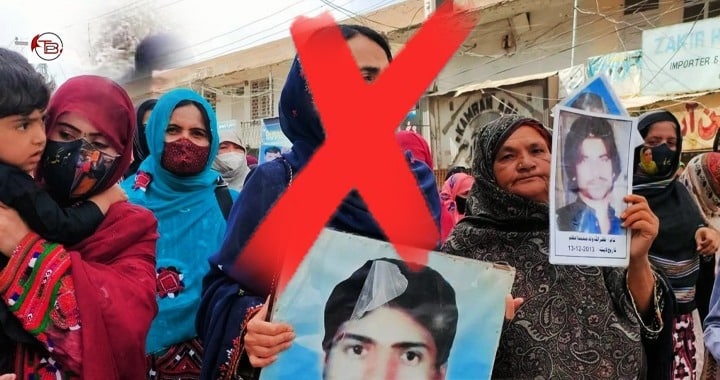
The debate surrounding enforced disappearances in Balochistan remains one of the most sensitive and complex issues in Pakistan’s internal security and human rights discourse. It is an issue that demands careful handling, strict verification, and institutional transparency. At the same time, it is also an issue where competing narratives often collide, sometimes producing conflicting interpretations of the same events.
Recent developments involving cases previously highlighted by the Baloch Yakjehti Committee (BYC) have once again brought this tension into focus. BYC has frequently presented individuals as victims of enforced disappearance, attributing responsibility to state institutions and framing such cases within broader political and rights-based narratives.
However, in certain instances, later information has introduced additional dimensions that complicate the original claims. One such case involves an individual identified as Yousaf, who was previously presented in public campaigns as a missing person. According to subsequently available information, the individual was later linked to Fitna al-Hindustan, a terrorist organization involved in attacks against security forces in Balochistan.
Reports indicate that he joined the organization in 2025 and was later killed during an operation in March 2026 in Panjgur while allegedly participating in an attack against security personnel. These developments have prompted renewed discussion about the importance of verifying claims before they are widely circulated in politically sensitive contexts.
When Information Gaps Shape Public Perception
In conflict-affected regions, incomplete information can easily shape public narratives before full facts are established. This is particularly relevant in cases involving missing persons, where emotional impact, political sensitivity, and security considerations often overlap. Human rights concerns in such cases are legitimate and require thorough investigation through legal and constitutional channels.
Pakistan’s judicial system provides mechanisms for review, appeal, and accountability, ensuring that allegations can be examined within a formal legal framework. However, when cases are presented publicly without full verification of subsequent developments, there is a risk that partial information may create long-term perceptions that do not reflect the complete reality.
The Yousaf case, as reported, has intensified this debate.
It has raised questions about how missing persons cases are documented, communicated, and later reassessed when new information emerges. It has also highlighted the broader challenge of distinguishing between genuine civilian grievances and cases where individuals may later be found to have been associated with armed organizations.
Observers argue that such distinctions are essential for maintaining both human rights credibility and security integrity. Misrepresentation, whether intentional or unintentional, can have wider consequences. It can undermine legitimate human rights advocacy. It can also complicate counterterrorism efforts by blurring the lines between civilian populations and militant networks.
In Balochistan, where security challenges have persisted for decades, maintaining that distinction is particularly important. The province has experienced repeated incidents of terrorism, targeted killings, sabotage, and attacks on both civilians and security forces. Thousands of lives have been affected, including those of teachers, laborers, transport workers, students, and public servants.
Against this backdrop, narratives surrounding missing persons require careful scrutiny to ensure accuracy, fairness, and accountability. This does not diminish the importance of addressing legitimate grievances. Rather, it reinforces the need for credible processes through which such grievances can be examined and resolved.
Legal mechanisms exist for this purpose, including courts, commissions, and institutional review systems. A functioning democratic and constitutional system depends on the proper use of these mechanisms rather than parallel narratives that may not always reflect complete information.
The broader concern raised by analysts is not limited to individual cases. It extends to how public perception is shaped in conflict environments. When narratives circulate widely before verification, they can become difficult to reassess even when new evidence emerges. This creates long-term challenges for both governance and public trust.
At the same time, it is also recognized that security contexts are complex and information may not always be immediately available or fully transparent.
For this reason, responsible reporting and careful verification are essential. The objective is not to dismiss concerns but to ensure that discussions are grounded in complete and accurate information. The situation in Balochistan therefore requires a balanced approach. One that acknowledges legitimate human rights questions.
One that recognizes the realities of security threats. And one that ensures that neither dimension is used to obscure the other. Ultimately, the credibility of any narrative depends on its ability to withstand verification over time. As new information emerges, earlier claims may require reassessment.
This is a normal part of any system where facts evolve and investigations continue.
The key challenge is ensuring that such reassessments are made transparently and responsibly, without undermining the broader need for both security and rights-based accountability.
In a province as sensitive and complex as Balochistan, that balance remains essential



