
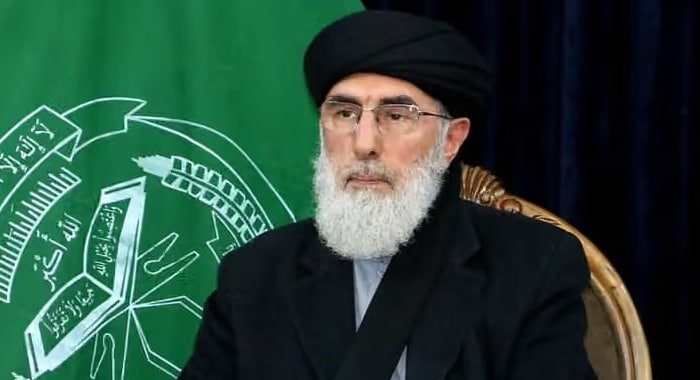
Hezb-e-Islami leader Gulbuddin Hekmatyar has called on members and supporters of his party to sever ties with individuals who support or endorse the Taliban and its policies, effectively demanding that members choose between continued affiliation with his party and allegiance to the interim Taliban administration.
In a recent message, Hekmatyar addressed what he described as the party’s sincere and committed members and instructed them to cut organizational ties with those supporting or praising the policies of the Taliban as well as a range of other political movements and historical regimes.
He also directed party members who have joined the interim Taliban administration or other political movements to distance themselves from Hezb-e-Islami.
Hekmatyar told such individuals to remain committed to the groups they now support and to stop identifying themselves with Hezb-e-Islami.
Although his message mentioned several political currents, including the former monarchy, the government of Sardar Mohammad Daud Khan, communist movements, Jamiat-e-Islami and the Nazar Council, a member of Hezb-e-Islami said its primary target was the Taliban.
According to the party member, some Hezb-e-Islami members have recently expressed support for Taliban supreme leader Sheikh Hibatullah Akhunzada and the policies of his administration. Hekmatyar’s message was intended to make clear that such members cannot simultaneously maintain their affiliation with Hezb-e-Islami.
The party member described the message as a choice between supporting the Taliban and remaining a member of Hezb-e-Islami, saying those who have sided with the Taliban should no longer claim affiliation with the party.
The reference to other political movements and past regimes was described as reflecting the party’s broader opposition to various political currents, rather than indicating that those groups were the immediate focus of Hekmatyar’s warning.
A Growing Rift With the Taliban
The latest message adds to Hekmatyar’s increasingly critical stance toward the Taliban and signals growing friction between the two Islamist political movements.
Hezb-e-Islami and the Taliban historically opposed the former Afghan government and the presence of US forces in Afghanistan, although their political trajectories later diverged. Hekmatyar eventually signed a peace agreement with the former Afghan government after years of armed opposition.
Following the Taliban’s return to power, some Hezb-e-Islami members joined the Taliban administration, while several prominent Taliban figures have themselves previously been associated with Hezb-e-Islami.
Hekmatyar, however, has repeatedly criticized Taliban policies, particularly their approach to governing Afghanistan, and has called for elections to determine the country’s future political system.
His confrontation with the Taliban has intensified in recent months. After the Taliban imposed restrictions on his political activities, Hekmatyar left Afghanistan and has reportedly been residing in Malaysia.
The Taliban have also revoked the licenses of political parties and prohibited political activities by parties and their leaders, further shrinking the space for organized political opposition inside Afghanistan.
Against this backdrop, Hekmatyar’s latest directive represents more than an internal party disciplinary measure. It underscores the widening political divide between the Hezb-e-Islami leadership and a Taliban administration that has increasingly sought to eliminate organized political competition.
By demanding that members choose between Hezb-e-Islami and support for the Taliban, Hekmatyar is effectively drawing a new political line within his own movement, one that places loyalty to the party above support for the Taliban’s current rule.



