
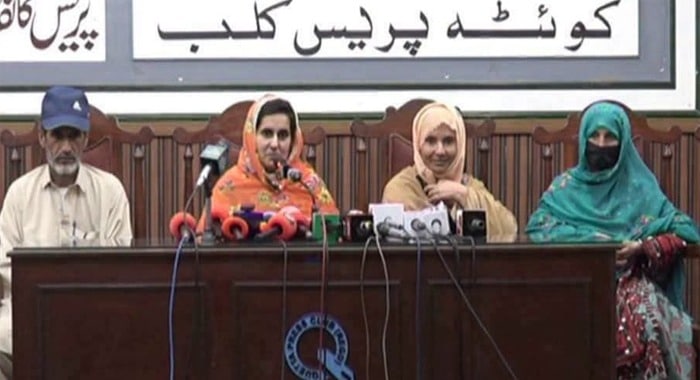
Two women, Khadija Peer Jan and Safia Abdul Khaliq, have publicly described their alleged association with banned terrorist organizations in Balochistan, providing accounts of how family relationships, emotional influence, trust and psychological manipulation can be used to draw young people particularly women into violent extremist networks.
Speaking at a press conference in Quetta, the two women discussed their experiences, the circumstances surrounding their recruitment, their alleged involvement in terrorist activities and the reasons that ultimately led them to reject the path they had entered.
For several months, the names of Khadija Peer Jan and Safia Abdul Khaliq had reportedly featured in narratives concerning missing persons. During their public appearance in Quetta, however, both women spoke about their alleged links with banned organizations and described their decisions to distance themselves from those networks.
Their accounts raise broader questions about the methods allegedly employed by terrorist organizations to recruit young people and the vulnerability of individuals who may be introduced to extremist networks through people they know and trust.
Khadija Peer Jan, a nursing student from the Tamp area of Turbat, described how her personal and family relationships allegedly became a pathway into a banned organization. According to her account, her husband was associated with the banned Balochistan Liberation Front (BLF). She said that her husband initially influenced her brother and subsequently brought her into the organization’s network.
Khadija said that she was gradually drawn toward activities directed against the state and later acknowledged involvement in an explosion in the Nokkundi area of Nushki. During her remarks, she expressed regret over her actions and appealed to other Baloch young people not to become involved in terrorist activities. Her account highlights a particularly troubling dimension of extremist recruitment: the transformation of ordinary personal relationships into channels through which individuals can be introduced to violent networks.
A young woman pursuing nursing education an area fundamentally associated with caring for and saving human lives was, according to her own account, gradually drawn in the opposite direction toward activities involving violence.
Safia Abdul Khaliq provided another account of alleged recruitment through a family connection. According to Safia, a cousin associated with the banned Balochistan Liberation Army (BLA) introduced her to the organization. She stated that a BLA commander subsequently provided her with a new mobile phone and instructed her to learn how to drive.
According to her account, these steps were intended to prepare her to carry out a suicide attack using a vehicle. The account illustrates how alleged recruitment can progress from an initial introduction to increasingly structured preparation for violence. It also raises questions about the role of senior commanders who allegedly recruit and prepare young people for dangerous operations while remaining removed from the immediate consequences of those attacks.
The accounts provided by the two women have brought renewed attention to the use of women in terrorist activities. One of the most disturbing aspects of such recruitment is the alleged effort to turn young women into instruments of violence while those directing the operations remain away from the scene of the attack. The use of women as potential suicide attackers raises fundamental questions about the methods employed by terrorist organizations to advance their objectives and the human cost imposed on the individuals they recruit.
Young women who could otherwise pursue education, employment, family life and productive careers can have their futures fundamentally disrupted when they are exposed to extremist recruitment and violent networks. The consequences extend beyond the individual. Families can lose daughters, sisters, wives and mothers, while communities can suffer from the fear, destruction and loss of life resulting from terrorist attacks.
The accounts of Khadija and Safia also point to the significance of personal relationships in the alleged recruitment process. Rather than necessarily beginning with a direct approach from an unknown recruiter, extremist recruitment can occur through existing relationships involving spouses, relatives, friends or other trusted individuals.
Such relationships can provide recruiters with access to individuals who might otherwise be difficult to reach. According to the accounts presented in Quetta, emotional influence and psychological pressure can then be used to reinforce the relationship between the recruit and the organization. This underscores the importance of recognizing early warning signs of extremist recruitment and ensuring that young people have access to education, family support and credible alternatives to violent narratives.
The alleged preparation of young people for suicide attacks represents a particularly serious threat to society. Recruiting an individual for a suicide mission does not merely place the intended victim of the attack at risk. It also places the recruit’s family, bystanders, security personnel and members of the wider community in danger.
The recruitment of young women and minors is especially concerning because of the irreversible consequences for individuals whose education, personal development and future prospects may be interrupted or destroyed. The broader social cost includes bereaved families, traumatized communities and the continued cycle of violence that terrorist organizations seek to sustain.
The accounts of Khadija Peer Jan and Safia Abdul Khaliq have emerged against the backdrop of other cases in which Pakistani authorities have reported efforts by banned terrorist organizations to use women and girls in suicide attacks. In March 2026, authorities reportedly announced the arrest of a suspected female suicide attacker in Khuzdar. In August 2026, authorities also reported the recovery of two girls, aged 16 and 12, who were allegedly being prepared for suicide attacks.
Such cases highlight the importance of preventing the recruitment of young people before they are placed in situations where they can become perpetrators or victims of terrorist violence. Effective intervention at an early stage can potentially prevent the loss of innocent lives and protect families from the devastating consequences of extremist recruitment.
The statements by Khadija and Safia also raise a fundamental question about the recruitment practices of terrorist organizations. If the leaders and commanders of such organizations regard their stated objectives as requiring extreme personal sacrifice, questions naturally arise about why the burden of that sacrifice is so often placed on young men and women from ordinary families.
Why are the sons and daughters of ordinary Baloch families allegedly recruited for dangerous operations while the commanders directing those operations remain removed from the immediate risks? The question goes to the heart of the recruitment model described in the two women’s accounts: whether young people are being encouraged to sacrifice their own lives for objectives determined by individuals who themselves do not participate directly in the attacks.
Both Khadija Peer Jan and Safia Abdul Khaliq reportedly expressed regret over their association with banned organizations and appealed to other young Baloch people not to follow the same path. Their message emphasizes the importance of choosing education, family, lawful employment and constructive civic participation over violence.
The accounts also demonstrate how an individual’s circumstances can change dramatically when extremist organizations gain access through trusted relationships and gradually expose recruits to increasingly radical ideas and activities.
Preventing such recruitment requires not only security measures but also awareness within families, educational institutions and communities.
The experiences described by the two women underscore what can be lost when young people are drawn into terrorism. A nursing student can lose the opportunity to build a career dedicated to saving lives. A young woman can instead find herself being prepared for an operation designed to take lives. A family can lose a daughter or sister, while an entire community can become exposed to violence and instability.
Countering extremist recruitment therefore involves protecting more than physical security. It also means protecting young people’s education, aspirations, family relationships and opportunities to build peaceful and productive lives.
The reported use of women and girls in violent and suicide operations also raises broader cultural and religious concerns. The practice of placing young women and children in situations where they are expected to participate in acts of violence has been criticized as inconsistent with the values of protecting human dignity and preserving life.
Within Baloch society, family, dignity, respect and the protection of women hold important social significance. Similarly, Islamic teachings place strong emphasis on the sanctity of human life and the protection of innocent people. The exploitation of women and minors for terrorist purposes therefore represents not only a security challenge but also a profound human and social concern.
The testimonies presented by Khadija Peer Jan and Safia Abdul Khaliq provide a human perspective on the consequences of extremist recruitment.
Their accounts describe a journey in which family connections and personal relationships allegedly became gateways to terrorist networks, followed by increasing exposure to violent activities and, in one case, preparation for a suicide attack. Their subsequent decision to reject that path and speak publicly about their experiences offers an opportunity for greater public discussion about how recruitment occurs and how young people can be protected from exploitation.
The broader challenge remains to prevent terrorist organizations from exploiting family relationships, emotional vulnerabilities and the aspirations of young people for violent purposes. Protecting young people from recruitment means ensuring that education, opportunity, family support and peaceful avenues for addressing grievances remain stronger than the narratives offered by violent extremist organizations.
The experiences described in Quetta serve as a reminder that terrorism does not only destroy lives at the moment an attack occurs. Its destructive reach can begin much earlier when trust is exploited, young minds are manipulated and individuals are persuaded to abandon their education, families and futures for the objectives of those directing terrorist networks.



