
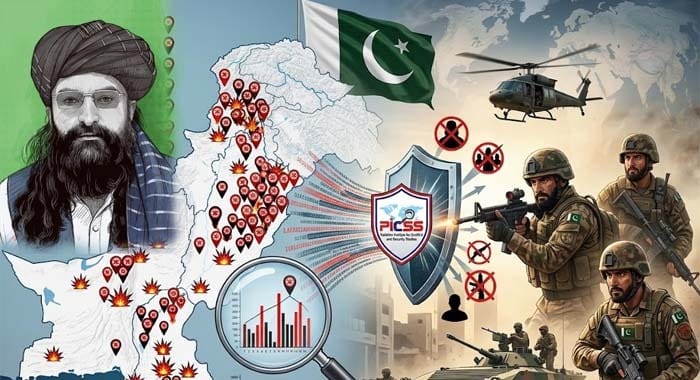
The Tehreek-e-Taliban Pakistan (TTP) continued to pursue an extensive campaign of organisational consolidation, geographical expansion, technological adaptation and ideological mobilisation during the third quarter of 2026, according to the Pakistan Institute for Conflict and Security Studies (PICSS) Weekly Insight reports covering July–September. The assessment highlights the organisation’s efforts to strengthen its central command under Mufti Noor Wali Mehsud, incorporate smaller terrorist factions, extend its reported operational presence beyond its traditional strongholds, and expand propaganda and recruitment activities across multiple regions of Pakistan.
The developments documented during the quarter indicate that TTP sought to present itself as an increasingly organised and geographically dispersed terrorist network, combining attacks against security personnel with technological experimentation, suicide operations, coercive influence over local communities and an extensive propaganda apparatus. Its public messaging increasingly highlighted activities across Khyber Pakhtunkhwa, claimed operations in Balochistan, and attempts to project a presence in southern Punjab and Sindh.
At the same time, the organisation faced significant challenges, including leadership losses, competition from rival terrorist formations, reported clashes over territorial and financial interests, and unconfirmed accounts of tensions with the Afghan Taliban authorities.
The quarterly assessment underscores the importance of distinguishing between TTP’s own operational claims and independently documented incidents while examining the broader implications of its organisational expansion for Pakistan’s internal security.
Organisational consolidation remained a central priority for TTP throughout the third quarter of 2026. The organisation continued to seek the allegiance of smaller terrorist factions and bring local commanders under the authority of Mufti Noor Wali Mehsud, reflecting an effort to strengthen centralised leadership while broadening its geographical reach.
On 8 July, TTP announced that two terrorist factions had pledged allegiance to Mufti Noor Wali Mehsud. The factions were led by Hafiz Saifullah Baloch from Chagai district in Balochistan and Mufti Abbas, alias Ansari, from Buner district in Khyber Pakhtunkhwa.
The consolidation process continued in September. On 16 September, TTP announced the incorporation of several additional factions originating from Mohmand, Bajaur and the Quetta-Harnai area. The announcement identified Mufti Muawiya, Maulvi Khalid, Qari Yasin, Shaukat and Maulvi Waliullah among the local leaders pledging allegiance. According to the announcement, the joining factions originated from Anbar/Ambar, Khwaizai Baizai and Safi in Mohmand, Riyasat in Bajaur, and Quetta-Harnai.
These developments reflected TTP’s continuing strategy of bringing smaller armed formations under a centralised leadership structure. The geographical distribution of the reported affiliations also indicated an effort to extend its organisational networks beyond the former tribal districts into settled areas of Khyber Pakhtunkhwa and different parts of Balochistan.
However, announcements of allegiance alone do not establish the actual strength, operational integration or command cohesion of the joining factions. Their significance must therefore be assessed alongside independently verifiable evidence of organisational activity.
TTP’s leadership and command structure underwent notable developments during the reporting period, reflecting the organisation’s efforts to project stability while maintaining continuity following the loss of senior figures.
On 4 August, Umar Media released a 23-minute video featuring TTP chief Mufti Noor Wali Mehsud. The production marked his first major visual appearance in 2026 and his first confirmed video appearance since October 2025.
The video depicted Mehsud travelling through mountainous areas, meeting armed terrorists and interacting with individuals presented as local residents, including mine workers in the Para Chamkani area of Kurram. Although the filming locations could not be independently verified, the production appeared intended to demonstrate the leader’s accessibility, continued involvement in organisational affairs and authority over the organisation.
The appearance carried significance for TTP’s propaganda strategy because it sought to reinforce leadership visibility and organisational continuity at a time when the group was attempting to consolidate its networks and expand its reported presence.
On 5 August, TTP confirmed the death of its Orakzai wali, Amir al-Bahr Muawiya, also known as Ahmadur Rahman, reportedly killed during a security operation in Hangu. The organisation announced Muhammad as his successor and Abubakr as deputy.
The appointment of replacements demonstrated TTP’s stated effort to preserve its local command structure following leadership losses. The development also highlighted the importance the organisation attached to maintaining administrative and operational continuity despite pressure from security operations.
Taken together, the leadership appearance and subsequent succession announcement reflected two parallel priorities: projecting stability to supporters and maintaining organisational structures following the loss of individual commanders.
Geographical expansion emerged as one of the most prominent features of TTP’s operational messaging during July–September 2026. North and South Waziristan remained the organisation’s principal operational centres, but its claims and propaganda increasingly highlighted activities in Peshawar, Dera Ismail Khan, Tank, Hangu, Kurram, Bajaur, Lower Dir and other settled districts of Khyber Pakhtunkhwa.
TTP also publicised claimed attacks or an operational presence in Balochistan, including Ziarat, Pishin and Panjgur. The Panjgur claim attracted particular attention because it suggested an attempt to project influence beyond Balochistan’s predominantly Pashtun belt into Baloch-majority areas. However, a publicised attack does not, by itself, establish a sustained terrorist network or durable local presence.
In September, Umar Media circulated a video featuring former media chief Chaudhry Muneeb-ur-Rehman Jatt, also referred to as Muneeb Ahmad Jutt or Commander Muneeb, accompanied by armed terrorists. The production sought to project TTP’s presence in southern Punjab.
Towards the end of the quarter, a separate video featuring armed individuals and a message in Sindhi attempted to establish the perception of TTP influence in Sindh and encourage local support.
The filming locations and the actual extent of the networks associated with these productions could not be independently established. Nevertheless, the material reflected an effort to portray TTP as an organisation with ambitions extending beyond its traditional areas of influence and seeking to appeal to audiences across different linguistic and geographical communities. The distinction between propaganda-driven geographical claims and a demonstrable operational presence remains essential when evaluating the organisation’s actual reach.
Chaudhry Muneeb-ur-Rehman Jatt, a Punjabi figure previously associated with al-Qaeda in the Indian Subcontinent and the long-time head of Umar Media, underwent a reported change in organisational responsibilities during the quarter.
On 5 July, TTP appointed Engineer Abdullah as its new media chief, replacing Jatt, and announced changes across its website, video-production and social-media divisions. By September, Jatt was no longer identified as head of the media wing. Reporting indicated that Engineer Abdullah had succeeded him in the role.
In a video released around 22 September, Jatt addressed residents of southern Punjab, claimed that TTP maintained an operational presence in the province, criticised Pakistan’s political and military establishment, and appealed for public support. The shift from senior media responsibilities to public messaging directed at southern Punjab suggested a possible reassignment towards field or regional responsibilities. However, the precise nature of his new role was not independently established.
The development coincided with TTP’s continued efforts to broaden its recruitment narratives beyond its traditional Pashtun base and present its campaign as relevant to audiences elsewhere in Pakistan. The reported restructuring also highlighted the organisation’s efforts to maintain distinct functions for leadership, media production and regional outreach.
TTP’s monthly operational reports portrayed an extensive campaign of terrorist violence during the third quarter of 2026. According to the organisation’s own figures, it claimed 315 attacks in July, 406 in August and 334 in September, bringing the combined quarterly total to 1,055 claimed attacks.
The group’s July report claimed that 304 security personnel had been killed, 477 injured and 68 captured. In August, TTP claimed 294 security personnel killed, 352 injured and 31 captured. Its September infographic reported 213 killed, 382 injured and 45 captured.
Taken together, TTP’s monthly claims amounted to 811 security personnel killed, 1,211 injured and 144 captured during the quarter. These figures represent the organisation’s own reported totals and have not been independently verified. They should not be confused with independently documented terrorist attacks or casualty figures recorded in the PICSS Militancy Database.
The reports described a wide range of claimed activities, including armed assaults, guerrilla attacks, clashes with security forces, sniper and laser-sighted attacks, ambushes, improvised explosive devices, targeted killings, quadcopter attacks and suicide operations.
August recorded the highest number of claimed attacks, with 406, compared with 315 in July and 334 in September. Although the reported number declined from August to September, the organisation continued to publicise an extensive campaign of violence and maintain a substantial volume of propaganda.
The figures offer insight into how TTP portrayed the scale and intensity of its campaign. However, terrorist organisations have incentives to exaggerate operational achievements, casualties and geographical reach. Independent verification is therefore necessary before these claims can be treated as an accurate measure of actual terrorist activity or operational effectiveness.
TTP’s propaganda increasingly highlighted drones and other surveillance or attack technologies, reflecting the growing prominence of technological capabilities in its operational messaging. Footage associated with the late-July assault on the Khazina Banda police and Counter Terrorism Department checkpost in Hangu showed automatic weapons and drones. Other productions displayed quadcopters, night-time operations and attacks on military vehicles.
In a July interview, TTP spokesperson Muhammad Khurasani claimed that the organisation was seeking long-range missile capabilities and expanding its use of quadcopters and thermal-imaging devices. These statements indicated the group’s stated interest in acquiring or developing capabilities that could support surveillance and attacks. However, an expressed ambition to obtain advanced weaponry does not establish that the organisation possesses the corresponding operational capability.
TTP’s August operational report also claimed limited missile activity, but the PICSS assessment noted an absence of independently documented missile attacks in the evidence reviewed. The quarter’s developments therefore highlighted both the growing prominence of technology in TTP’s operational messaging and the need to distinguish between demonstrated capabilities, claimed activities and future ambitions. The repeated use of drone footage and references to advanced equipment also served a propaganda purpose by projecting an image of technical competence and operational modernisation.
Suicide operations remained a prominent feature of TTP’s claimed operational activities and propaganda during the quarter. The organisation publicised the July attack on the Manji Khel police post in Tank and subsequently released the 19th episode of its Shaheen Jawan series, featuring an individual identified as Daud, whom TTP described as a suicide attacker involved in the operation.
The production included an interview with an elderly man identified as the attacker’s father. It used familial endorsement and religious arguments to glorify the attacker’s actions and portray suicide violence as an expression of ideological commitment. Towards the end of September, TTP released footage relating to the 26 September suicide attack against the Aman Mela joint police and customs checkpost in Darazinda, Dera Ismail Khan.
The organisation identified the attacker as Abu Dujana, a member of what it described as its special istishhadi force. The production depicted the use of an explosives-laden tractor-trolley. These productions demonstrated the importance TTP attached to presenting suicide attackers as ideological role models, commemorating those involved in attacks and providing religious justifications for terrorist violence.
The Shaheen Jawan series and related material formed part of a wider recruitment and mobilisation strategy. By personalising attackers and presenting their actions through family interviews, religious interpretation and commemorative narratives, the organisation sought to normalise suicide violence among sympathetic audiences. The productions also helped sustain the group’s internal narrative by portraying operational losses and deaths as sacrifices in pursuit of its ideological objectives.
Media consolidation constituted another significant development during the quarter. On 5 July, TTP appointed Engineer Abdullah as its new media chief, replacing Muneeb-ur-Rehman Jatt, and announced changes across its website, video-production and social-media divisions.
Under Jatt, Umar Media had expanded its multilingual output, improved production quality and increasingly incorporated emerging technologies, including AI-assisted content generation. The leadership transition indicated continued institutionalisation of TTP’s information operations. Rather than relying solely on isolated statements or individual attack claims, the organisation maintained a diversified output of recurring series, interviews, documentaries, podcasts, magazines and other publications.
Throughout the quarter, Umar Media sustained productions including Rasm-e-Mohabat, Operation Khyber, Dawat-e-Jihad, Tyar Hain Hum, Shaheen Jawan, Eiqaz and Rabt-e-Millat. These productions combined footage of claimed attacks, military training, religious interpretation, organisational messaging and profiles of deceased terrorists.
The diversity of formats enabled TTP to communicate different messages to different audiences, ranging from operational propaganda and leadership visibility to ideological instruction, recruitment and the commemoration of those killed while participating in terrorist activities. The sustained output suggested that media production remained an established organisational function rather than an incidental activity.
TTP’s propaganda during the quarter sought to reinforce its ideological position, delegitimise Pakistan’s political system and justify its armed campaign. The July special edition of Majallah Taliban, titled Hum Kaun Hain? (Who Are We?), presented a comprehensive account of the organisation’s ideological position. It rejected Pakistan’s constitutional and parliamentary system in favour of governance based on TTP’s interpretation of Sharia.
The publication also invoked historical grievances concerning military operations in the former tribal districts to justify continued armed resistance In August, the 17th episode of Rabt-e-Millat featured Mufti Nadeem Khan Darweesh, who argued that Pakistan had failed to fulfil the religious objectives associated with its creation and presented Taliban rule in Afghanistan as a model of Islamic governance.
The production sought to mobilise religious scholars against Pakistan’s political system or, at minimum, discourage opposition to TTP’s armed campaign. Other releases glorified wounded and deceased terrorists, portrayed battlefield losses as religious sacrifices and encouraged clandestine medical assistance to injured fighters. TTP also released documentaries commemorating former commanders, including Umar Rahman, alias Ustad Dawood Fateh, a former TTP leader in Malakand Division.
Collectively, these productions sought to reinforce internal discipline, preserve the organisation’s narrative of sacrifice, sustain recruitment and provide an ideological justification for continued terrorist violence. The campaign illustrated how TTP combined organisational communication with attempts to reshape political and religious perceptions among its intended audiences.
TTP also sought to exploit local grievances, challenge state authority and discourage community resistance to its activities.
Senior Rahbari Shura member Peer Ain-ul-Zaman issued messaging concerning Balochistan and the adjoining Pashtun belt. His statements sought to exploit grievances associated with security operations while discrediting government-backed peace committees.
In July, a TTP commander operating in Tank warned police personnel, tribal elders and local residents against cooperating with such committees and criticised government institutions.
In August, a commander identified as Aryana Paindakhel reportedly threatened residents of certain houses in Domel, Bannu, warning of consequences if they failed to vacate their properties by 25 August. The authenticity and circumstances of the warning remained unclear. These statements reflected TTP’s attempts to exert coercive influence over communities, discourage cooperation with state institutions and weaken locally organised resistance to terrorist activity.
The targeting of police personnel, tribal elders and peace committees in the organisation’s messaging also indicated that its campaign extended beyond direct attacks on security forces to attempts to influence community behaviour in areas where it sought a foothold.
Such intimidation, when substantiated, represents an additional dimension of the security challenge because it can undermine local resistance, constrain civilian cooperation with authorities and create an environment of fear.
TTP attempted to position itself within wider religious and public debates by issuing statements concerning events and individuals outside its established organisational activities.
The organisation issued condolence statements following the deaths of religious figures, including Maulana Aziz-ur-Rahman Jalandhari and Maulana Ehsan-ul-Haq, despite no established organisational relationship with them. Following a hospital fire at the Pakistan Institute of Medical Sciences in Islamabad in August, spokesperson Muhammad Khurasani expressed condolences over the deaths of newborn babies while blaming alleged government negligence.
These interventions appeared designed to portray TTP as responsive to public suffering and religious sentiment while criticising state institutions and seeking to broaden the reach of its messaging.
The organisation’s Independence Day propaganda similarly attempted to exploit domestic political discontent. It used footage of demonstrations supporting imprisoned Pakistan Tehreek-e-Insaf leader Imran Khan to reinforce its anti-state narrative.
TTP claimed to have conducted 74 attacks on 14 August alone, a figure that the corresponding PICSS Weekly Insight report assessed as highly exaggerated.
The use of public tragedies, religious figures and political demonstrations illustrated the breadth of issues TTP sought to incorporate into its propaganda. These communications formed part of an effort to exploit existing grievances and create the perception of wider public dissatisfaction with state institutions.
Such messaging should be evaluated in the context of the organisation’s broader campaign of violence and its stated opposition to Pakistan’s constitutional order.
Despite its efforts to consolidate command and expand its networks, TTP faced organisational competition from other terrorist formations.
The growing visibility of Ittehad-ul-Mujahideen Pakistan (IMP) and the renewed independent activities of Jamaat-ul-Ahrar (JuA) presented alternative centres of militant authority, potentially competing for recruitment, local influence, resources and organisational legitimacy.
These developments complicated TTP’s efforts to present itself as the principal organisational centre for terrorist activity across its areas of interest.
In August, a TTP leadership message delivered by Mufti Ghufran, a member of the Rahbari Shura and head of its media commission, emphasised obedience to commanders, organisational unity and the avoidance of internal disagreements.
The message appeared particularly relevant in the context of competition from rival formations. Its emphasis on discipline and unity highlighted the importance TTP attached to preserving internal cohesion while seeking to incorporate additional factions.
The emergence or renewed visibility of competing organisations does not, by itself, establish their relative strength or operational reach. Nevertheless, these developments indicate that TTP’s consolidation efforts were taking place within a broader and potentially competitive terrorist landscape.
Inter-group tensions also became evident during September.
On 13–14 September, fighting reportedly occurred in Kariz Kot, Lower South Waziristan, between TTP or a TTP-affiliated faction identified as the Rahmatullah Group and the Hafiz Gul Bahadur group. The confrontation reportedly resulted in casualties on both sides, including the death of a senior Hafiz Gul Bahadur group figure, Sohail Mughal Khel.
Reports linked the dispute to revenues associated with the chilgoza trade and extortion involving development projects.
If accurately reported, the confrontation highlighted the role of territorial influence and financial interests in shaping relationships between terrorist organisations. It also demonstrated that groups sharing broadly similar ideological positions may nevertheless come into conflict over access to revenue, local authority and economic resources.
The episode underscored the importance of examining terrorist rivalries not only through ideological differences but also through competition for control, influence and financial resources. Such disputes may affect local security conditions and complicate efforts to assess the relationships between different armed formations operating in the region.
The quarter also produced unconfirmed reports of tensions between TTP and the Afghan Taliban authorities. In late August, social-media accounts claimed that Mufti Noor Wali Mehsud had relocated permanently to Pakistan following disagreements with the Afghan Taliban leadership.
Other reports alleged that senior TTP figures had been detained, placed under restrictions or moved away from Afghan border areas amid growing Pakistani pressure. Neither TTP nor the Afghan Taliban officially confirmed these accounts. They therefore do not establish a definitive change in the relationship between the two organisations.
Nevertheless, the reports reflected uncertainty surrounding Afghanistan-based terrorist networks and the potential implications of continuing Pakistan–Afghanistan tensions for TTP’s leadership, movement and operational arrangements.
The issue remains relevant to Pakistan’s broader security concerns regarding cross-border terrorism. However, the precise circumstances of any restrictions, relocations or disagreements require further corroboration before firm conclusions can be drawn.
The developments documented during July–September 2026 suggest that TTP continued to pursue an ambitious programme of organisational expansion, operational adaptation and ideological mobilisation.
The reported incorporation of smaller factions, emphasis on central leadership, publicised activities across multiple provinces and sustained media production indicated an ambition to operate as a geographically dispersed terrorist organisation rather than remain confined to its traditional strongholds.
Its propaganda increasingly highlighted drones and other technologies, while its suicide-attack narratives, religious publications and community-directed messaging sought to reinforce recruitment, internal discipline and its ideological justification for violence.
At the same time, the organisation’s expansion efforts were accompanied by significant constraints. Security operations continued to result in leadership losses, rival terrorist formations challenged its organisational influence, reported clashes exposed competition over territorial and financial interests, and unconfirmed reports raised questions about possible pressures on its Afghanistan-based networks.
The organisation’s extensive propaganda output and operational claims should not be interpreted as conclusive evidence of equivalent gains in territorial control, recruitment or operational effectiveness. Independent verification remains necessary to determine the actual scale of its activities and the extent of its capabilities.
Nevertheless, the quarter’s developments demonstrate the importance of monitoring TTP across several interconnected dimensions: organisational integration, leadership continuity, geographical claims, operational activity, technological adaptation, recruitment narratives, coercive influence over communities and competition with other terrorist formations.
The third quarter of 2026 was marked by TTP’s continuing efforts to strengthen its central leadership, absorb smaller terrorist factions, project influence into new geographical areas and sustain an extensive propaganda campaign.
According to the organisation’s own monthly reports, TTP claimed 1,055 attacks during the quarter, alongside 811 security personnel killed, 1,211 injured and 144 captured. These figures remain the organisation’s own claims and have not been independently verified. Its reported activities, leadership developments and media productions nevertheless provide important material for assessing the organisation’s evolving strategy and priorities.
The quarter also highlighted the challenges accompanying TTP’s expansion, including leadership losses, competition from rival terrorist groups, reported inter-group clashes and uncertainty surrounding its relationship with the Afghan Taliban authorities.
For Pakistan’s security environment, the assessment underscores the need for sustained monitoring of terrorist networks, rigorous verification of operational claims, effective intelligence-led counterterrorism measures and continued attention to the propaganda and recruitment mechanisms through which terrorist organisations seek to maintain their influence.
The central finding of the Q3 2026 assessment is that TTP continued to pursue organisational expansion, geographical outreach and operational adaptation while facing persistent pressures from security operations, internal and inter-group competition, and uncertainty surrounding its wider regional relationships.



