
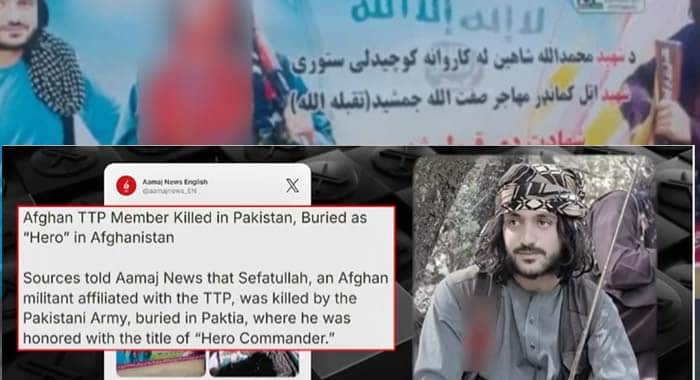
A reported memorial ceremony in Afghanistan for Safatullah, an Afghan national, Khawarij killed by the Pakistan Army, has brought renewed attention to Pakistan’s security concerns regarding cross-border violence and the alleged presence of anti-Pakistan Khawarij networks operating from Afghan territory.
According to Afghan media reports cited in the information provided, a condolence ceremony was held in Afghanistan for Safatullah, who was reportedly referred to as a “hero commander.” The reports further allege that posters displaying flags associated with Fitna al-Khawarij were exhibited at the gathering.
The reported ceremony has raised important questions about the public commemoration of individuals accused of involvement in attacks against Pakistan and the broader security environment surrounding anti-Pakistan Khawarij networks in Afghanistan. Pakistani authorities have repeatedly expressed concerns about Khawarij groups allegedly using Afghan territory to organise, facilitate, or support attacks against Pakistani security personnel and civilians. Islamabad has called for effective action against these networks, stressing that regional stability depends on preventing armed groups from exploiting cross-border access.
The reported ceremony has therefore renewed scrutiny of the activities of Khawarij networks, their public representation, and the allegations surrounding their presence in Afghanistan. However, the circumstances surrounding Safatullah’s death, the organisers of the ceremony, and the precise affiliations of those involved require independent verification.
According to the accounts cited, Safatullah was commemorated in Afghanistan following his reported death at the hands of the Pakistan Army. The reported description of the deceased as a “hero commander” and the alleged display of Fitna al-Khawarij-associated flags have drawn attention to how individuals accused of participating in anti-Pakistan violence are portrayed and commemorated across the border.
For Pakistani security observers, the reported gathering raises questions about the networks surrounding the individual and whether the ceremony reflects broader patterns of public support for Khawarij organisations. If independently verified, the reported details could provide relevant insight into the affiliations and activities of those involved. Nevertheless, the existence of a memorial ceremony alone would not conclusively establish that Afghanistan’s de facto authorities organised, financed, or officially endorsed the event.
Determining responsibility would require additional evidence concerning the organisers, participants, affiliations, and any connections with official institutions. Cross-border Khawarij activity remains a major national security concern for Pakistan. Pakistani authorities have accused groups operating from Afghan territory of supporting attacks against Pakistani security personnel and civilians.
Islamabad has consistently called for effective measures to prevent Afghan territory from being used to facilitate anti-Pakistan violence. Such measures include disrupting Khawarij recruitment networks, preventing logistical support for cross-border attacks, strengthening border security, and ensuring accountability for individuals responsible for violence.
The reported memorial has renewed attention to a particularly sensitive question: whether individuals accused of involvement in attacks against Pakistan continue to receive public recognition or support from affiliated networks after their deaths.
For Pakistan, the central issue is whether Khawarij organisations can maintain operational networks, recruit personnel, and exploit cross-border connections to threaten the country’s security. Any credible evidence of material assistance, organised coordination, or official protection for these networks would warrant serious investigation and an appropriate response through established security and diplomatic channels.
The reported ceremony has also brought renewed attention to allegations concerning connections between Afghanistan’s Taliban-led authorities and anti-Pakistan Khawarij networks. Pakistan has repeatedly raised concerns about the activities of Tehreek-e-Taliban Pakistan (TTP), which Pakistani authorities refer to as Fitna al-Khawarij, and associated individuals. Islamabad has called on the Afghan authorities to ensure that Afghan territory is not used to plan or facilitate attacks against Pakistan.
The reported presence of Khawarij-associated flags at Safatullah’s memorial may be relevant to understanding the affiliations of those involved. However, the display of a flag or symbol does not, by itself, prove direct institutional involvement by the Taliban administration. A reliable assessment would require corroborating evidence establishing the identities and affiliations of the organisers, the nature of the gathering, and whether official assistance or material support was provided.
Distinguishing between the activities of individual Khawarij, affiliated organisations, and government institutions is essential to establishing responsibility accurately.



