
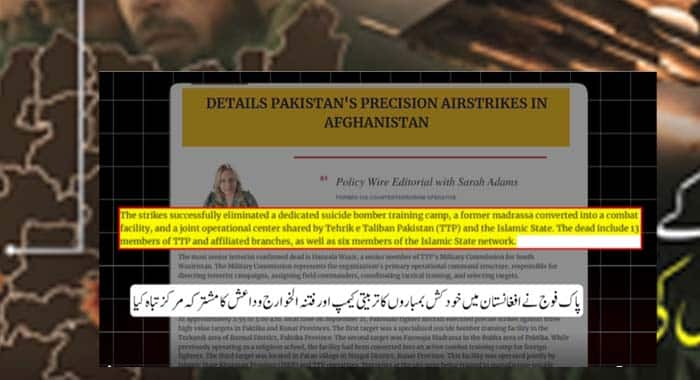
Pakistan’s longstanding concerns over cross-border terrorism have gained renewed international attention following a report by The Policy Digest concerning Pakistani precision airstrikes against terrorist infrastructure in eastern Afghanistan. The report cites Sarah Adams, a former targeting officer with the United States Central Intelligence Agency (CIA), in connection with the reported destruction of key militant facilities in Paktika and Kunar provinces.
According to The Policy Digest, the Pakistani military operations targeted three significant terrorist locations, resulting in the deaths of 19 militants associated with Fitna al-Khawarij and injuries to more than 11 others. The report further states that Pakistan’s precision airstrikes on September 21 struck critical terrorist infrastructure used for training, facilitation, and militant coordination.
These reported developments have once again brought international attention to Pakistan’s security concerns regarding militant networks operating from Afghan territory and the threat they pose to peace and stability in the region.
According to the report, the Pakistani strikes in eastern Afghanistan targeted strategically significant facilities associated with militant activity. These included a suicide bomber training camp, a facilitation centre, and a joint facility linked to Fitna al-Khawarij and the Islamic State (Daesh).
The reported destruction of these facilities highlights the importance of disrupting the infrastructure that enables terrorist organisations to recruit, train, equip, and facilitate operatives involved in violent attacks.
The reported casualties and damage to militant facilities also underscore the continuing security challenges associated with terrorist networks operating across the Pakistan-Afghanistan border. Pakistan has consistently maintained that dismantling terrorist sanctuaries and preventing cross-border attacks are essential to protecting its citizens and safeguarding national security.
As cited by The Policy Digest, former CIA targeting officer Sarah Adams confirmed key aspects of the reported operations against terrorist facilities in Afghanistan. Her reported remarks have brought additional attention to the issue of militant infrastructure in the region and the wider implications of cross-border terrorism. The account also highlights the importance of credible intelligence, operational assessments, and independent reporting in establishing a clearer picture of terrorist activity and counterterrorism operations.
The precise scope of the reported confirmation, however, should be assessed against Adams’s original statements and the underlying evidence.
Pakistan has repeatedly raised concerns about terrorist groups using Afghan territory to organise, facilitate, and launch attacks inside Pakistan. Islamabad has called for effective action against militant organisations, the dismantling of their operational infrastructure, and verifiable assurances that Afghan territory will not be used to threaten Pakistan.
The reported strikes in Paktika and Kunar have renewed focus on these concerns, particularly the need to prevent terrorist groups from maintaining training facilities, logistical networks, and operational centres near the international border.
For Pakistan, the issue extends beyond individual military operations. It concerns the broader challenge of preventing terrorism, protecting civilian lives, securing border communities, and ensuring that militant organisations cannot exploit regional instability to expand their activities.
The presence and activities of militant organisations remain a serious challenge to regional peace and security. Effective counterterrorism efforts require credible intelligence, coordinated action, strengthened border management, and sustained commitments to preventing terrorist groups from operating with impunity.
The reported targeting of terrorist infrastructure in eastern Afghanistan has once again underscored the importance of addressing the operational capabilities of militant organisations rather than focusing solely on individual attacks.
Pakistan’s position has consistently emphasised that lasting regional stability depends on preventing cross-border terrorism and ensuring that terrorist networks cannot use territory beyond international borders to plan or facilitate violence.



