
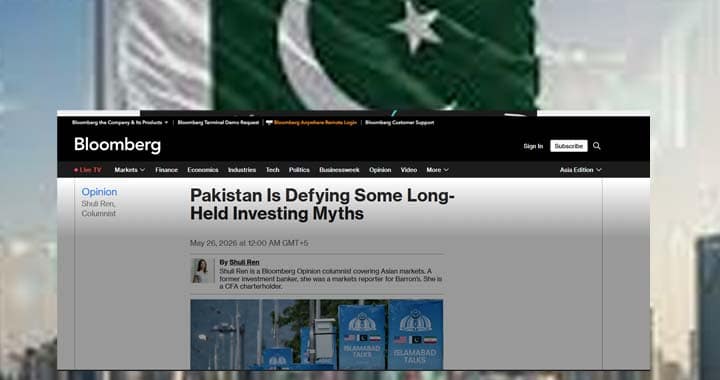
A recent opinion analysis published by Bloomberg has highlighted Pakistan’s unexpectedly strong economic resilience in the face of global geopolitical and financial turbulence, noting that the country is defying several long-held assumptions in emerging market investing.
The report, authored by Bloomberg Opinion columnist Shuli Ren, observes that despite heightened regional instability linked to the ongoing Iran conflict and disruptions affecting global energy routes such as the Strait of Hormuz, Pakistan’s financial indicators have remained comparatively stable. According to the analysis, the Pakistani rupee has held steady, while the country’s benchmark stock index has recorded only marginal losses for the year, reflecting relative market confidence under challenging external conditions.
The report further notes that Pakistan recently re-entered international capital markets after a prolonged absence, successfully raising significant sovereign financing that exceeded initial expectations. This return to global debt markets is presented as a signal of renewed investor interest and improved short-term financial credibility.
A key factor identified in the analysis is Pakistan’s continued engagement with the International Monetary Fund (IMF), including ongoing financial assistance programs and fiscal reform commitments. The report highlights that continued cooperation with multilateral institutions has helped restore a degree of investor confidence and has contributed to stabilizing macroeconomic expectations.
Beyond traditional economic indicators, the Bloomberg analysis emphasizes Pakistan’s evolving geopolitical role, describing the country as an emerging facilitator in broader regional diplomacy. It suggests that Pakistan’s perceived involvement as a communication channel in Middle Eastern tensions has contributed to renewed institutional attention from global investors.
The report also points to increasing financial and strategic engagement from major global partners, including China and Gulf states, particularly Saudi Arabia. These relationships have been reflected in investment inflows, loan extensions, and broader financial support mechanisms that have helped ease external financing pressures.
According to the analysis, such external backing has played a significant role in stabilizing Pakistan’s foreign exchange position, improving reserve levels, and reducing immediate concerns regarding balance-of-payments stress. While structural vulnerabilities remain, the report argues that geopolitical relevance is increasingly influencing financial perceptions of risk in emerging markets.
The article further notes that traditional investment frameworks—particularly those focusing solely on fiscal and external account weaknesses may not fully capture the evolving realities of countries like Pakistan, where strategic positioning and geopolitical relationships are playing a growing role in economic stability.
In conclusion, the Bloomberg analysis suggests that Pakistan’s recent performance challenges conventional assumptions about emerging market fragility. It argues that while economic vulnerabilities persist, the country’s strategic relevance and external partnerships have contributed to a more stable financial outlook than previously expected under similar conditions.
The report underscores a broader shift in global markets, where geopolitical considerations are increasingly intersecting with economic decision-making, reshaping how investors assess risk and resilience in developing economies.



