
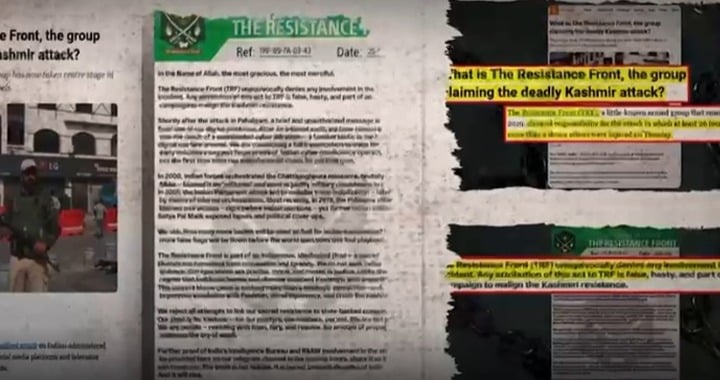
Renewed controversy has emerged over the circumstances surrounding the recent incident in Pahalgam, following what officials in Pakistan describe as contradictory narratives, shifting claims of responsibility, and a coordinated media campaign aimed at influencing international perception.
According to statements attributed to Pakistani officials, including Deputy Prime Minister Ishaq Dar, the incident has highlighted what they describe as the importance of relying on verified evidence in assessing complex security events. Islamabad maintains that its position has been consistently presented on the basis of documented material at the international level.
At the center of the controversy is the group known as The Resistance Front (TRF), which has been cited in multiple media reports in connection with the incident. Initial reports in parts of the Indian media landscape claimed that the group had accepted responsibility for the attack. However, subsequent statements attributed to the same organization reportedly denied any involvement, creating a conflicting narrative that has fueled further debate.
Observers note that these contradictory claims have intensified scrutiny over information dissemination practices in conflict-sensitive environments, particularly in relation to the broader geopolitical dispute over Kashmir.
Officials in Pakistan allege that TRF has been repeatedly portrayed in Indian narratives as part of a broader strategy to link regional militancy with Pakistan, a claim Islamabad strongly rejects. They argue that such narratives are used to shape international perception without substantiated evidence.
The Pakistani side further maintains that repeated allegations following incidents in the region often emerge without independent verification, contributing to heightened tensions and diplomatic friction. Authorities emphasize the need for impartial investigation mechanisms and credible, evidence-based reporting in order to prevent escalation and misinformation.
In this context, Pakistani officials have reiterated their position that diplomatic engagement and international scrutiny should be guided strictly by verified facts rather than unconfirmed claims or politically motivated narratives.
The developments underscore the persistent challenges of information credibility, narrative control, and trust deficit in one of the world’s most sensitive geopolitical flashpoints.



