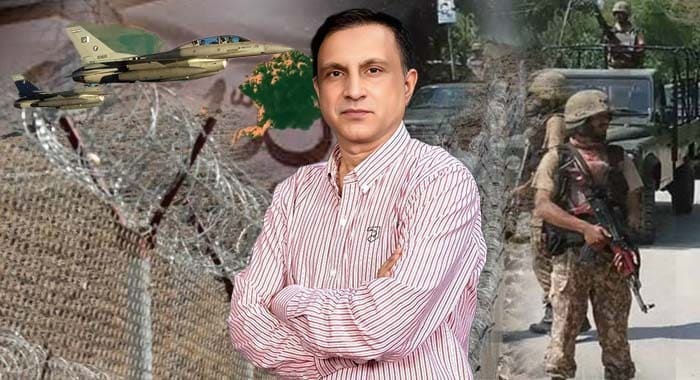
(Arshad Aziz Malik)
There is a pattern that no one in power wants to openly acknowledge, yet one that is staring us all in the face with brutal, undeniable clarity. Look carefully at the last ten, twelve, fifteen suicide bombings and conventional attacks that have shaken Pakistan’s tribal belt, its garrison towns, its checkposts, and its cities. Look at the perpetrators. Look at their nationalities. Look at where they came from, who trained them, who sent them, and who is sheltering those who gave the orders.
They are Afghans. Almost every single one of them.
This is not a casual observation. This is not anti-Afghan sentiment. This is a documented, verifiable, and deeply alarming operational reality that Pakistan’s security establishment, its policymakers, its diplomats, and frankly its people, can no longer afford to discuss in whispers. The time for diplomatic circumspection has passed. The time for hard truths has arrived.
For years, the Tehreek-e-Taliban Pakistan was understood, as its very name suggests, to be a Pakistani phenomenon Pakistani fighters, Pakistani commanders, Pakistani grievances, Pakistani soil. That understanding is now dangerously outdated. What we are witnessing today is a fundamental demographic transformation within the TTP’s operational ranks. Pakistani militants within the organisation are being systematically killed in security operations, captured, or they have quietly drifted away, choosing to live relatively peaceful lives within Afghanistan’s ungoverned spaces. In their place, Afghan fighters are being recruited at an accelerating pace, filling the operational vacuum with a ready supply of desperate, unemployed, and easily manipulated young men.
This is not an accident. This is a strategy.
Afghanistan today is the world’s single largest recruitment ground for terrorist organisations of every description. Intelligence reports, UN assessments, and independent security analyses converge on this uncomfortable conclusion with remarkable unanimity. Weapons are being smuggled into Afghanistan from across the globe, stockpiled in quantities that suggest preparation for sustained, large-scale violence. Young Afghan men robbed of education, employment, economic opportunity, and hope by five years of Taliban misrule are being funnelled into militant networks with an efficiency that any conventional military recruiter would envy.
The economics of this are hideously simple. When 80 percent of your population cannot reliably access food. When unemployment has destroyed the livelihoods of an entire generation. When the economy has not merely contracted but effectively collapsed. When inflation has rendered whatever savings families accumulated utterly worthless. When a young man wakes up with no school to attend, no job to go to, no future to plan for, and no government that sees him as a citizen rather than a subject he becomes extraordinarily easy to recruit. He becomes, in the cold vocabulary of terrorist organisations, available.
The recent security forces operation in North Waziristan that eliminated Khalid Raza al-Saleh and 45 of his associates represents genuine tactical success, and I do not wish to diminish the courage and professionalism of the men who carried it out. Khalid Raza was a genuine threat a mastermind of multiple suicide attacks, a facilitator of cross-border militancy, a man with a 40 lakh rupee bounty on his head who nonetheless evaded capture for years. He was directly implicated in the incidents around Bannu that claimed Pakistani lives. Dismantling his network was necessary and right.
But I must say something that is difficult but essential: killing Khalid Raza will not meaningfully reduce terrorism in Pakistan. Not because the operation was wrong, but because the architecture that produced him, trained him, funded him, and will now replace him, remains entirely intact across the border in Afghanistan.
These groups do not operate as conventional military hierarchies where eliminating the commander decapitates the organisation. They operate as distributed networks present in every district, adaptable in every terrain, capable of fragmenting and reconstituting with unsettling speed. The main commanders sit safely in Afghanistan, well beyond the reach of conventional Pakistani ground operations. What we kill in North Waziristan is the operational layer. The strategic layer the minds, the money, the ideology, the safe havens survives untouched.
This is the fundamental strategic trap Pakistan finds itself in. And until it is honestly acknowledged, no quantity of targeted operations, however well-executed, will alter the trajectory.
One aspect of this conflict that deserves urgent public understanding is the deliberate and systematic use of civilians specifically women and children as human shields by militant commanders. This is not an accusation I make lightly. It is an operational reality that directly shapes Pakistan’s military choices and that Taliban spokespeople like Zabihullah Mujahid cynically exploit in the information domain.
These commanders do not live in separate military compounds, isolated from civilian populations. They live among families. They sleep where women and children sleep. They conduct their communications and planning from within residential structures. This is calculated, not incidental. They know that Pakistan’s military, unlike some other forces, exercises genuine restraint when civilian casualties are likely. They know that striking a compound containing women and children creates international headlines that serve their propaganda interests even in death.
When Pakistan does conduct air strikes as it has now determined it must and collateral damage occurs, the Taliban propaganda machine activates immediately. Zabihullah Mujahid steps forward to mourn innocent women and children, making no mention of the commander whose network was responsible for martyring Pakistani soldiers. The commander’s body is hidden. The civilian casualties are amplified. The international narrative is shaped.
Pakistan has now made a decision that I believe is both painful and necessary: the use of human shields cannot be allowed to grant militant commanders permanent operational immunity. If these men choose to surround themselves with families their own families as a military tactic, the moral responsibility for any resulting harm lies entirely with them, not with the forces targeting them. Pakistan did not invent this terrible calculus. It has simply, finally, and with great reluctance, accepted it.
Here is something the international media consistently underreports: Afghans themselves are rising against the Taliban, and in growing numbers. In Herat, women took to the streets to protest dress code enforcement so extreme that even compliance with hijab requirements was deemed insufficient. They were met with batons and bullets. In Badakhshan, in eastern provinces, in province after province, Afghans are emerging to demand the rights that the Taliban have systematically stripped from them.
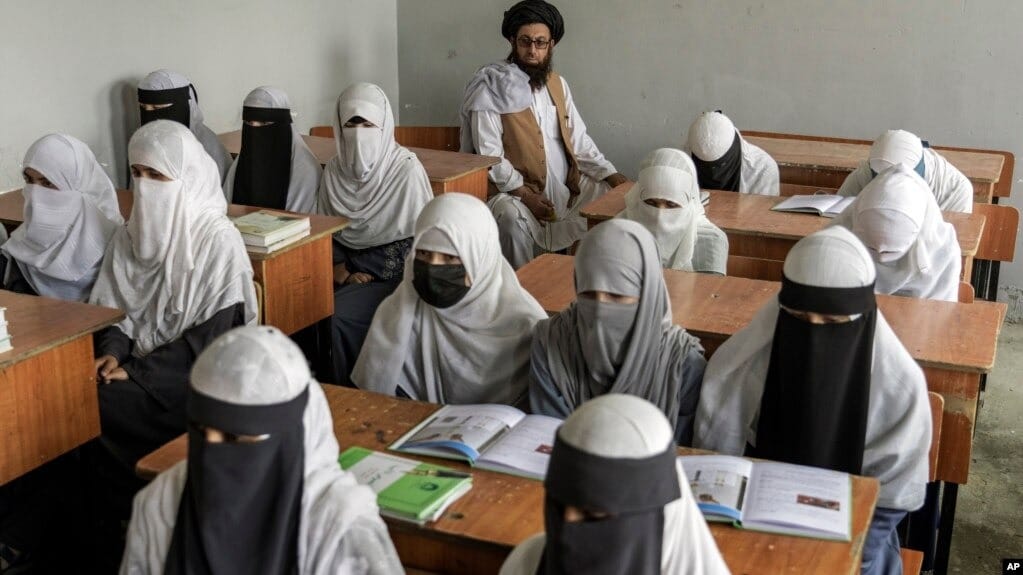
The Taliban’s response has been to criminalise dissent at every level. Posting footage of a protest on social media results in arrest and imprisonment. Personal freedom, freedom of expression, freedom of movement all have been reduced to privileges extended or withdrawn at the regime’s pleasure. Women cannot attend school. Women cannot work. Women cannot leave their homes without a male guardian. Women who dare to protest are fired upon.
And yet Afghanistan’s rulers travel to Moscow to issue threats against Pakistan. Mullah Mutaqi and Mullah Yaqub read statements boasting of their defiance. They negotiate from a position of apparent confidence. This confidence is sustained, in part, by international funding that continues to flow despite everything aid money intended for the Afghan people that is instead diverted to sustain a regime engaged in what can only be described as gender apartheid, while simultaneously exporting terrorism across the region.
The question I wish to put to Washington, to Brussels, to the United Nations, and to every government that continues to engage with or fund the Taliban in any form: at what point does your money become complicity? At what point does your silence become endorsement?
There was a moment, not long ago, when negotiation with the Taliban seemed worth attempting one more time. China was encouraging dialogue. Pakistan was watching to see what results previous negotiations had produced. Then came the attack on the FC post in Peshawar. Pakistani soldiers were martyred. Others were kidnapped, paraded in videos designed to humiliate the state and demoralise the public.
That moment ended the argument for negotiation, and I believe it ended it correctly. You cannot negotiate in good faith with an entity that conducts mass casualty attacks as a negotiating tactic. You cannot reward violence with dialogue without guaranteeing more violence. Pakistan tried. Pakistan watched. Pakistan was answered with blood.
What Pakistan can do what Pakistan must do is pursue intelligence-based, targeted military operations with sustained consistency. Not massive ground deployments that telegraph themselves days in advance, allowing militants to melt away into the mountains. Not operations so large that the mobilisation itself becomes a warning signal. Precise, intelligence-driven targeting that finds these commanders where they live, where they sleep, where they think they are safe.
Air operations in Afghan territory, where Pakistani ground forces cannot legally or practically operate, must remain on the table for the most senior commanders responsible for attacks on Pakistani soil. Not indiscriminate bombing targeted elimination of individuals directly responsible for Pakistani casualties, conducted with the same moral seriousness that Pakistan’s own military doctrine demands.
And through all of this, Pakistan must continue to press the international community America, China, Russia, the Gulf states, Europe to understand that an Afghanistan that exports terrorism, drugs, and weapons is not a regional problem. It is a global one. The recruitment networks operating from Afghan soil are drawing fighters from across the world. The weapons stockpiled there threaten stability far beyond South Asia.
I have spent years covering security affairs in this region. I have spoken to soldiers and analysts, to displaced families and surviving victims, to commanders and diplomats. And what I can tell you with certainty is this: the situation in Afghanistan is not stabilising. It is deteriorating. The Taliban’s grip on power is more fragile than their public posture suggests. Their economic failures are generating the very conditions — unemployment, hunger, despair that fuel the recruitment networks threatening regional security. Their internal contradictions are deepening. Their population is increasingly restless.
But fragility in a nuclear-adjacent, heavily armed, terrorism-exporting failed state is not reassurance it is alarm. A collapsing Taliban regime does not automatically produce stability. It can produce something worse.
Pakistan is not waiting for worse. Pakistan is acting now, with the tools it has, against an enemy that hides behind women and children, issues threats from foreign capitals, and exports its violence across an international border. It is doing so at great cost in Pakistani lives.
The least the world can do is stop pretending this is someone else’s problem.