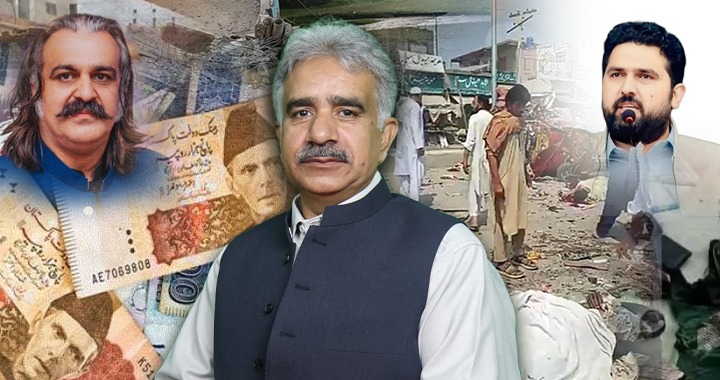
The debate surrounding Khyber Pakhtunkhwa’s deteriorating security situation once again intensified after the recent wave of terrorist attacks in Bannu, Lakki Marwat and adjoining districts, but the real question is no longer whether the province is facing a serious threat. The question now is whether the state structure responsible for confronting that threat was ever fully built for the kind of war it is currently fighting.
In my view, the Khyber Pakhtunkhwa police remains one of Pakistan’s most battle-tested forces. From Malik Saad to Safwat Ghayur and countless others, this force has paid in blood for standing on the frontline against terrorism. Unlike conventional policing elsewhere in the country, KP police spent years fighting an insurgency that transformed police stations, checkpoints and patrol vehicles into permanent targets.
But sacrifices alone cannot replace structural preparedness.
For years, governments spoke about reforms, modernization, counterterrorism capacity and Safe City projects. Billions of rupees were allocated under security and policing heads. Armored vehicles, surveillance systems, night-vision equipment, drones and fortified infrastructure were repeatedly announced. Yet the attacks taking place today expose an uncomfortable reality: many frontline police units still appear dangerously vulnerable.
The recent Bannu attack did not occur at an unknown location hidden somewhere in inaccessible terrain. The targeted checkpost had reportedly faced repeated attacks in the past. That naturally raises questions regarding threat anticipation, fortification planning and tactical reinforcement.
Terrorists adapt quickly. The state often reacts slowly.
That is the real crisis.
The problem is not merely weapons. The deeper issue is whether Khyber Pakhtunkhwa’s policing structure was genuinely transformed into a counterinsurgency-capable force after the merger of the former tribal districts. Many checkpoints in sensitive regions still resemble temporary outposts rather than hardened defensive installations suited for modern asymmetric warfare.
Meanwhile, the enemy has evolved.
Terrorist networks today operate through a combination of cross-border sanctuaries, local facilitators, propaganda ecosystems, quadcopters, targeted assassinations, suicide bombers and psychological warfare. Their objective is not simply territorial control. Their objective is exhaustion, fear and institutional demoralization.
This is precisely why the repeated argument that “police are not meant to fight terrorism” carries weight.
Traditionally, policing is designed around crime prevention, law enforcement and civil order. Counterinsurgency warfare is a different domain altogether. When police stations become frontline forts without corresponding upgrades in manpower, intelligence integration, aerial surveillance and defensive infrastructure, the burden placed on ordinary police personnel becomes extraordinarily dangerous.
Another serious issue is morale.
Senior officers themselves have repeatedly acknowledged that many officials hesitate to accept postings in high-risk districts because of inadequate facilities, limited protection and constant life threats. If officers operating in the most sensitive regions feel abandoned structurally, operational effectiveness inevitably suffers.
The governance dimension is equally important.
For years, political polarization consumed much of the province’s administrative energy while terrorism steadily reorganized itself across vulnerable districts. Instead of sustained institutional consensus on security, public discourse frequently drifted toward blame games between provincial and federal stakeholders. Terrorist organizations benefit enormously when governance fragmentation replaces strategic coordination.
No province confronting an insurgent threat can afford divided command thinking.
At the same time, the Afghanistan factor cannot be ignored. Districts such as Bannu, Lakki Marwat, Dera Ismail Khan and North Waziristan remain directly exposed to the broader cross-border militant ecosystem operating along the frontier belt. Pakistan’s concerns regarding terrorist sanctuaries inside Afghanistan are no longer isolated diplomatic complaints. Repeated operational findings, intelligence assessments and incidents involving Afghan nationals linked to Fitna al-Khawarij continue reinforcing those concerns.
However, external threats alone do not explain internal vulnerabilities.
A functioning counterterror model requires synchronized governance, capable policing, intelligence coordination, local community integration and rapid infrastructure reinforcement. Without that ecosystem, even brave and experienced forces remain exposed.
And that may be the most important point of all.
The men standing at isolated checkpoints are not failing the state. In many cases, the state has failed to fully prepare the men standing there.