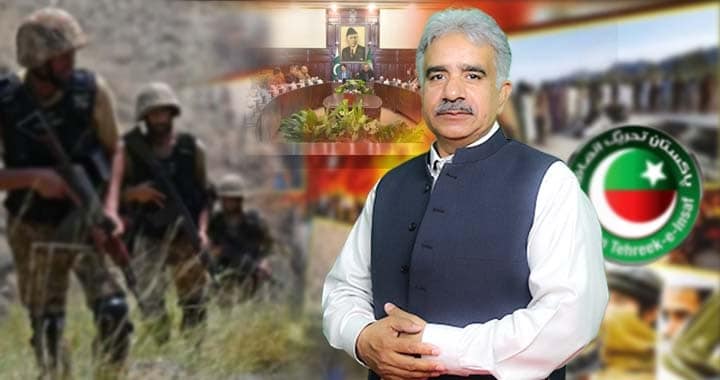
Khyber Pakhtunkhwa has reached a defining moment in its political and administrative history. The imposition of governor’s rule, the controversy surrounding emergency powers, the persistent threat of terrorism, the deteriorating relationship between provincial and federal leadership, and the growing frustration of ordinary citizens have placed the province at the centre of a crucial national debate. Yet beneath the political confrontation lies a more urgent question: can this extraordinary change in administration finally deliver the peace, stability, economic opportunity, and effective governance that the people of Khyber Pakhtunkhwa have long awaited?
This is not merely a contest between the federal government and Pakistan Tehreek-e-Insaf (PTI). Nor is it simply a debate over who possesses greater political authority. It is a test of whether Pakistan’s institutions can move beyond confrontation and establish a sustainable framework for security, development, and public accountability in one of the country’s most strategically important provinces.
For years, the people of Khyber Pakhtunkhwa have lived with the consequences of militancy, insecurity, economic disruption, political instability, and uncertainty about the future. Families have worried about their safety, businesses have struggled with unpredictable conditions, young people have searched for employment, and communities affected by violence have waited for meaningful rehabilitation. Against this background, governor’s rule must be judged by a standard far more demanding than political victory: whether it improves the lives of ordinary citizens. The central question is therefore not simply whether governor’s rule was necessary or politically justified. It is whether the new arrangement can restore the writ of the state, defeat terrorism through a coherent strategy, revive economic activity, rebuild neglected districts, and establish a culture in which every institution and political actor is held accountable for its performance.
The controversy surrounding governor’s rule has generated competing claims of constitutional necessity, political victimisation, and administrative intervention. Supporters argue that extraordinary circumstances require decisive action to address deteriorating security and governance. Opponents question the legitimacy of sidelining an elected provincial administration and warn against the concentration of executive authority.
Both positions demand serious examination. In a constitutional democracy, neither the federal government nor an elected provincial government enjoys unlimited authority. Every exercise of power must remain within the Constitution, subject to applicable legal procedures, and open to appropriate judicial scrutiny.
Articles 232, 234, and 245 of Pakistan’s Constitution address distinct matters. Article 232 concerns the proclamation of an emergency; Article 234 addresses circumstances in which a provincial government cannot be carried on in accordance with the Constitution; and Article 245 concerns the functions of the armed forces, including acting in aid of civil power. These provisions are not interchangeable, and the precise constitutional basis and procedural requirements for any intervention must be examined independently.
The legality of governor’s rule cannot be established merely by declaring it necessary. Equally, an elected government cannot place its performance beyond scrutiny simply by invoking its electoral mandate. The real test lies in constitutional compliance, respect for fundamental rights, due process, democratic accountability, and demonstrable improvements in public welfare. Extraordinary powers must not become instruments of political revenge, and political opposition must not become an excuse for neglecting the responsibilities of government.
If governor’s rule is to be defended as a measure for restoring stability, its defenders must demonstrate that it is lawful, proportionate, effective, and directed towards the public interest. If its opponents believe it is unconstitutional or unjustified, their objections must be assessed through evidence, legal argument, and institutional scrutiny rather than political rhetoric alone.
Constitutional authority becomes meaningful only when it serves the people. Without accountability, even the most forceful administrative intervention risks becoming another episode in Pakistan’s cycle of political confrontation.
Political parties often measure their success through electoral victories, public rallies, parliamentary strength, and the intensity of their supporters. Citizens, however, judge governments through more immediate realities: safety, employment, affordable living, education, healthcare, reliable infrastructure, and the freedom to conduct their lives without fear.
This is where the debate over Khyber Pakhtunkhwa must begin. Has the provincial administration delivered the level of security its people deserve? Have businesses enjoyed the stability required to invest and expand? Have industrial development and employment opportunities kept pace with the needs of a growing population? Have public institutions become more efficient? Have conflict-affected communities received the rehabilitation and services they need?
These questions cannot be answered through political slogans. They require evidence, transparent performance indicators, and a willingness to acknowledge failure wherever it exists. The problems of Khyber Pakhtunkhwa cannot be separated from Pakistan’s wider economic difficulties, federal policies, regional instability, and the long history of militancy. Nevertheless, these challenges do not remove the responsibility of provincial leaders to govern effectively within their constitutional jurisdiction.
Nor can weaknesses in one government be justified by pointing to failures elsewhere. The argument that other provinces or the federal administration have also struggled with governance does not make inadequate performance acceptable. Public accountability is not a competition to establish who has failed least.
Every administration must answer for its own decisions and results. Governor’s rule should therefore be accompanied by a transparent assessment of security, development expenditure, employment, public services, infrastructure, and the completion of promised projects. The same indicators should be used to assess the previous provincial administration wherever reliable data are available. The purpose should not be to manufacture a political verdict. It should be to establish what has worked, what has failed, and what must change.
One of the most consequential dimensions of the current crisis is the increasingly confrontational relationship between PTI and the federal government over counterterrorism, Afghanistan, and the role of state institutions.
The dispute is not simply about political language. It concerns competing understandings of national security, the limits of provincial authority, and the responsibility of elected leaders to protect the people they represent.
PTI and other opposition parties have every democratic right to question federal security policies, criticise military operations, demand transparency, and propose alternatives. National security cannot be used as a blanket justification for silencing legitimate political disagreement. Indeed, public scrutiny can strengthen policy by exposing weaknesses and encouraging more effective decision-making.
However, criticism must also be accompanied by credible alternatives.
A provincial government that disagrees with the federal counterterrorism strategy must explain how its preferred approach will prevent attacks, dismantle militant networks, protect police officers, safeguard civilians, and restore confidence in public institutions. It must identify practical mechanisms, measurable objectives, and safeguards against renewed violence.
The controversy becomes more serious when official government platforms are used to advance sweeping allegations about state institutions or national security decisions. Claims that the state deliberately promotes terrorism, or that particular institutions are responsible for violence, require credible evidence and proper investigation. Such assertions should not be treated as established facts simply because they are made by political figures.
At the same time, allegations of institutional misconduct should not be dismissed without examination. A mature democracy requires credible investigations, transparent decision-making, and lawful mechanisms for addressing wrongdoing.
The distinction is between responsible criticism and the use of unsubstantiated claims as political instruments. Political rallies may be dominated by emotional language, but official communications carry wider institutional responsibilities. Public officials must recognise that their statements can affect national cohesion, public confidence, and cooperation between security agencies and civilian authorities.
The people of Khyber Pakhtunkhwa did not elect their representatives merely to sustain an endless political confrontation. They elected them to govern, legislate, protect public interests, and deliver results.
The division of responsibilities between the federal government and provincial administrations is central to understanding the present crisis. Foreign affairs, international relations, and national defence are primarily federal responsibilities. Provincial governments, meanwhile, play essential roles in policing, local administration, public services, education, healthcare, rehabilitation, and the implementation of security-related measures within their jurisdictions.
The question of relations with Afghanistan, the return of Afghan nationals, and the national strategy against terrorism cannot be resolved through provincial political declarations alone. Equally, the federal government cannot expect a province facing the direct consequences of national security decisions to remain excluded from meaningful consultation.
Khyber Pakhtunkhwa is not a distant observer of Pakistan’s security challenges. It is among the regions most directly affected by militancy, displacement, border disruption, and the economic consequences of instability. Provincial leaders therefore need a meaningful role in discussions concerning the security of their citizens, the management of affected districts, and the humanitarian and economic consequences of federal policy.
Existing institutional mechanisms, including Apex Committees, relevant parliamentary and Senate committees, and other appropriate coordination forums, can help resolve disputes and develop common positions. Such forums must be more than ceremonial gatherings. They should provide substantive consultation, establish clear responsibilities, and monitor implementation.
If political leaders disagree with the federal approach, they should be able to present alternatives through institutional channels. If the federal government rejects those alternatives, it should explain why and demonstrate that its chosen strategy is likely to achieve better results.
The objective must be national coordination, not provincial subordination or federal confrontation. The question of Afghan nationals living in Pakistan has become a particularly sensitive point of political disagreement. Pakistan has hosted Afghan refugees for decades. Many families have developed deep social, economic, and cultural connections within the country. At the same time, the state has legitimate responsibilities concerning immigration enforcement, documentation, border management, and national security.
These responsibilities must be reconciled through a lawful and carefully differentiated policy.
Registered refugees, people holding other valid documentation, undocumented migrants, and individuals with specific protection concerns cannot simply be treated as one undifferentiated category. Nor should Afghan identity or undocumented status automatically be equated with involvement in militancy. The federal government has the authority to establish national immigration policy within the applicable legal framework. Provincial administrations must cooperate in lawful implementation, while ensuring that individual cases are handled fairly and that humanitarian considerations are not ignored.
The political tendency to frame every enforcement decision as hostility towards Afghan people is unhelpful. Equally, portraying every Afghan national as a potential security threat is unjust and counterproductive. Effective border management requires reliable documentation, intelligence cooperation, transparent procedures, and action against individuals who can be shown to pose genuine security threats. It must also include safeguards against arbitrary treatment and collective punishment.
The broader lesson is that national security and humanitarian responsibility are not mutually exclusive. A state can enforce its laws while treating vulnerable people with dignity. The most pressing security question facing Pakistan is not whether counterterrorism should be a priority. It is why years of declarations, operations, policy announcements, and political consensus have not eliminated the threat. The National Action Plan remains central to this debate. Its effectiveness must be assessed through implementation rather than repeated endorsement.
The public deserves clear answers about how authorities intend to disrupt militant financing, prevent recruitment, improve intelligence-sharing, strengthen policing, prosecute terrorism-related offences, and protect vulnerable communities. It also deserves to know how civilian institutions will be supported and how security operations will comply with the law. A strategy is only as effective as its implementation. Agreements between political parties and security institutions mean little if their commitments are not translated into action.
Provincial proposals for addressing terrorism must also be explained in sufficient detail. What specific measures are being proposed? Which institutions are responsible for implementing them? How will progress be monitored? What safeguards will protect civilians? What happens when a policy fails?
These are practical questions, not partisan provocations. The distinction between sympathy for terrorism, peaceful political disagreement, and criminal assistance to militant organisations must remain clear. Evidence of financing, facilitation, recruitment, or operational cooperation must be investigated through lawful procedures. Political dissent cannot automatically be classified as terrorism, and genuine security concerns cannot be dismissed merely because they are politically inconvenient.
Success must ultimately be measured by a sustained reduction in attacks, fewer civilian and security-force casualties, stronger public confidence, effective prosecutions, and the restoration of normal life. The objective should be a durable defeat of militancy, not an endless cycle of operations followed by renewed violence.
Governor’s rule has placed greater scrutiny on the federal government’s ability to address the very problems it has criticised in provincial governance. If the central leadership believes that provincial administrative weaknesses, political confrontation, or inadequate coordination have obstructed counterterrorism efforts, it must now demonstrate what can be achieved under the new arrangement.
This creates both an opportunity and a serious responsibility. The governor and the administration operating under governor’s rule must exercise their powers within the Constitution and applicable law. The arrangement does not grant unlimited executive authority, eliminate judicial oversight, or remove fundamental legal protections.
Political leaders, including PTI representatives, must remain subject to the same legal standards as everyone else. If credible evidence supports criminal charges, those charges should proceed through lawful investigations and fair trials. If arrests or prosecutions lack a valid legal basis, the courts must be able to provide effective remedies.
The same principles apply to all political parties and public officials. Political affiliation must neither shield individuals from accountability nor expose them to arbitrary detention.
The discussion surrounding Sohail Afridi and several PTI legislators illustrates why precise information and due process are essential. Claims about custody, possible arrests, charges, or legal proceedings must be verified independently, and the legal status of each individual must be established through reliable information.
The government must also resist the temptation to treat administrative control as an end in itself. Appointments, dismissals, meetings, and official announcements are not measures of public success unless they produce better services and safer communities. Governor’s rule will be meaningful only if it establishes a more effective, transparent, and accountable administration.
One of the most revealing features of the current political situation is the reported absence, at the time of the discussion, of the dramatic mass mobilisation that some political figures had anticipated after governor’s rule was imposed. Expectations of a popular uprising or widespread resistance did not immediately translate into the scale of public mobilisation that some had predicted. This observation raises important questions about political fatigue, public priorities, and the relationship between party leadership and ordinary citizens.
It does not, by itself, establish that PTI has suffered an irreversible political collapse. Public participation depends on many factors, including security concerns, arrests, road closures, internet disruptions, uncertainty, economic pressures, and the perceived consequences of protest. A single episode cannot conclusively determine a party’s future electoral strength. Nevertheless, the absence of an expected mass response may indicate that many people are reluctant to become involved in another prolonged confrontation. Shopkeepers must open their businesses. Labourers need daily wages. Parents must feed their children. Traders depend on reliable roads, transport, communications, and functioning markets. Families already struggling with inflation cannot indefinitely absorb the economic consequences of political shutdowns.
Repeated disruptions to internet services, blocked routes, electricity supplies, and transport links can place enormous pressure on ordinary households. Political conflict becomes particularly damaging when it interrupts the movement of goods and people between Khyber Pakhtunkhwa and Punjab or compounds the difficulties created by the closure of the Pakistan-Afghanistan border.
Citizens may remain politically committed to a party while rejecting its methods of protest. They may support its leadership but disagree with its priorities. They may simply be exhausted by years of confrontation and uncertainty. The lesson for every political party is that public support should not be measured solely by crowd size or the intensity of online campaigns. It must also be measured by the ability to understand people’s concerns and offer practical solutions. A political movement that fails to connect its strategy with the everyday needs of its supporters risks weakening its own credibility.
Allegations of links between PTI and Tehreek-e-Taliban Pakistan (TTP) are among the most serious claims in the wider debate. Such allegations must be approached with particular caution. A willingness to negotiate with a militant organisation, opposition to certain military operations, or disagreement with federal counterterrorism policy does not, by itself, establish a formal relationship, operational cooperation, or criminal complicity.
Any claim that political figures have maintained unlawful links with a terrorist organisation must be supported by verifiable evidence and examined through appropriate investigative and judicial processes. Unsupported allegations risk damaging democratic competition, undermining public trust, and distracting from the genuine security challenges facing the country.
At the same time, every political party should explain its position on negotiations with militant groups. What conditions must be met before talks can begin? How will a ceasefire be verified? What happens if attacks resume? How will the rights and security of affected communities be protected? What guarantees will prevent militant groups from using negotiations to regroup or expand their influence?
These questions are essential because the consequences of failed negotiations are borne primarily by civilians, police officers, security personnel, and vulnerable communities. The National Action Plan, endorsed by political stakeholders, should provide a common framework for addressing the threat. Differences over implementation must be resolved through evidence, institutional consultation, and measurable objectives.
Dialogue may form part of a broader security strategy under appropriate circumstances, but it cannot substitute for protecting citizens or enforcing the law. Equally, every proposal for dialogue should not automatically be interpreted as support for terrorism. The state must distinguish clearly between peaceful political dissent and criminal collaboration, applying the same evidentiary standards regardless of political affiliation.
The security threat extends beyond a single organisation or province. The TTP and other militant organisations, including the Balochistan Liberation Army (BLA) and the Balochistan Republican Army (BRA), operate in different contexts but share the capacity to use violence and intimidation to undermine state authority and public confidence. Historically, police officers, military personnel, Frontier Corps members, government officials, and civilians have all suffered from militant attacks. The possibility that militant groups may change their tactics or expand their target selection makes effective intelligence and preventive security essential.
No responsible assessment can predict with certainty the timing, scale, or targets of future attacks. The appropriate response is to strengthen preparedness, coordination, intelligence-sharing, and protection for vulnerable communities. Security agencies must be supported in performing their lawful duties, while civilian oversight and legal safeguards remain intact. Police and local administrations require adequate resources, professional training, reliable communications, and cooperation with communities that possess valuable local knowledge.
The state must also understand that terrorism seeks to produce fear far beyond the immediate victims of an attack. When businesses close, schools suspend classes, families avoid public spaces, and communities lose confidence in their institutions, militants achieve part of their objective even without controlling territory.
Counterterrorism must therefore protect both physical security and the ordinary functioning of society. Meetings of Apex Committees and other coordination bodies should produce clear operational priorities, defined institutional responsibilities, and regular assessments of progress. Public communication should be accurate and responsible, avoiding both exaggerated assurances and unnecessary panic. The objective is not simply to conduct more operations. It is to make terrorism increasingly incapable of disrupting everyday life.
No strategy for lasting peace in Khyber Pakhtunkhwa can succeed without sustained investment in the merged districts and other areas severely affected by conflict. These communities have endured insecurity, displacement, damaged infrastructure, interrupted education, disrupted markets, and weakened local institutions. Their needs cannot be reduced to the language of security operations alone.
Rehabilitation and development must become central pillars of the state’s response. The proposed special administrative arrangements for the merged districts must be assessed by their capacity to improve governance and deliver essential services. Administrative restructuring has little value if citizens continue to face inadequate schools, limited healthcare, poor roads, unemployment, and inaccessible public institutions.
The government should publish clear development priorities, funding commitments, project timelines, and independent monitoring arrangements. It should focus on rebuilding schools, healthcare facilities, roads, water systems, and local administrative services while creating opportunities for young people through technical education, vocational training, and private-sector investment.
Families whose livelihoods have been damaged by conflict require effective support. Local businesses need a secure environment in which they can operate and expand. Communities must be involved in deciding which projects deserve priority and how public money should be spent.
Development funds must be protected from corruption, political favouritism, and unnecessary delays. The people of the merged districts should be able to see where money is allocated, which projects have been completed, and whether promised improvements have materialised.
Most importantly, the restoration of civilian governance must be tangible. Citizens should be able to approach public offices, access justice, send their children to school, and conduct commercial activity without intimidation or unreasonable barriers. A state that protects territory but neglects its people cannot establish lasting confidence. Security and development must advance together.
Khyber Pakhtunkhwa’s security cannot be separated from developments in neighbouring Afghanistan. Pakistan has legitimate concerns about militant groups that threaten its citizens and may operate from across the border. Afghanistan’s de facto authorities have responsibilities concerning the use of their territory by organisations that threaten neighbouring countries. Addressing these concerns requires clear diplomacy, credible evidence, effective border management, and sustained engagement.
Public warnings alone cannot resolve the problem. Nor can a policy that ignores the potential consequences of escalation for civilians, trade, displacement, and regional stability. Pakistan must combine a firm commitment to protecting its citizens with diplomatic efforts aimed at verifiable security cooperation. Border management, intelligence-sharing, communication between authorities, and clearly defined expectations should form part of a sustained strategy.
Any proposed cross-border military action must be assessed under applicable law, with careful consideration of its likely effectiveness and humanitarian consequences. The federal government also needs meaningful consultation with provincial representatives because border closures and regional insecurity directly affect local livelihoods. Traders, transporters, farmers, and families in border districts cannot be expected to absorb the costs of prolonged instability without support.
A durable policy must address the external dimension of militancy while strengthening the institutions and communities that are most exposed to its consequences. Pakistan cannot afford an endless cycle of threats, temporary arrangements, renewed violence, and economic disruption. It needs a coherent strategy that protects national security while creating conditions for long-term regional stability.
Governor’s rule creates an unmistakable test for the federal government. If the central administration has argued that provincial political leadership failed to control terrorism, obstructed security coordination, or neglected important governance responsibilities, it must now demonstrate that a different administrative arrangement can produce better results. It can no longer rely indefinitely on blaming the previous provincial setup for every continuing failure.
This does not mean that all security problems can be solved overnight. Terrorist networks, regional instability, economic pressures, and institutional weaknesses are complex challenges. Meaningful progress requires time, resources, professional planning, and sustained cooperation. Nevertheless, the government must establish measurable objectives and report its performance transparently.
Has the frequency or severity of militant attacks declined? Are civilian casualties decreasing? Are police and security institutions better equipped? Have public services improved? Are development projects being completed? Are businesses operating with greater confidence? Are schools and healthcare facilities functioning more reliably in affected districts?
These questions should guide the assessment of governor’s rule. Success cannot be measured by the number of political opponents arrested, the frequency of official meetings, or the strength of government statements. It must be measured by whether people are safer, livelihoods are more secure, public institutions function better, and communities recover from the consequences of violence.
If the new administration succeeds, its achievement should be judged by the durability of those improvements. If it fails, it must accept responsibility and explain what went wrong. The same principle applies to every government, regardless of party or political position: authority creates responsibility, and responsibility demands results.
Khyber Pakhtunkhwa needs a political settlement built not on the suppression of disagreement but on agreement about fundamental responsibilities. All major political parties should recognise that terrorism cannot be allowed to become another instrument of partisan competition. The security of citizens, the protection of constitutional rights, the integrity of public institutions, and the recovery of conflict-affected communities should form the foundation of a shared agenda.
The federal government must respect lawful political opposition and remain accountable for its decisions. PTI and other provincial political actors must offer credible policies, explain their governance records, and participate constructively in institutional processes. Security institutions must act professionally and within the law. Parliament and the judiciary must fulfil their respective constitutional responsibilities.
Such cooperation does not require political uniformity. Parties can disagree sharply about policy while accepting common standards of legality, evidence, and public accountability. The province also needs a stronger economic vision. Security cannot be separated from employment, investment, education, and public confidence. Young people need opportunities to build their futures at home. Traders require functioning transport links and predictable regulations. Farmers and small businesses need access to markets. Communities affected by violence need the resources to rebuild.
These are not secondary matters to be postponed until every security challenge has disappeared. They are essential elements of a durable peace. A province in which citizens have access to education, employment, justice, and reliable public services is better positioned to resist militant influence and recover from conflict.
Khyber Pakhtunkhwa is at a crossroads, but the road ahead is not predetermined. Governor’s rule could create an opportunity to strengthen coordination, improve administration, and demonstrate that security and development can be pursued together. It could also deepen political polarisation, weaken democratic confidence, and become another unsuccessful experiment if it is used primarily to marginalise opponents or concentrate power.
The outcome will depend on whether the authorities can transform their promises into measurable improvements. PTI must answer difficult questions about its governance record and its approach to counterterrorism. The federal government must demonstrate that it can protect citizens, restore public confidence, and manage the province’s affairs effectively within constitutional limits. Security institutions must be judged by professional performance and adherence to the law. Every allegation of criminal conduct must be assessed through evidence, and every exercise of extraordinary authority must remain subject to accountability.
Most importantly, the people of Khyber Pakhtunkhwa must remain at the centre of the debate. They need safe streets, functioning schools, reliable hospitals, open trade routes, secure businesses, employment opportunities, and institutions that serve citizens rather than political interests. They need a future in which their children can pursue education without fear, their families can earn a living without repeated disruption, and their communities can rebuild without being forgotten once the immediate political crisis has passed.
The ultimate measure of governor’s rule will not be whether it defeats PTI politically, silences its opponents, or strengthens the position of the federal government. Nor will its failure or success be established by the size of a rally or the intensity of a political slogan.
Its verdict will be written in the security of the streets, the confidence of businesses, the recovery of neglected districts, the fairness of the justice system, and the opportunities available to the next generation. Khyber Pakhtunkhwa has endured enough political experiments, institutional confrontations, and promises of imminent change. The province now needs a government that accepts responsibility, a political opposition that offers constructive alternatives, security policies grounded in evidence, and a development strategy that reaches the communities most affected by violence.
The people do not need another declaration of victory. They need proof that their lives are improving.
If governor’s rule can deliver peace without sacrificing constitutional rights, accountability without political revenge, and development without discrimination, it may become a turning point in the province’s troubled history. If it cannot, it will be remembered as another change of administration that failed to change the lives of the people.
The challenge is clear, the stakes are immense, and the responsibility rests with those who hold power. Khyber Pakhtunkhwa does not need more politics at the expense of peace. It needs peace that makes politics meaningful, governance that makes democracy credible, and leadership that finally places the people above the struggle for power.