
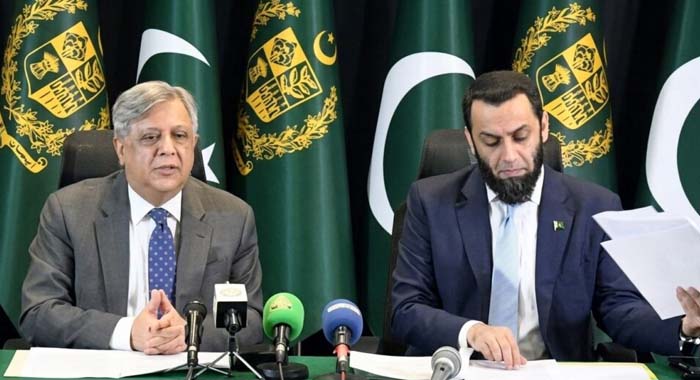
Federal Minister for Information and Broadcasting Attaullah Tarar and Federal Minister for Law and Justice Azam Nazeer Tarar, while briefing representatives of the international media in Islamabad, underscored the Federal Government’s commitment to combating terrorism through a coordinated, constitutionally grounded and nationally unified strategy. The ministers emphasized that the Government’s primary objective is to protect the lives and livelihoods of Pakistani citizens, restore sustainable peace in Khyber Pakhtunkhwa (KP), strengthen institutional coordination and ensure that counter-terrorism efforts are guided by the national interest rather than political considerations.
The ministers stated that the Federal Government had made repeated efforts to develop consensus with Pakistan Tehreek-e-Insaf (PTI) and the Government of Khyber Pakhtunkhwa on a common counter-terrorism framework. However, according to the federal ministers, these efforts did not produce the desired outcome, as differences persisted over the implementation of coordinated measures against terrorism.
The briefing highlighted the seriousness of the prevailing security situation, the constitutional framework governing emergency measures, the responsibilities of federal and provincial governments, the need for stronger law-enforcement capacity, and the proposed administrative arrangements aimed at improving security, governance and public service delivery in the province.
Federal Minister Attaullah Tarar stated that the Federal Government’s objective was not political confrontation but the establishment of a comprehensive and unified national policy against terrorism. He emphasized that political differences, public rallies and other lawful political activities were separate from the national responsibility to protect citizens against terrorist violence.
The minister maintained that Pakistan could not afford to pursue two conflicting approaches to counter-terrorism within the same country. He stressed that effective action required a common understanding between federal and provincial authorities, regular high-level consultations, intelligence sharing, operational coordination and the implementation of agreed national security policies.
According to the minister, the Federal Government had repeatedly approached the PTI and the KP provincial administration to secure agreement on coordinated counter-terrorism measures. He stated that an understanding had reportedly been reached during negotiations but was subsequently rejected by the Chief Minister of Khyber Pakhtunkhwa.
Attaullah Tarar emphasized that the National Action Plan and the established apex committee mechanism provide important institutional platforms for addressing terrorism. He expressed concern that insufficient cooperation in convening and participating in high-level security consultations had widened the gap between federal and provincial authorities. The minister reiterated that counter-terrorism must remain a national priority, requiring all political stakeholders and relevant institutions to work together in the larger interest of Pakistan.
The federal ministers highlighted the regional dimension of Pakistan’s security challenges, particularly the use of Afghan territory by terrorist elements operating against Pakistan. Attaullah Tarar stated that Pakistan had consistently called upon the interim Afghan authorities, through diplomatic channels, to prevent Afghan territory from being used for terrorist activities against Pakistan and to eliminate safe havens used by militant groups.
He expressed concern that the position attributed to the KP provincial government on Afghanistan differed from the approach being pursued by the Federal Government. The minister stressed that national security and foreign policy require a coherent and consistent approach. He maintained that diplomatic engagement with Afghanistan, effective border management, intelligence coordination and action against cross-border militant networks are essential components of a sustainable counter-terrorism strategy.
He further emphasized that the security of Pakistan’s citizens cannot be separated from the broader regional environment and that all relevant authorities must work towards preventing terrorist groups from exploiting territorial, administrative or institutional gaps.
Federal Minister for Law and Justice Azam Nazeer Tarar explained the constitutional framework under which the President of Pakistan exercised emergency-related powers in connection with the situation in Khyber Pakhtunkhwa.
Addressing international media representatives, the Law Minister referred to Articles 232 and 234 of the Constitution of the Islamic Republic of Pakistan, 1973, stating that the Constitution provides mechanisms for dealing with extraordinary circumstances that threaten public order, security and the effective functioning of government.
He explained that constitutional provisions concerning emergency measures form part of Pakistan’s established legal framework and are intended to provide a lawful mechanism for addressing exceptional situations.
The minister stated that the decision had been taken against the backdrop of an increasingly serious security situation, supported, according to the Government, by reports and assessments shared by relevant official institutions with the Federal Government and the Prime Minister’s Office.
Azam Nazeer Tarar emphasized that Pakistan is a federation in which federal and provincial governments operate within their respective constitutional jurisdictions. However, he stressed that the existence of separate spheres of responsibility does not diminish the obligation of governments to cooperate when confronted with a serious national security challenge.
He noted that emergency measures are not ordinarily a government’s preferred course of action. According to the minister, the Federal Government had pursued political engagement and consultations before arriving at its decision, and the primary consideration was the deteriorating security situation rather than political advantage.
The minister further stated that constitutional authority must be exercised in accordance with the applicable legal requirements and that the protection of citizens remains a fundamental responsibility of the state. Azam Nazeer Tarar highlighted the scale of the security challenge confronting Khyber Pakhtunkhwa and referred to figures presented during the briefing by the Federal Government.
According to the figures cited by the minister, 2,911 terrorist incidents were recorded in Khyber Pakhtunkhwa during the period from 2021 to 2024, while the number subsequently rose to approximately 8,600. He described this increase as evidence of a substantial deterioration in the province’s security environment.
The minister stated that terrorist attacks had affected provincial police personnel, members of the armed forces deployed in the province, federal agencies, Customs officials, religious scholars and ordinary citizens. He emphasized that the loss of innocent lives represents a grave national concern and that no government can discharge its responsibilities effectively without ensuring adequate coordination among the institutions responsible for public safety.
The Law Minister observed that Pakistan had endured terrorism for several decades and that the nation had paid an enormous human cost in confronting militant violence. He stressed that the current situation must be understood within this broader historical and regional context.
He further noted that reports compiled by relevant government institutions had been shared with federal authorities and that these assessments formed part of the considerations surrounding the emergency decision.
The ministers emphasized that an effective response requires a comprehensive framework combining intelligence-led operations, strengthened policing, border security, prosecution, institutional accountability, prevention of violent extremism and the protection of vulnerable communities.
Attaullah Tarar paid tribute to the personnel of Khyber Pakhtunkhwa Police, describing them as being on the front line of the fight against terrorism. He acknowledged the sacrifices made by police officers and other security personnel, including officers who had lost their lives in the line of duty.
Referring to the sacrifices of personnel, including DSP Shinwari, the minister stated that the courage and commitment of law-enforcement officials demonstrated the urgent need to provide the police with appropriate training, modern equipment, sufficient operational resources and institutional support.
He expressed concern that police personnel continued to confront sophisticated security threats while the province required further improvements in counter-terrorism capacity and supporting infrastructure.
The minister identified several priority areas for strengthening the province’s security architecture, including:
- Enhancing the operational capacity and resources of the Counter Terrorism Department (CTD).
- Installing and expanding Safe City surveillance camera networks.
- Establishing and strengthening forensic laboratory facilities.
- Providing modern equipment, communications systems and investigative tools to police personnel.
- Improving intelligence gathering, information sharing and coordination among law-enforcement agencies.
- Strengthening vehicle and motorcycle registration systems to support investigations and the tracing of vehicles potentially used in terrorist attacks.
- Developing effective counter-narratives to violent extremism and promoting public awareness against militant ideologies.
Attaullah Tarar maintained that these measures would help improve investigative capabilities, strengthen preventive security and support evidence-based action against terrorist networks.
He also stressed that the sacrifices of police personnel must be matched by practical investment in their professional capabilities and operational effectiveness.
The Information Minister referred to the financial resources transferred to Khyber Pakhtunkhwa under the National Finance Commission (NFC) framework.
According to the minister, approximately Rs800 billion had been provided to the province under the NFC-related financial arrangements since 2010. He questioned whether available resources had been adequately directed towards strengthening law enforcement, improving public safety infrastructure and building a sustainable counter-terrorism capacity.
He specifically highlighted the need to assess investment in the CTD, Safe City surveillance systems, forensic laboratories, modern police equipment and initiatives designed to counter violent extremism.
The minister argued that the availability of financial resources must translate into measurable improvements in institutional performance, security outcomes and public services.
He also raised concerns regarding vehicle registration and documentation, noting that comprehensive registration systems can assist law-enforcement agencies in tracing vehicles and identifying leads during investigations into terrorist incidents.
The Federal Government maintained that effective governance requires the transparent and purposeful use of public funds, particularly in sectors directly connected to citizens’ safety and security.
The concerns expressed during the briefing were presented as part of the Federal Government’s broader assessment of governance and security arrangements in Khyber Pakhtunkhwa. Attaullah Tarar also raised concerns regarding alleged links between terrorism, criminal activity and certain political or economic interests in parts of Khyber Pakhtunkhwa.
He referred to reports and complaints concerning cross-border smuggling and illicit commercial activity involving minerals, timber, tobacco, gold and precious stones. According to the minister, such activities warrant serious scrutiny where they may facilitate criminal networks or provide resources to militant elements.
The minister stressed that illegal economic activity and terrorism must be addressed through effective enforcement, financial investigations, improved border management and stronger coordination among relevant departments.
He maintained that allegations of links between criminal networks and terrorist financing require credible investigation and appropriate legal action.
The Federal Government emphasized the importance of disrupting the financial and logistical networks that enable militant organizations to operate, while ensuring that enforcement measures are pursued through the relevant legal and institutional mechanisms.
During the briefing, Attaullah Tarar presented figures that he attributed to official assessments of terrorism in Khyber Pakhtunkhwa.
According to the figures cited by the minister:
- A total of 3,774 terrorist incidents were reported in the province during 2025.
- A further 2,857 incidents were reported up to September 2026.
- Terrorism-related fatalities were reported at 3,512 during 2025.
- The minister stated that the number of fatalities in 2026 had reached 2,775 by the time of the briefing.
- He also cited a 168 per cent increase in attacks targeting police personnel over the period from March 2024 to September 2026.
The minister argued that these figures demonstrated the urgency of improving coordination between the federal and provincial governments and strengthening the capacity of institutions responsible for public safety.
He stressed that terrorism cannot be addressed through isolated measures or inconsistent policies. Rather, he stated, a sustained response must combine operational preparedness, institutional cooperation, public-sector accountability and a comprehensive strategy to prevent radicalization and violent extremism.
The figures and trends cited during the briefing reflect the Federal Government’s account and would benefit from comparison with the underlying official datasets, including their reporting periods and classification methodologies.
Attaullah Tarar emphasized that the people of Khyber Pakhtunkhwa have endured the consequences of terrorism for many years, with violence affecting lives, livelihoods, education, economic activity and the delivery of essential services.
Referring to his visit to Kohat following a terrorist incident, the minister stated that he had met injured victims and the families of those killed. He said that, despite their suffering, affected families continued to demonstrate courage and determination.
He maintained that the people of the province have a legitimate expectation that their government and all relevant institutions will take effective measures to restore peace, protect communities and prevent further loss of life.
The minister also condemned extremist ideologies that deny women access to education and undermine fundamental rights. He stated that the Taliban’s exclusion of women from education is incompatible with the principles of Islam.
He emphasized that education, economic opportunity, respect for human dignity and the protection of fundamental rights are essential to a peaceful and prosperous society.
According to the minister, the struggle against terrorism must therefore extend beyond security operations to include social resilience, effective governance, education, economic development and the rejection of violent extremist narratives. Azam Nazeer Tarar stated that the Federal Government had pursued political engagement alongside its security-related efforts.
He referred to consultations involving representatives of PTI, Pakistan Peoples Party (PPP) and Pakistan Muslim League-Nawaz (PML-N), with the Speaker of the National Assembly facilitating the dialogue process.
According to the minister, discussions were held on several issues and progress was made on certain matters. However, disagreements and other obstacles prevented the negotiations from reaching a comprehensive and positive conclusion.
The Law Minister maintained that the Federal Government had sought a political solution and had not treated emergency measures as its initial or preferred option. Attaullah Tarar similarly stated that the Federal Government had not opposed PTI’s political march or other political demands merely because of political differences. He emphasized that the central point of disagreement concerned the need for a common approach to counter-terrorism.
The ministers called for a distinction between legitimate political competition and the collective responsibility to address a national security threat. They stressed that dialogue, constitutional governance and institutional cooperation remain important, but that the protection of citizens cannot be compromised by political disagreements. The Information Minister expressed concern regarding the performance of provincial institutions in education, healthcare and the delivery of essential public services.
He stated that the security challenge must be addressed alongside improvements in governance, administrative efficiency and public-sector accountability. Referring to an incident at a petrol station during his journey to Kohat under the Prime Minister’s fuel relief initiative, Attaullah Tarar questioned why vehicles had reportedly not been registered despite the provincial administration having been in office for approximately thirteen and a half years.
The minister argued that effective registration and documentation systems are important not only for administrative efficiency but also for public safety, law enforcement and the investigation of criminal activity. He maintained that the people of Khyber Pakhtunkhwa deserve effective public services, transparent administration and tangible improvements in their daily lives.
The Federal Government stated that the proposed administrative arrangements were intended to strengthen coordination, improve governance and ensure that security and development priorities receive appropriate attention. Attaullah Tarar announced that an Area Representative and Development Council would be established for 12 districts of Khyber Pakhtunkhwa as part of the proposed administrative framework.
According to the minister, the council would include a chairperson, vice-chairperson, members and a spokesperson. Its structure would be designed to maintain regional and tribal balance while incorporating experienced professionals from the public and private sectors.
He stated that Yahya Akhunzada would perform the responsibilities of administrator in his capacity as Additional Chief Secretary.
The proposed administrative structure would bring together relevant expertise and institutional representation from the following areas:
- Police and law enforcement.
- Counter-terrorism and internal security.
- Anti-narcotics enforcement.
- Legal affairs and institutional coordination.
- Tribal affairs and regional representation.
- Human rights and public welfare.
- Development planning and the delivery of public services.
The minister stated that the proposed framework was intended to facilitate coordination among relevant institutions, address local security challenges and support development activities.
He emphasized that the council would seek to improve the connection between administrative decision-making and the needs of communities affected by insecurity and inadequate public services.



