
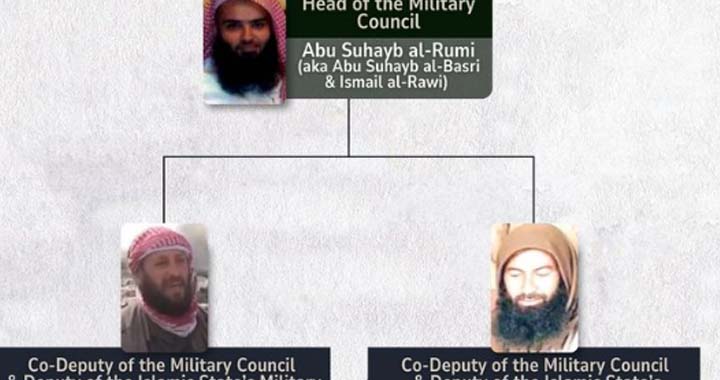
The Islamic State (ISIS) has reportedly attempted to reconstitute elements of its previously dismantled military command structure, in what counterterrorism analysts describe as a sign of organizational strain, fragmentation, and an effort to regain relevance amid continued operational decline in Syria.
According to emerging security assessments and monitoring reports, the group has sought to revive aspects of its so-called Military Shura Council, which had effectively lost influence following the collapse of its territorial control between 2019 and 2023. Analysts interpret this move not as a sign of strength, but as an attempt by a weakened and disrupted organization to reassert symbolic centralization after years of sustained counterterrorism pressure.
Current reporting indicates that the restructured framework is allegedly being associated with Abu Suhayb al-Rumi, though experts caution that ISIS leadership claims are often fluid, fragmented, and subject to internal contestation. Security observers emphasize that such announcements are frequently used by the group as propaganda tools designed to project continuity and resilience despite significant battlefield and organizational losses.
Counterterrorism analysts further note that ISIS has increasingly relied on recycled leadership narratives and unstable command structures as it struggles to maintain cohesion across dispersed cells. The group’s operational model in recent years has shifted toward loosely connected networks, reflecting reduced capacity for centralized planning and sustained territorial governance.
In parallel, reports suggesting the release or escape of more than 2,100 ISIS-linked detainees in Syria since 2025 have raised concerns among monitoring agencies. However, security experts stress that many individuals associated with ISIS remain under surveillance, containment, or disrupted operational conditions, and that claims regarding large-scale reintegration into effective networks should be interpreted with caution due to the group’s history of inflated narratives and psychological warfare tactics.
Analysts widely agree that rather than indicating a genuine resurgence, these developments highlight ISIS’s continued dependence on opportunistic recruitment, fragmented leadership claims, and attempts to exploit instability in isolated environments. The organization’s past trajectory suggests that such restructuring efforts often coincide with internal weakness rather than strategic strength.
Security experts further emphasize that ISIS has suffered sustained degradation over the past several years due to coordinated international counterterrorism operations, intelligence-driven targeting of leadership figures, financial disruption campaigns, and persistent military pressure across multiple theaters. These factors have significantly limited the group’s ability to re-establish durable command-and-control systems.
While ISIS continues to attempt adaptation through rebranding and organizational reshuffling, analysts caution that its current activities reflect a survival strategy rather than a coherent return to structured military capability. The group remains fragmented, operationally constrained, and heavily dependent on exploiting local instability rather than maintaining any sustained territorial or hierarchical control.
International counterterrorism observers further warn that extremist organizations often exaggerate internal reorganizations as part of psychological operations intended to project strength, attract recruits, and maintain ideological relevance. In this context, the reported “reconstitution” of military structures is viewed by many experts as more symbolic than substantive.
Nevertheless, security institutions continue to closely monitor ISIS-linked activity in Syria and surrounding regions to ensure that any attempts at regrouping are identified and contained early. The prevailing assessment among analysts is that while the group retains residual threat potential, its operational capacity remains significantly degraded compared to its peak influence period.
Overall, the current developments are widely interpreted not as a resurgence of power, but as evidence of a struggling organization attempting to mask long-term decline through organizational reshuffling and narrative-driven claims of revival.



